A Smile of Hope: Taiwanese People’s Heartfelt Testimony in the Aftermath of the 311 Tsunami
Text and Photos by Su Po-an
[Prologue]
On March 11th of last year (2012), marking the first anniversary of the Great East Japan Earthquake, I participated in a series of related events organized by NGO earth in Taiwan. The deep bond between Taiwan and Japan that I witnessed with my own eyes was so moving that I know I will never forget it.
Back in Japan, I couldn’t help but wonder: a year has passed, but what’s the situation in Tohoku now? And what can I do to help? After thinking about it seriously, I realized I actually knew nothing about the current conditions in the disaster areas. Though we often passively learn about the affected regions through news and photos, whether it’s the gripping written accounts or word-of-mouth reports, while they may stir compassion, they don’t allow us to truly grasp the reality of the situation—and before long, most of us gradually forget.
“Why not go see for myself?” That’s when the idea started to form.
Although I wasn’t sure how I could be of any help, I believed that once I got there, I would find out. But questions like “How should I get there?”, “What should I do when I arrive?”, and “If I’m seen as just a tourist, could that have the opposite effect?” kept swirling in my head. No matter how hard I thought, I couldn’t resolve them, so I couldn’t decide on a departure date.
In late May, through a friend’s introduction, I finally had the chance to meet residents of Kesennuma (Mr. Asada and Mr. Miura). I immediately shared my thoughts and concerns with them. To my surprise, not only did they tell me not to worry, but they also warmly welcomed me to visit Kesennuma, and even offered to show me around the entire city. Though it was our first meeting and our conversation lasted less than 30 minutes, with the support of these two locals, I didn’t hesitate to set a departure date with them. Two weeks later, I headed to Kesennuma, beginning a journey that would change my life.
[1] Time Ruthlessly Frozen — Kesennuma
Due to limited travel funds, I could only afford the cheapest option—bus. Departing from Aichi Prefecture after a grueling 13-hour bus ride, I finally arrived at Kesennuma Station. There, Mr. Miura greeted me with an enthusiastic wave, saying, “Welcome to Kesennuma!” Then, Mr. Miura and another volunteer, Mr. Chibon, who had also come from Aichi Prefecture, drove me to several heavily damaged areas.
The scenes before me were beyond anything I had imagined. What I saw were empty lots where, just over a year ago, there had been peaceful little towns—now, time in many places had been forever frozen in that moment of ruthlessness. There was a massive 330-ton ship that shouldn’t have been there, severely burned cars, towering mountains of debris, exposed building frames and foundations, unusable schools, and more. The sights gave me goosebumps, and I was left speechless. Before taking out my camera to document these scenes, I felt uneasy, worried that taking pictures might disrespect the local residents, so I carefully asked Mr. Miura, “Is it okay if I take photos?” When he said it was fine, I began to record everything before me, wanting to share these things with more people.
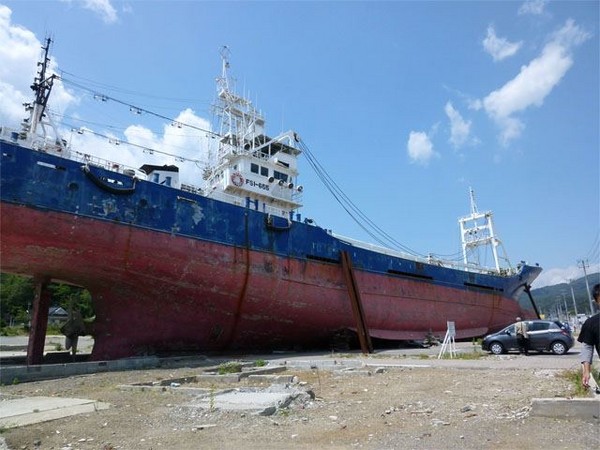
▲ A 60-meter-long, 330-ton ship lying right by the road.
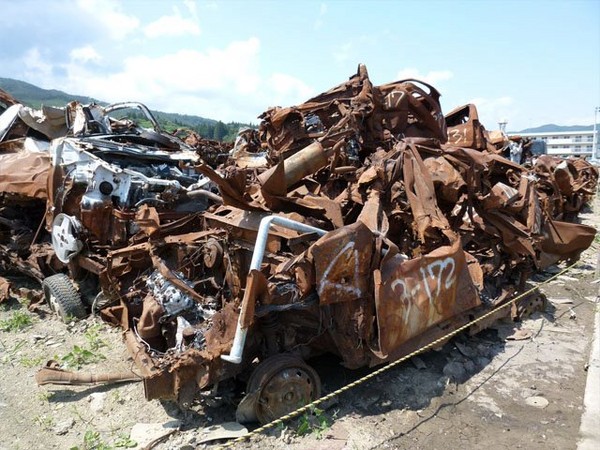
▲ Cars burned in the fire, now completely unrecognizable.
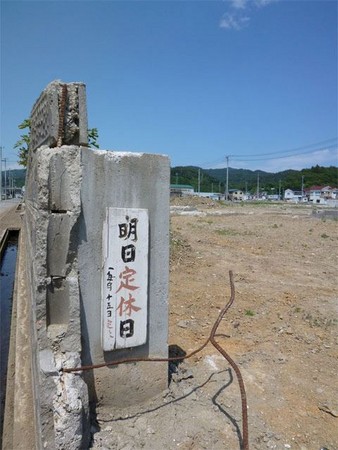
▲ “Closed for Business Tomorrow,” but it will never reopen again.
[2] The City That Couldn’t Escape — Rikuzentakata
Kesennuma, thanks to its terrain, had some small hills for people to flee to, but in Rikuzentakata, there were no hills—the tallest buildings were only three or four stories high, and the tsunami nearly submerged them all. Just how high is a 14-meter tsunami?
In the past, when seeing such figures, I could only imagine what happened that day. But here, looking up at the gas station sign that was submerged by the tsunami—something no person could ever reach—I truly understood the meaning of shock for the first time. Faced with such a tsunami, you have less than a minute from noticing it to escaping. I really don’t know what I would’ve done if I were there. Standing on the shore here, I looked back at the debris left behind after the tsunami swept everything away. A sorrow welled up inside me that I couldn’t put into words. Mr. Chibon sighed and said, “There was nowhere to escape here. Most people were taken by the tsunami.”
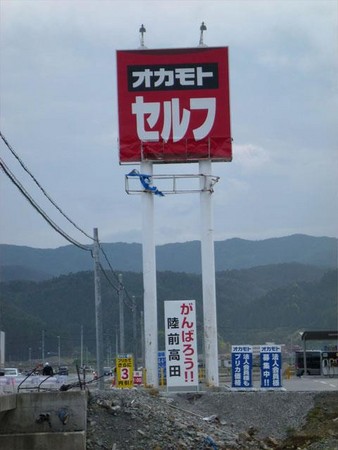
▲ Under the “Self” sign, there are marks from the water—this was the height of the tsunami.
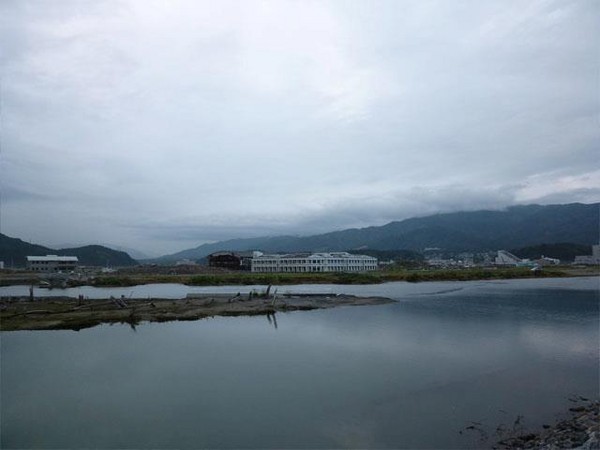
▲ This used to be land, but there are no tall buildings in sight that could have been used to escape.
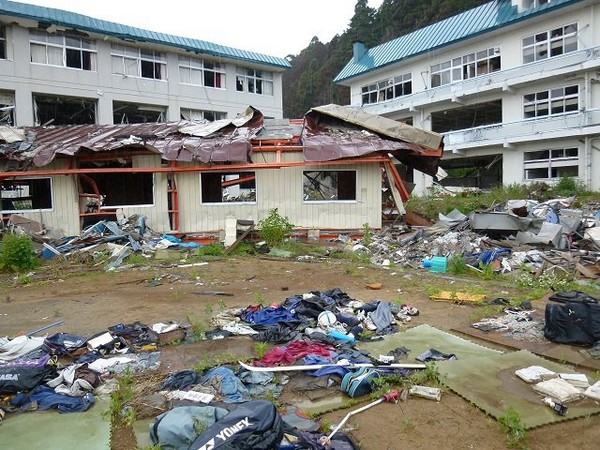
▲ A school submerged by the floodwaters, leaving behind items from club activities.
Then, he took out a box of incense sticks and said, “We can’t do much more for them, but at least we can send them off properly like this.” So at the next few places, we prayed as best we could for the deceased. And when we finished offering the last stick of incense and left the Rikuzentakata City Hall, the sky, which had been raining nonstop, gradually cleared, and a ray of light shone through the clouds. In the distance, a rainbow appeared. “Maybe this is some kind of message?” I thought, believing that this must be a beam of hope symbolizing that this town would not lose to the disaster.
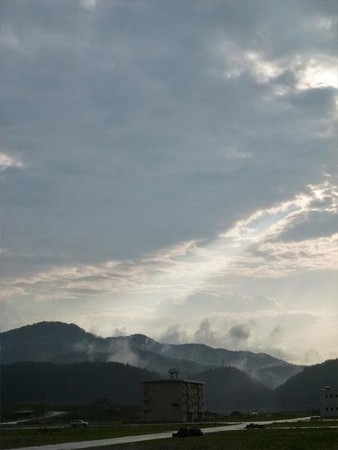
▲ After offering the last stick of incense, the rain stopped. A ray of light shone through the clouds—I believe this is what we call the light of hope.
[3] Strong and Selfless Love
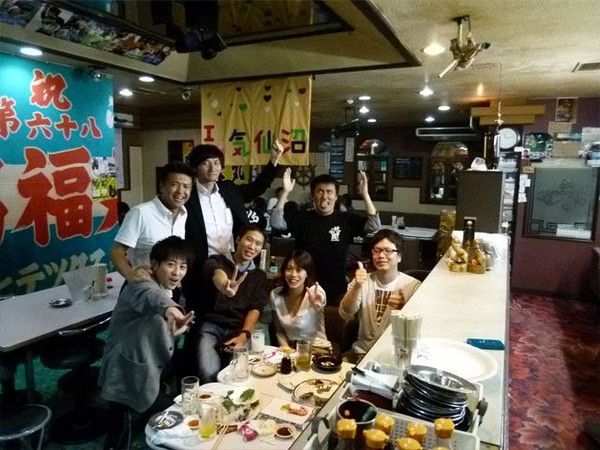
In the evening, they invited me to eat at the most famous izakaya in town. The table was filled with fresh sashimi dishes made from that day’s catch. After a toast, everyone chatted about everything under the sun, and I took the opportunity to exchange opinions and ask questions with the locals. Mr. Miura told me, “Everyone here carries pain, but coming here lets them forget their worries. After working hard during the day, at night we can laugh and chat with friends, drink some sake, and enjoy the day—that’s the life of a Kesennuma person.”
He took a sip of his drink and continued, “I’m really happy that you came all the way here to Kesennuma. We don’t have highways here, just a small train station. Though we’re a bit cut off from the outside world, we have everything we need—it’s like a little country. We’ve always felt that we didn’t need to leave Kesennuma.”
He paused, then added, “But after the earthquake, we received so much help from other places and from all over the world. For the first time, I realized that we’re truly connected to the rest of the world. So I’m really happy that you came here to understand our town and how we feel. Like how you asked me this morning if it was okay to take photos—I’m really happy you had that mindset. You’re my number one foreign friend, and my most important Taiwanese friend.” He grew more and more emotional, and with both hands, he firmly shook mine and said, “I believe that from today onward, because you came here, through you, me, and everyone here, Kesennuma will reach the international stage. And we’ll be the bridge between Kesennuma and Taiwan.” Only after saying that did he finally let go of my hand. To this day, I still can’t forget the strength of Mr. Miura’s handshake that day—those were the hands of someone who deeply loves his hometown and sincerely hopes for a better future.
At the dinner table, besides me and Mr. Chibon, the other five were all from Kesennuma. Even though we had only met once or twice, or even for the first time, tonight it felt like we were old friends talking about everything. I truly felt the warmth of Kesennuma. After the meal, Mr. Miura said to me, “Though we’ve received so much help, in the end, we have to stand up on our own. Please also care about your hometown—not just Kesennuma, but your own surroundings, your place of residence, must also have many issues. Please put effort into your own community first. As long as you do that, no matter where you are, you’ll always be closely connected to Kesennuma.”
The next morning, Mr. Asada and Mr. Ohara drove me out of Kesennuma, taking me along the way to the final stop of this trip—the Minamisanriku Disaster Prevention Center. That day, one staff member, Miss Miki, stayed at her post until the very end, urging residents to evacuate. Many people managed to escape and survive because of Miss Miki’s voice—but in the end, she was mercilessly swallowed by the tsunami. Now, many items are displayed here, offered by residents in memory of their angel, Miss Miki, who saved them. Next to them is a story describing her brave deeds. As I read, I couldn’t hold back my tears. Flipping through the incense burner to find unburned sticks, I lit them and stood in front of the building, silently praying with tears in my eyes.
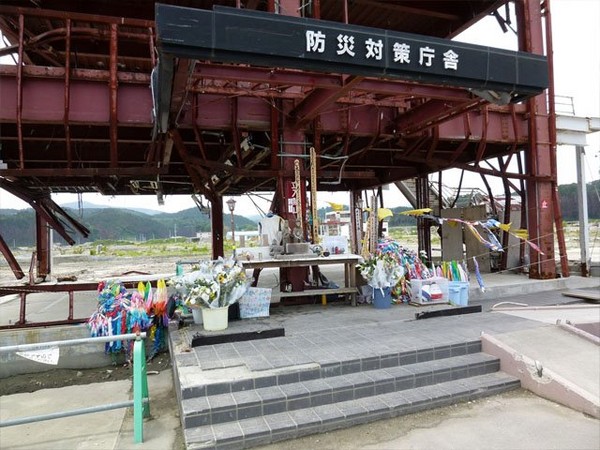
▲ At the Minamisanriku Disaster Prevention Center, Miss Miki, who held out until the very end, tragically didn’t make it out in time.
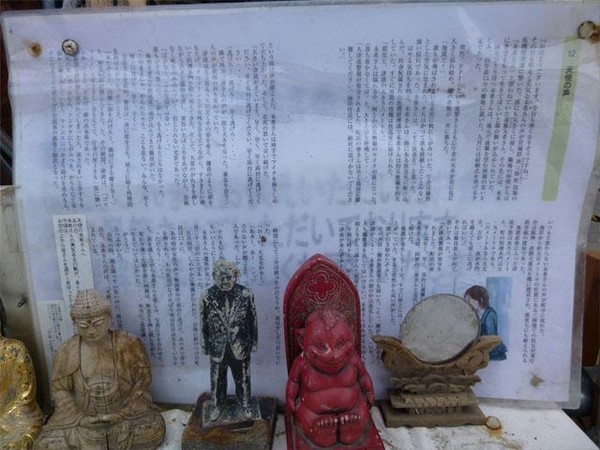
▲Here lies the collective thoughts and gratitude of everyone for Miss Miki. It was because of her voice that most people were saved.
【IV】Being One of the “Survivors”
After coming here, I finally understood many things. Including the actual situation of the earthquake at that time, the post-disaster recovery efforts, the feelings of the residents, and the various difficulties they faced... and so on. Without coming here, all of this would have been something I could never have comprehended. Despite the tremendous disaster that struck the citizens of Kesennuma, they still go about their daily lives with smiles and hard work. Though their hearts may still bear wounds, dwelling on the past will not move them forward.
“Because I survived,” said Mr. Miura. “So we must live even more diligently, on behalf of those who tragically lost their lives.” Everyone here lives with this mindset, cherishing each day that comes and every person they meet. They help one another, overcome hardships together, and although the road to recovery is still long, they take small steps every day toward the future. Being able to come to Kesennuma and witness the purest and strongest bonds between people was truly moving.
As for what I can do, I think it is to write this article and let more people know about the current situation in Kesennuma. Even if one person’s strength is small, if it helps just one more person understand their feelings and know their circumstances, then even that mere “understanding” can become a force that builds a connection between everyone and the city of Kesennuma.
In another sense, those of us in Taiwan are also “survivors.” We often feel at a loss when facing the misfortunes of others: too much indifference or overly excessive sympathy and pity don’t seem to be the right attitudes. Many of Mr. Miura’s words actually helped me through my own sense of helplessness. The suffering in Kesennuma did not cause its residents to fall into blame or despair, but instead led them to cherish their hometown even more. I believe that the people affected by the Tohoku earthquake and tsunami need not only material aid, but perhaps more importantly, emotional support and understanding from others. And Mr. Miura’s words reminded me that if one cannot love their own hometown, how can they understand the feelings of others who treasure theirs?
I think there is more than one thing we can do, but at least one certain and feasible way is: to cherish and deeply feel the land where we were born and raised, and then gradually expand that love for the land. Only by doing so can we truly empathize with the suffering and needs of people in other lands—that is the power of selflessness.
The Great East Japan Earthquake plunged Kesennuma into what felt like an endless night, and it has not yet fully awakened. But the smiles of the people of Kesennuma are like rays of dawn breaking through the darkness, giving us faith that morning will come. If more people can see this light, I believe its power will grow stronger. Please do not stop caring—let’s all help Kesennuma continue to bravely embrace the rebirth that is near yet still to come.
Share
This article is published by HowToTrip. Sharing and reposting are welcome — please credit the source.
Article URL: https://www.howtotrip.net/views-29053
Related Articles
- Shaoxing's "Grandpa Gourd" hangs the gourds back up: "If there are too many people, we'll interact less — just take a quick look from afar"
- Chinese authorities announce "reciprocal adjustment" to Japan visa fees — single-entry visa jumps from 2,250 to 16,750 yen!
- The "health stones" carried by a traveler were found to have radiation levels exceeding safety limits by a thousand times, potentially endangering fellow passengers on the same flight. Customs issues warning!
- Shenzhen Airport Issues Late-Night Notice: Unidentified Aerial Object Detected, Causing Widespread Flight Delays!
- “They only said it cost money after I opened the box and washed it!” 200g of grapes sold for 60 yuan on a high-speed train—12306 responds!
- Can't buy an airline ticket? Denied exit? Blocked from boarding? A large number of Chinese tourists have mysteriously become "discredited individuals"
- Adverse weather and economic fluctuations impact Colombia's coffee market
- Beach bathing area responds to 2 yuan/30 seconds fee for freshwater foot rinsing: Clearly priced!
- Taking off with an improperly closed cabin door? Wing malfunction? Multiple flights made emergency returns mid-journey!
- Experience the gifts of nature! A countdown of the world’s ten most stunning coastlines