La Vie / Exquisite. A Southern Island Diary of Taketomi Island%s Kohama Island
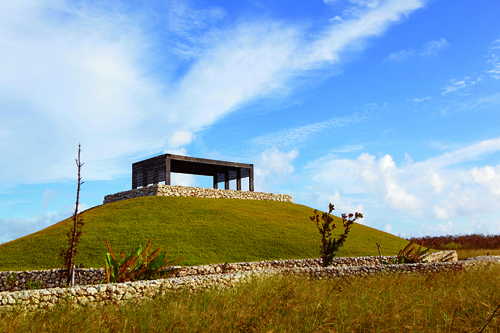
▲ Hoshinoya built pavilions on the hill of the resort, with different opening designs facing the directions of Ishigaki Island and Taketomi Village, symbolizing that travelers should not look back but focus on their holiday.
[Written by: Ko-Rin Ko, Photography: Thomas K., Cooperation: V-Travel www.itis.com.tw, Originally published in La Vie Magazine Issue 113]
"Oh sea, oh universe, oh gods, oh life—may you remain forever calm and peaceful. Oh island song, ride the wind, fly with the birds, and cross the ocean." The strumming sounds of the sanshin played by the people of Taketomi Island resonate crisply through the coral walls, while the island song echoing back along the path of the breeze is indescribably (ineffable) serene and beautiful.
Even over 30 days after leaving Hoshinoya Taketomi, the sound of Michiko Kawakami demonstrating the traditional Ryukyuan sanshin tuning—“Nada Sousou” (Tears All Around)—still occasionally echoes in my ears. "Opening an old photo album, murmuring the words 'thank you,' to the person who has always encouraged me..."
That day, Kawakami played under a traditional red-tiled villa, her slightly weathered voice and deliberately off-beat syncopated rhythm giving the lyrics a profound depth. Compared to the sweet and clear version by Rimi Natsukawa (Note 2), it felt closer to the folk island songs passed down orally, resonating from the ears straight to the heart and drawing out warm currents. You find yourself avoiding direct eye contact, afraid you might tear up from shyness.
At that moment, I could deeply relate to British travel writer Alan Booth playing the shamisen and singing the first line of “Tsugaru Jongara Bushi”—“Hey, you there, the one stepping down from Tsugaru Bridge”—which left his audience stunned.
"What moving music!" After the song, I noticed some people also had glistening eyes, shyly trying to hide them.
Twenty-three years ago, Kawakami was the leading sanshin player in the Yaeyama Islands (Note 3) and was invited to perform in countries such as North Korea. Now, she resides permanently on Ishigaki Island, running sanshin classes and taking the boat in the afternoon to perform at Hoshinoya Taketomi as a private music tutor for visitors.
From being completely unable to read kunkunshi notation to playing a tune independently takes about an hour. Staying at Hoshinoya not only allows you to escape the hustle and bustle, but also provides guidance from a master, bringing the excitement and novelty of learning an instrument for the first time.
Kawakami then played and sang a wedding song with the lyrics, "The bride picks red flowers to dye her fingernails," symbolizing keeping her mother’s words in her heart. The final song, an island tune that sounds like a love ballad, is actually a requiem created by composer Kazufumi Miyazawa after being moved by a visit to the Himeyuri Peace Memorial Tower, commemorating the Okinawan victims of the Battle of Okinawa.
After the Fukushima incident two years ago, the trend of moving from mainland Japan to Okinawa has become popular. Urbanites choosing to settle in this pristine land have also brought an urban richness of taste. Gradually, Okinawa and the cultural mix have become increasingly integrated.
Arriving at the small island of Taketomi, there stands the “Taketomi Charter” rejecting corporate development and preserving the unique local culture and environment of the island.
Kawakami said, "There are many shamisen players in Tokyo and Osaka, but in Okinawa, playing the sanshin is about singing life." Amid the beautiful blue skies, turquoise seas, and coral reefs, you’ll encounter many islanders living in a utopia, singing of peaceful times.
Direct flight to Ishigaki → Head to Taketomi Island village
The emotion from a month ago feels like yesterday. This otherworldly utopian village is actually not far away.
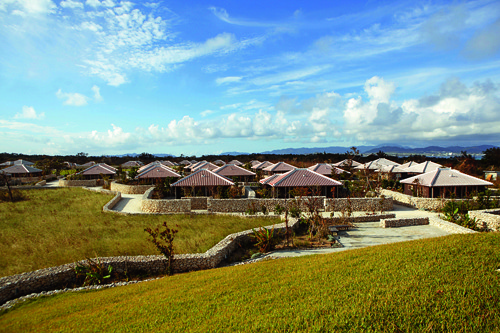
▲ Hoshino Group spent five years negotiating repeatedly with the islanders to become the sole hotel on Taketomi Island and, under the guidance of the villagers, built every coral stone wall by hand.
Flights are now available this year, just a 45-minute journey (not even enough time to fall asleep). Going to Ishigaki Island is now as easy as going to Kinmen for a bowl of beef noodles—no longer needing to make excuses for being busy or brushing off the call of travel.
This small island, just 210 kilometers from Taiwan, will make you believe you should temporarily cut ties with home, leave your computer and phone behind, and fully explore the true essence of the island.
A direct flight is like tossing a juicy fruit tied with a string to a hungry traveler, giving you a reason you can’t refuse. Tempted by the direct flight to come here, you begin a “Taketomi Island–Kohama Island” island-hopping trip, where Ishigaki Island, usually the main star, this time reluctantly plays the role of a “stepping stone.”
After landing, take a taxi straight to the ferry terminal, and you’ll notice that the drivers on Ishigaki Island are unlike the indifferent ones in big cities like Kyoto. They’re often dressed in crisp white shirts, vests, and hats—or more casually, in short-sleeved dress shirts with tanned, shiny necks peeking out, fingers thick and stubby, speaking in heavily accented Japanese...
"There must be fewer than five Japanese taxi drivers who speak Taiwanese!" Mr. Tojo becomes more animated as he speaks, but his eyes stay fixed on the road. Ten minutes later, we arrive at the ferry terminal, ending our first round of southern island surprises.
Buy a 670-yen ferry ticket, say goodbye to Mr. Tojo, and board the speeding ferry that sends up billowing white foam as it surges through the waves—Taketomi Island comes into view.
Hoshinoya’s Guardianship: Rediscovering a Cultural Island
As you disembark, the white coral gravel crunches underfoot, and a charming attendant holding a sign that reads “Hoshinoya Taketomi” greets you. Recalling my stays at Hoshinoya Kyoto and Karuizawa, the century-old Japanese Hoshinoya hotel group always designs modern accommodations in harmony with the ecological environment. Guests feel like they are hidden in a traditional mountain village, losing track of time. If you’re not busy checking in on Facebook or taking photos, the serene beauty may move you into oblivion of your smart devices.
Taketomi Island is even more special, covering only 5.42 square kilometers with a population of about 350 people (there were once 1,800 during the war), yet attracting 400,000 tourists annually, without any damage to the red-tiled roofs, white sand paths, or the undisturbed lives of the islanders.
For over 30 years, the islanders’ spontaneous “Taketomi Village Preservation Movement” has continued. They care deeply about preserving old houses, reject corporate development, and personally maintain over 400 structures on the island. They all spontaneously start cleaning their doorsteps at 5 a.m., and three times a year, they carry white coral sand from the shore to pave the roads, earning the title “Village of Purity.”
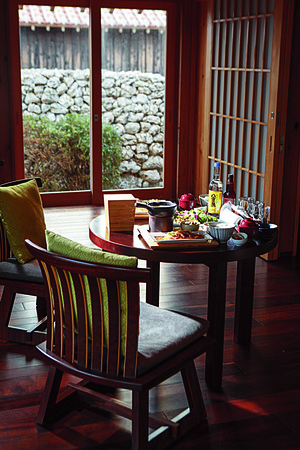
%The luxurious experience of staying here is deeply rooted in tradition, serenity, and artistry.
Hoshinoya Group spent five years negotiating repeatedly with the islanders to become the sole hotel on Taketomi Island and, under the guidance of the villagers, built every Villa coral stone wall (Gukku) by hand. The stone walls, like other buildings on the island, use no cement—only small pieces of coral rock to fill gaps in the walls. The fixed height of 1.6 meters is ancient wisdom, allowing gentle breezes in while dispersing strong winds to prevent the roof from being blown off.
However, the plants are barely holding their own. When we visited, it had just been hit by a typhoon, and the tall cogon grass and tree branches on Taketomi Island were lying askew, but here, every tree and piece of timber is cherished and put to good use.
The people of Taketomi built storage sheds on the island to gather and stockpile old lumber and broken tree trunks for emergencies, and even materials salvaged from demolished old houses on the neighboring Ishigaki Island can be sent to Taketomi.
“When the ocean temperature reaches 28 degrees, it can kill coral. In a way, the typhoon actually protects the ecosystem.” “The typhoon brings a heavy blow of salty sea breeze—especially hard on the mint, which mostly withered—but the longevity grass is a native plant originally from coastal cliffs, which is why it survived.”
Chef Nakazima Tatsuo explained the ecology of “survival of the fittest and living at the mercy of nature,” while the “island herbs” grown at Hoshinoya—reduced by the storm to just a few yellow-green sprigs—made the salad on the plate, freshly picked from the herb garden with purple basil, thyme, and longevity grass served with island tofu and a half-boiled egg from Ishigaki black chicken, taste all the more grateful.
“36 water buffaloes, 24 dogs, 40 goats, 79 cats, 345 Ishigaki cattle, 24 chickens, 41 elementary and middle school students, 21 teachers.”
A hand-written poster by an island shop using a marker pen displays the current count of living beings on Taketomi Island, where humans and animals share the island’s natural resources.
The famous Ishigaki cattle roam freely on the island and grow sturdy. The chef selects premium Ishigaki beef, sears it until the fat slightly melts, and pairs it with Taketomi sweet potatoes and locally grown vegetables, along with pan-fried black pomfret, black-purple rice grilled rice, and foie gras served with Okinawan traditional sata andagi, Hagoromo Farm’s goat milk ice cream, and a “Takumi no Shima” set as a luxurious dinner that excites the palate. One night here feels too short, three nights not enough—you might just fall in love with this place and become an islander, forgetting the beautiful island itself.
At night, black crows flying low brush past the withered woods and the pink bougainvillea. Snap, snap, cackle, cackle—that’s the only sound at Hoshinoya at night. After dinner, you return to your villa to sip on Yaeyama Ryukyu awamori and Ishigaki Island beer, waiting for the yuzu leaves in the bathtub to slowly dissolve. A stay here—just one night is too little, three nights never enough—you might truly fall for this place and become one of the islanders, forgetting the beautiful island itself.
Note 1: The most basic tuning method for the shamisen has the second string four degrees higher than the first, and the third string eight degrees higher than the first. For example, from first to third, the notes are C, F, and C.
Note 2: A singer of Ryukyuan (Okinawan) ethnicity from Ishigaki Island in Japan’s southernmost prefecture of Okinawa, known as the “Spiritual Songstress” in Japan. In 1987, she was praised by Ichiro Fujita as “a singer who appears only once every forty years,” and she is a representative performer of the sanshin (Okinawan three-stringed instrument).
Note 3: An archipelago located 450 kilometers southwest of Okinawa’s main island, featuring well-developed coastal coral reefs. It consists of islands including Ishigaki Island, Taketomi Island, Kohama Island, Kuroshima, Irabu Island, Yonaguni Island (part of Taketomi Town), Hateruma Island, and Iriomote Island.
 [For the full article, please see September 2013 issue]
◎ For more updates on the latest lifestyle and design news, visitla vie Design Aesthetics
la vie Design Aesthetics website Fan page
Share
This article is published by HowToTrip. Sharing and reposting are welcome — please credit the source.
Article URL: https://www.howtotrip.net/views-26560
Related Articles
- Shaoxing's "Grandpa Gourd" hangs the gourds back up: "If there are too many people, we'll interact less — just take a quick look from afar"
- Chinese authorities announce "reciprocal adjustment" to Japan visa fees — single-entry visa jumps from 2,250 to 16,750 yen!
- The "health stones" carried by a traveler were found to have radiation levels exceeding safety limits by a thousand times, potentially endangering fellow passengers on the same flight. Customs issues warning!
- Shenzhen Airport Issues Late-Night Notice: Unidentified Aerial Object Detected, Causing Widespread Flight Delays!
- “They only said it cost money after I opened the box and washed it!” 200g of grapes sold for 60 yuan on a high-speed train—12306 responds!
- Can't buy an airline ticket? Denied exit? Blocked from boarding? A large number of Chinese tourists have mysteriously become "discredited individuals"
- Adverse weather and economic fluctuations impact Colombia's coffee market
- Beach bathing area responds to 2 yuan/30 seconds fee for freshwater foot rinsing: Clearly priced!
- Taking off with an improperly closed cabin door? Wing malfunction? Multiple flights made emergency returns mid-journey!
- Experience the gifts of nature! A countdown of the world’s ten most stunning coastlines