Are you paying your respects to shrines and temples in Japan the right way? Learn the correct procedures and customs
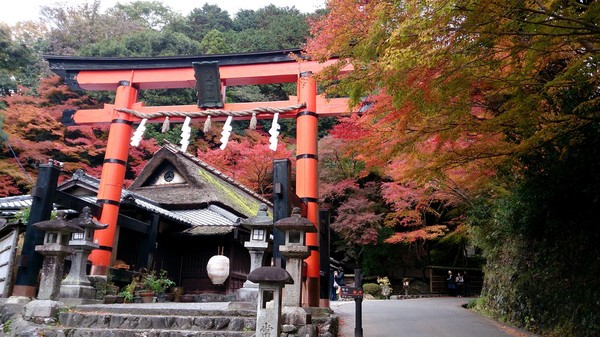
▲ In Japan, only “shrines” have torii gates, which symbolize the boundary between the realm of the gods and the human world. Passing through a torii gate means entering the domain of the deities. The photo shows the Sagano Torii Gate Origin and the First Torii Gate in Kyoto (Photo / fromKyoto City Tourism Association’s official Facebook page)
Travel Center / Comprehensive Report
Japan is home to numerous shrines and temples, which are not only spiritual pillars for the Japanese but have also become deeply integrated into daily life. As such, visiting shrines or temples is often listed as a must-do activity when traveling in Japan. But are you doing it correctly?
Before detailing the worship procedure, let’s first discuss the difference between a Japanese “shrine” and a “temple.” The simplest distinction is the presence of a “torii gate”—if there is one, it’s a shrine; if not, it’s a temple. Additionally, shrines enshrine Shinto deities representing elements of nature (e.g., Amaterasu, the god of rice, Inari, etc.), or members of the imperial family (e.g., Meiji Shrine); temples, on the other hand, house Buddhist figures (e.g., Senso-ji Temple enshrines a statue of Kannon).
Let’s start with how to worship at a “shrine.” When you step through the torii gate, remember to walk along either side—you must not walk down the center. The Japanese believe that the torii gate marks the boundary between the human and divine worlds, so entering through it signifies stepping into the realm of the gods, with the center considered the “path of the gods.” Therefore, your act of worship begins the moment you enter.
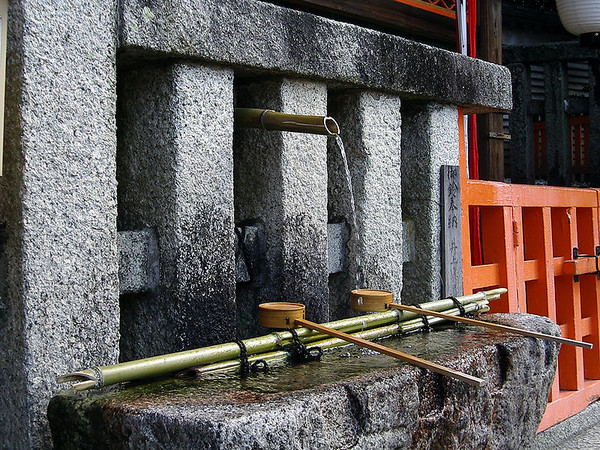
▲ Illustration of a temizuya (hand-washing basin). (Photo / from Wikipedia)
Next to the main hall of the shrine (or before entering it), there is always a “temizuya,” a hand-washing basin. Before praying, you must wash your hands and rinse your mouth to purify yourself as a sign of respect to the deities. But washing your hands isn’t just about casually dipping them in water—devout Japanese have developed an elaborate ritual for this process.
Temizuya purification steps: Use your right hand to pick up the ladle, scoop water, and wash your left hand first. Then switch to your left hand to wash your right hand. Next, use your right hand to pour water from the ladle into your left palm and rinse your mouth with it. Finally, hold the ladle upright (spout facing inward) and let the remaining water flow down from top to bottom to clean the handle.
It’s important to note that the above steps must be done using “the same ladle of water,” so when scooping, fill it about 60–70% full. Do not bring the ladle directly to your mouth to rinse, and never swallow the water used for rinsing. The purpose of holding the ladle upright is to clean the handle for the next worshipper.
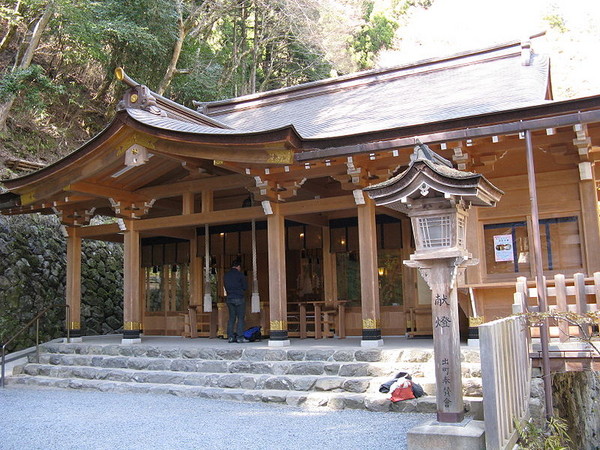
▲ Only after purification can you proceed into the main hall to pray. The photo shows the main hall of Kumano Shrine, with the hanging ropes on both sides being the bell ropes, and the box in front where worshippers stand being the offering box. (Photo / from Wikipedia)
After purification, you can approach the main hall to offer prayers to the deity. The prayer sequence goes: “bow, toss coin, ring bell, bow twice, clap twice, bow once while praying.” Enter the main hall, bow to the deity in front of the offering box, then toss a coin into the box, ring the bell, and bow twice. Clap your hands twice, press your hands together, and make a wish to the deity. After making your wish, bow once more—that completes the full worship process.
As for how much money to put in the offering box, it’s common to toss in a single 5-yen coin, because in Japanese, “5 yen” (go-en) sounds like “good fortune” or “connection.” Also, avoid carrying anything in your hands during worship—you can wear your bag or place it by your feet.
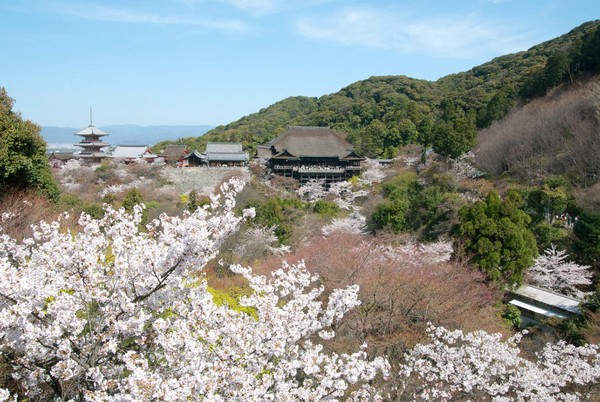
▲ Worship at a “temple” is simpler, but remember to follow the proper steps to ensure your prayers are answered. The photo shows Kyoto’s Kiyomizu-dera Temple in full cherry blossom bloom. (Photo / fromKiyomizu-dera Temple’s official Facebook page)
The worship process at temples is not as elaborate as at shrines. If there is a temizuya, follow the same purification steps mentioned earlier. Before entering the main hall, there is usually an incense burner placed in the middle of the path. Buy incense sticks, light them, and then place them in the burner (you can stick them in or lay them flat). Wave the smoke toward your body to cleanse away impurities. Once inside the main hall, toss a coin into the offering box, press your hands together in silent prayer, and skip the clapping.
That’s roughly the process for worshipping at shrines and temples in Japan, though some shrines may differ slightly. For example, the historic Izumo Taisha Shrine traditionally involves clapping four times. Next time you visit Japan for worship, try following the correct procedures. Though a bit more involved, it allows you to better appreciate the deep reverence the Japanese have for their deities.
Share
This article is published by HowToTrip. Sharing and reposting are welcome — please credit the source.
Article URL: https://www.howtotrip.net/views-25307
Related Articles
- Shaoxing's "Grandpa Gourd" hangs the gourds back up: "If there are too many people, we'll interact less — just take a quick look from afar"
- Chinese authorities announce "reciprocal adjustment" to Japan visa fees — single-entry visa jumps from 2,250 to 16,750 yen!
- The "health stones" carried by a traveler were found to have radiation levels exceeding safety limits by a thousand times, potentially endangering fellow passengers on the same flight. Customs issues warning!
- Shenzhen Airport Issues Late-Night Notice: Unidentified Aerial Object Detected, Causing Widespread Flight Delays!
- “They only said it cost money after I opened the box and washed it!” 200g of grapes sold for 60 yuan on a high-speed train—12306 responds!
- Can't buy an airline ticket? Denied exit? Blocked from boarding? A large number of Chinese tourists have mysteriously become "discredited individuals"
- Adverse weather and economic fluctuations impact Colombia's coffee market
- Beach bathing area responds to 2 yuan/30 seconds fee for freshwater foot rinsing: Clearly priced!
- Taking off with an improperly closed cabin door? Wing malfunction? Multiple flights made emergency returns mid-journey!
- Experience the gifts of nature! A countdown of the world’s ten most stunning coastlines