Houfang Village
Houfang Village
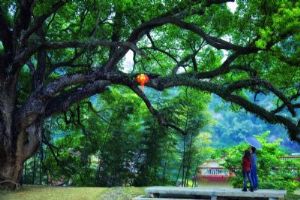
Houfang Village boasts many century-old banyan trees, osmanthus trees, and acacia trees, as well as thousand-year-old cycads and ancient camphor trees. Camphor and banyan trees grow side by side, crystal-clear waters teem with fish, and cobblestone paths often make one feel as if they’ve wandered into a “Peach Blossom Spring.” Since ancient times, there’s been a saying in the village: “Where trees stay evergreen, people live long.” The villagers have a strong ecological consciousness, never recklessly cutting down trees, and instead plant for future generations. To this day, they maintain a unique custom of worshipping a thousand-year-old sacred camphor tree known as the “General of the Great Tree,” revered as the deity of ecology.
Every year on the 14th day of the third lunar month, local villagers pay homage to the “General of the Great Tree,” praying for favorable weather, abundant harvests, and prosperity. It is said that in rural areas of Zhangzhou, it’s customary to worship ancient trees, as they are regarded as guardian deities. People often rest and relax under these grand trees, living in harmony with nature. This is perhaps the best embodiment of the ecological civilization philosophy of “respecting, adapting to, and protecting nature.”
Red bricks and white walls — traditional Minnan houses
The marks of time in Houfang Village are naturally found in its quaint, well-preserved traditional Minnan houses. The classic Minnan architectural style — featuring white walls, red bricks, gray tiles, and swallowtail ridges — creates a series of uniquely beautiful landscapes. In line with the principle of “preferring the local over the foreign, simplicity over complexity, subtlety over garishness, and softness over hardness,” the village has renovated the facades of buildings, unifying them with white walls and adding sloping red roofs. This harmonizes the structures with the surrounding green mountains and clear waters.
Wandering Through Ten-Thousand-Mu Peach and Plum Orchards
“In the Peach Blossom Cove stands the Peach Blossom Hermitage, beneath which dwells the Peach Blossom Immortal. The immortal plants peach trees, then plucks their blooms to trade for wine.” When spring arrives in Houfang Village, Zhangzhou, the hillsides and fields burst into gorgeous blooms of peach and plum blossoms, making it also known as Peach Blossom Island.
Peach Blossom Island is surrounded by water on three sides, with a gently flowing stream encircling it year-round. Crossing a floating bridge over the water, visitors are greeted by vast expanses of vibrant peach blossoms. Flower admirers are scattered throughout, chatting and laughing, their joy even more radiant than the blossoms themselves. Beside the peach trees, plum blossoms bloom in competition. Last night’s light rain has scattered white plum petals and pink peach petals across the ground — a carpet of white here, a drift of red there.
In addition to the beautiful peach blossoms, during the annual plum festival from April to May, the locally grown peaches and plums ripen, plump and juicy, with sweet-and-sour flesh hanging heavily from the branches. They sway gently in the breeze, offering every visitor an unforgettable rural and pastoral experience. General of the Great Tree: "Ancient Tree Bond".jpg
The Silently Watchful Camphor King
They say ShanZhong has many camphor trees, but Houfang has the oldest ones.
Houfang has dozens of age-old camphor trees, more than ten that are over a hundred years old, and two that are a thousand years old. Some stand alone like forests, some lie horizontally on the ground yet seem to “come back to life,” some have peculiar shapes, and others stand uniquely in the fields, all astonishing to behold. They have witnessed the vicissitudes of history and the rise and fall of Houfang.
Two of the thousand-year-old camphor trees grow on opposite banks of the Mayang Stream — one in Jiantou Community, the other in Houbian Community, facing each other from afar. The camphor in Jiantou Community is about 20 meters tall, with a canopy covering approximately 3 mu (around 2,000 square meters), and each branch has a diameter of over 1.5 meters — wide enough for four adults to hug. At first glance, it looks like two trees, but in fact, they share the same root. Over the decades, villagers have piled up soil for construction and roadwork, gradually burying the trunk so that only two main branches remain visible above ground. The camphor tree, nourished by the rich soil, has grown even more lush and verdant. It’s said there was once another main branch, but it fell long ago and has since vanished. With such massive forked trunks, one can only imagine the size of the deeply buried main trunk.
The camphor king in Houbian Community is even older than the one in Jiantou, reportedly a thousand-year-old “elder.” Houbian Community was originally called Hengzhang Community, likely named after this horizontally lying camphor tree. The massive trunk of the camphor king lies on the ground, with a main trunk diameter of over 2 meters and twin branches reaching skyward, each over 1 meter in diameter. The part of the trunk lying on the ground has rotted, but the camphor king remains extraordinarily resilient, with leaves still vibrant green. Its trunk is uniquely shaped, full of character. On the king’s body is a vivid image resembling a “lion looking back,” as if a strong and majestic lion proudly stands atop the tree, gazing back at Houbian Community and guarding the people of Houfang day and night. Even more astonishingly, two local trees known as “thorny dog nails” have taken root and grown parasitically at the base, now towering into the sky alongside the camphor king, together sheltering the land under one blue sky.
Green Valley Grape Garden: Bumper Harvest, Breathtaking Beauty – Copy.jpg The Nation’s Oldest Cycad
The ancient cycad in Shangmiao Natural Village grows inconspicuously in a small mountain valley, with terraced fields layered in front and lush bamboo forests behind. The cycad is like a hermit sage hidden deep in the mountains, absorbing the essence of the sun and moon, and the spiritual energy of the landscape. The cycad stands over 6 meters tall, weighs about 2 tons, and has a trunk diameter of about 80 centimeters — so thick it takes two people to hug. Part of the trunk is now buried in soil. Some sections of the trunk have been hollowed out, and through the exposed cavities, one can see that the exterior has become bark-like. Roots extend from the trunk into the earth, tenaciously fighting against natural adversities. According to an expert from the provincial forestry department, based on the trunk diameter, this cycad is estimated to be over 4,000 years old — currently the oldest known cycad in Fujian and possibly all of China.
In the eyes of the villagers, it is a “feng shui tree” that protects the peace of the region. Several years ago, it was nearly stolen several times, but thanks to the villagers’ care, it fortunately remained. Once, a sawn-off section of the trunk was recovered and replanted nearby, where it not only survived but has now grown lush and thriving.
The Poetic Balilian Waterfall Group
Houfang features a highly desirable natural attraction: the Balilian Waterfall Group.
Though the Jiulong Waterfall Group remains undeveloped, adventurers have long been “the first to climb.” Every step reveals new discoveries and surprises. Springs, cascades, and streams babble softly, with clusters of peculiar rocks creating a colorful and diverse scene. Each waterfall is a standalone spectacle — Dragon-Tiger Waterfall, Auspicious Dragon Waterfall, Twin Dragons Waterfall, Flying Dragon Waterfall, Spirit Turtle Seeking the Falls, Divine Turtle Exploring the Falls… it’s truly a feast for the eyes.
Source: Fujian Provincial Tourism Development Commission
Share
This article is published by HowToTrip. Sharing and reposting are welcome — please credit the source.
Article URL: https://www.howtotrip.net/travel-8717
Related Articles
- Shaoxing's "Grandpa Gourd" hangs the gourds back up: "If there are too many people, we'll interact less — just take a quick look from afar"
- Chinese authorities announce "reciprocal adjustment" to Japan visa fees — single-entry visa jumps from 2,250 to 16,750 yen!
- The "health stones" carried by a traveler were found to have radiation levels exceeding safety limits by a thousand times, potentially endangering fellow passengers on the same flight. Customs issues warning!
- Shenzhen Airport Issues Late-Night Notice: Unidentified Aerial Object Detected, Causing Widespread Flight Delays!
- “They only said it cost money after I opened the box and washed it!” 200g of grapes sold for 60 yuan on a high-speed train—12306 responds!
- Can't buy an airline ticket? Denied exit? Blocked from boarding? A large number of Chinese tourists have mysteriously become "discredited individuals"
- Adverse weather and economic fluctuations impact Colombia's coffee market
- Beach bathing area responds to 2 yuan/30 seconds fee for freshwater foot rinsing: Clearly priced!
- Taking off with an improperly closed cabin door? Wing malfunction? Multiple flights made emergency returns mid-journey!
- Experience the gifts of nature! A countdown of the world’s ten most stunning coastlines