Bajing Park
Bajing Park
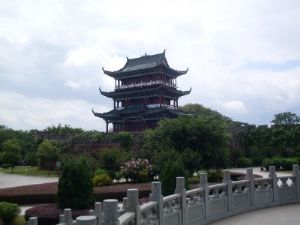
The current pavilion has three floors, built in an ancient-style architectural design, standing 28.5 meters tall with a total area of 574 square meters. The pavilion is constructed against the city wall. Originally made of wood, it was destroyed by fire several times. In 1983, it was rebuilt in the Song Dynasty style.
With upturned eaves, carved beams, and painted pillars, the structure is magnificent and splendid. Historical records indicate that the original pavilion was a stone tower, built during the Jiayou era (1056–1063) of the Northern Song Dynasty by Kong Zonghan. A 46th-generation descendant of Confucius from Gongfu, Shandong, Kong Zonghan noted that “the city walls were often eroded by floods, especially in the northeast where collapse was common.” Therefore, he “quarried stone for foundations and used iron to reinforce them,” transforming the earthen walls into brick and stone fortifications, and erecting a city tower on top.
After the Bajing Pavilion was completed, Kong Zonghan commissioned a painting and invited Su Dongpo to compose a poem. In response, Su Dongpo wrote “Eight Scenes of Qianzhou with Eight Poems and a Preface” and “Postscript to the Eight Scenes of Qianzhou.” In the former poem, Su Dongpo was the first in Chinese history to propose the concept of “eight urban scenic views,” creating a set of iconic tourist attractions that were later emulated—such as the Eight Scenic Views of Yan Mountain, Luzhou, Hong Kong, and Taiwan—making it a milestone in China’s tourism culture. Inside the Bajing Pavilion is also the Ganzhou Museum, which houses a rich collection of historical relics. The area beneath the pavilion has been developed into Bajing Park. The park features lush greenery, gently rippling waters, pavilions and towers standing in contrast, offering a fresh, tranquil, and picturesque scene. It has inspired numerous literary inscriptions throughout the dynasties.
From atop the pavilion, all eight scenic views of Ganzhou can be seen in one sweeping gaze. The eight scenic views during the Song Dynasty were: Stone Tower, Zhang-Gong Tower, White Magpie Tower, Black Canopy Tower, Yugu Tower, Mazuyan, Dustless Pavilion, and Fengshan. By the Qing Dynasty, due to changes in the landscape, the eight scenes visible from the Bajing Pavilion became: Three Towers Standing Like Tripods, Two Rivers Flowing in Circles, Moonlit Jade Rock, Morning Clouds over Baogai, Dawn Mirror at Chutan, Clear Haze over Tianzhu, Zen Shadows on Mayan Cliff, and Cultural Peaks of Wild Goose Pagoda.
Address: Take bus K2 or K3 and get off at the Bajing Intersection stop.
Type: Urban Park
Recommended Visit Duration: 1–2 hours
Ticket Information:
Free admission. Admission to the Bajing Pavilion is 20 RMB.
Share
This article is published by HowToTrip. Sharing and reposting are welcome — please credit the source.
Article URL: https://www.howtotrip.net/travel-7856
Related Articles
- Shaoxing's "Grandpa Gourd" hangs the gourds back up: "If there are too many people, we'll interact less — just take a quick look from afar"
- Chinese authorities announce "reciprocal adjustment" to Japan visa fees — single-entry visa jumps from 2,250 to 16,750 yen!
- The "health stones" carried by a traveler were found to have radiation levels exceeding safety limits by a thousand times, potentially endangering fellow passengers on the same flight. Customs issues warning!
- Shenzhen Airport Issues Late-Night Notice: Unidentified Aerial Object Detected, Causing Widespread Flight Delays!
- “They only said it cost money after I opened the box and washed it!” 200g of grapes sold for 60 yuan on a high-speed train—12306 responds!
- Can't buy an airline ticket? Denied exit? Blocked from boarding? A large number of Chinese tourists have mysteriously become "discredited individuals"
- Adverse weather and economic fluctuations impact Colombia's coffee market
- Beach bathing area responds to 2 yuan/30 seconds fee for freshwater foot rinsing: Clearly priced!
- Taking off with an improperly closed cabin door? Wing malfunction? Multiple flights made emergency returns mid-journey!
- Experience the gifts of nature! A countdown of the world’s ten most stunning coastlines