Former Residence of Dr. Sun Yat-sen in Shanghai Memorial Hall
Former Residence of Dr. Sun Yat-sen in Shanghai Memorial Hall (Sun Yat-sen Relics Museum)
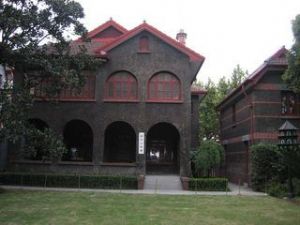
At that time, Sun Yat-sen was politically isolated and financially strapped. One day, four overseas Chinese who had returned from Canada visited Sun Yat-sen at his temporary residence at No. 63 Huanlong Road (now No. 59 Nanchang Road). Seeing that the house was old, they felt it was unworthy of someone engaged in such earth-shattering endeavors. The four overseas Chinese immediately decided to take out part of the funds they had pooled to start a cosmetics factory to buy a proper residence for Sun Yat-sen. Sun Yat-sen initially declined, but after repeated persuasion, he finally agreed to accept the gift. In January 1920, Sun Yat-sen moved into his new home at No. 29 Moliere Road (now No. 7 Xiangshan Road). He and his wife lived there for five years, the longest period he resided in Shanghai.
The Former Residence of Sun Yat-sen consists of a main building and an auxiliary building, both adjacent to each other and constructed with brick, wood, and concrete. The surroundings are tranquil, with a square lawn in front of the buildings, surrounded on the east, west, and south sides by evergreen trees such as magnolia, holly, camphor, pine, and cypress. The ground floor houses the living room and dining room, while the upper floor contains the study, bedroom, a medium-sized reception room, and a large indoor balcony. The interior furnishings were arranged according to the memories of Soong Ching-ling before her passing, and most of the items are original. The layout is compact and rational, reflecting the distinguished character of its occupants.
In the center of the living room sits a set of sofas used by Sun Yat-sen. The central photo on the wall was taken when he served as the Provisional President. The photo is mounted in a large frame assembled from wooden blocks in red, yellow, blue, white, and black—colors representing the Five-Colored Flag of the time, symbolizing the coexistence of the Han, Mongol, Manchu, Hui, and Tibetan peoples. The corners of the frame are engraved with identical floral patterns, each composed of 18 stars, signifying the 18 provinces and municipalities that responded to the Xinhai Revolution. Around the photo is a colorful ribbon arranged in the shape of a bell, symbolizing Sun Yat-sen’s intention to use the revolutionary bell to awaken the Chinese people. A photo on the side wall of the living room was taken on the first anniversary of Sun Yat-sen’s peril aboard the Yongfeng warship, which has since been renamed the Zhongshan warship. On May 16, 1922, when warlord Chen Jiongming rebelled and bombarded the area, Sun Yat-sen braved gunfire to board this warship and held out for over 40 days.
The dining room is connected to the living room. Inside the dining room is a round redwood table and chairs in the Cantonese style. On the wall hangs a photo of Sun Yat-sen and Soong Ching-ling during their inspection of the Guangzhou airfield, standing in front of China’s first self-assembled airplane, which was later named Rosamond after Soong Ching-ling’s English name. Also displayed in the dining room is a ceremonial sword gifted by Japanese friend Hisakichi Kuhara, a family heirloom that Sun Yat-sen used during the 1917 Northern Expedition. Among the exhibits are silver shields and cups presented by military and political figures and citizens along the route during Sun Yat-sen’s northern expedition in 1924.
The second floor includes the study, bedroom, and a small reception room. In the center of the study stands an ordinary writing desk with the Four Treasures of the Study that Sun Yat-sen used. The surrounding walls are adorned with 12 maps frequently consulted by Sun Yat-sen, some of which he personally drew, such as the “Map of Water and Land Transportation between Shanghai and Wusong with Troop Deployment Locations” and a hand-drawn military route map in ink. In the study and the hallway outside the bedroom, several neatly arranged bookcases hold about 5,400 books in Chinese and foreign languages, covering politics, economics, military science, history, geography, and law, indicating Sun Yat-sen’s love for reading.
Beyond the indoor balcony is the bedroom of Sun Yat-sen and his wife. The furnishings here are simple and unadorned. On the wall hangs a 1922 photo of Sun Yat-sen and Soong Ching-ling—Soong sitting gracefully in a chair with Sun standing affectionately beside her. There is a high-backed armchair where Sun Yat-sen often sat to write during his lifetime. In the upper right rear corner is a small reception room, with a small closet in the northeast corner housing the Zhongshan suit designed by Sun Yat-sen himself and worn during the Northern Expedition. Below the closet are also displayed medical instruments Sun Yat-sen used during his time as a doctor, as well as his ticket holder, glasses, and military utensils—all items that reflect the simplicity of his life at the time.
The Former Residence of Sun Yat-sen was not only the living quarters of Sun Yat-sen and his wife but also a place where they conducted revolutionary activities. Between 1918 and 1920, Sun Yat-sen completed important works such as The International Development of China and The Doctrine of Sun Wen here. On November 20, 1920, introduced by Chen Duxiu—one of the founders of the Chinese Communist Party—he met with communist envoy Voitinsky here. On August 23, 1922, he met with Chinese Communist Li Dazhao, and on August 25, 1922, he met with Maring, representative of the Soviet Union’s Plenipotentiary Ambassador to China, Adolph Joffe, to discuss the Chinese revolution, leading to the famous Sun-Joffe Manifesto. In September of the same year, Sun Yat-sen also convened a meeting on the garden lawn attended by Chinese Communists to discuss plans for reorganizing the Kuomintang, ultimately leading to the historically significant First United Front between the Nationalists and Communists.
At 9:30 a.m. on March 12, 1925, Sun Yat-sen passed away in Beijing at the age of 59 due to overwork and liver cancer. His life embodied the immortal spirit of a great revolutionary. The Former Residence of Sun Yat-sen at No. 7 Xiangshan Road is a highly significant site in his revolutionary career. Here, Sun Yat-sen’s thinking evolved from old democracy to new democracy; here, he conceived the reorganization of the Kuomintang and initiated the First United Front between the Nationalists and Communists; here, he deeply pondered China’s fate and wrote many immortal works, pointing out the correct direction for China’s bourgeois revolution. In 1961, the Former Residence of Sun Yat-sen was designated by the State Council as a Major Historical and Cultural Site Protected at the National Level and opened to the public.
Transportation
Address: No. 7 Xiangshan Road, Luwan District, Shanghai
Public transport: Buses 02, 17, 24, 36, 42, 96, 781, 786, 911, 920, 926, etc.
Address: No. 7 Xiangshan Road, Huangpu District, Shanghai
Type: Celebrity Former Residence Memorial Hall
Recommended visiting time: 1–2 hours
Phone: 021-53063361
Official Website: http://www.sh-sunyat-sen.org/
Opening Hours:
9:00–17:00 (ticket sales stop at 16:30)
Sun Yat-sen (1866~1925) Sun Yat-sen (1866–1925), whose given name was Wen, courtesy name Zaizhi, also known as Rixin or Yixian, with the childhood name Dixiang and alias Zhongshanqiao, often used Zhongshan as his name. Born into a farming family in Cuiheng Village, Xiangshan County (now Zhongshan City), Guangdong Province. In his youth, influenced by the revolutionary traditions of the people of Guangdong, he admired the revolutionary cause of the Taiping Heavenly Kingdom. He was a pioneer of modern China’s national democratic revolution, a great forerunner of China’s democratic revolution, the founder of the Republic of China and the Kuomintang, an advocate of the Three Principles of the People, and the creator of the Five-Power Constitution. He was the first to raise the banner of complete anti-feudalism, “founding the republic and ending two thousand years of feudal imperial rule.” 19...... More+
Share
This article is published by HowToTrip. Sharing and reposting are welcome — please credit the source.
Article URL: https://www.howtotrip.net/travel-6681
Related Articles
- Shaoxing's "Grandpa Gourd" hangs the gourds back up: "If there are too many people, we'll interact less — just take a quick look from afar"
- Chinese authorities announce "reciprocal adjustment" to Japan visa fees — single-entry visa jumps from 2,250 to 16,750 yen!
- The "health stones" carried by a traveler were found to have radiation levels exceeding safety limits by a thousand times, potentially endangering fellow passengers on the same flight. Customs issues warning!
- Shenzhen Airport Issues Late-Night Notice: Unidentified Aerial Object Detected, Causing Widespread Flight Delays!
- “They only said it cost money after I opened the box and washed it!” 200g of grapes sold for 60 yuan on a high-speed train—12306 responds!
- Can't buy an airline ticket? Denied exit? Blocked from boarding? A large number of Chinese tourists have mysteriously become "discredited individuals"
- Adverse weather and economic fluctuations impact Colombia's coffee market
- Beach bathing area responds to 2 yuan/30 seconds fee for freshwater foot rinsing: Clearly priced!
- Taking off with an improperly closed cabin door? Wing malfunction? Multiple flights made emergency returns mid-journey!
- Experience the gifts of nature! A countdown of the world’s ten most stunning coastlines