Hanwu Cultural Ecological Park
Hanwu Cultural Ecological Park
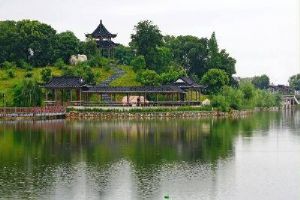
Qishan Mountain, also known as Mushi Mountain, borders the Yangtze River to the south, overlooks Jiuhua Mountain in the distance, connects to Gengkuizhai Lake to the east, and lies 30 kilometers north of the scenic area of Floating Mountain. Strategically located along the Yangtze River, Qishan offers sweeping views of the river’s islets. During the Western Zhou Dynasty, it was the site of the Zongzi Kingdom, and by the Warring States period, it had become a renowned riverine pass and commercial hub. Historical records indicate that Emperor Qin Shi Huang passed through this area during his southern tour and viewed “Jike.” In the fifth year of the Yuanshou era during Emperor Wu of Han's reign, he conducted a southern inspection tour, personally shot a flood dragon in the river nearby, set forth from this area, and composed the “Song of Prosperous Tang in Zhongyang,” after which the Zhongyang County was established in the same year. During the Three Kingdoms period, the famed Eastern Wu general Lü Meng built a fortress and stationed troops at the southern foot of Qishan Mountain to resist Cao Cao’s 800,000-strong army advancing southward. During the 1949 Yangtze River Crossing Campaign, Qishan served as one of the key launching points for the People’s Liberation Army’s river crossing operations.
Lotus Lake, also called Lotus Pond, according to the Annals of Anqing Prefecture, was the ancestral property of Fang Bao, a Grand Secretary during the Kangxi era of the Qing Dynasty, a great Qing prose writer, and one of the three founding figures of the Tongcheng School. From the mid-to-late Ming Dynasty onward, the Fang family of “Guilin Fang Clan” rapidly rose to prominence in China’s cultural circles, producing generations of talent, including nearly 100 cultural figures such as Fang Xuejian, Fang Yizhi, Fang Bao, and Fang Dongmei. They formed one of China’s most distinctive cultural dynasties, hailed by scholars and experts as “China’s Second Greatest Cultural Family.”
The Huang Zhen Library scenic spot is located on the northern side of the main Qishan scenic area and houses a collection of historical materials on notable figures from Zhongyang’s past.
The Martyrs' Cemetery red tourism site is situated at the western foot of Mushi Mountain, where revolutionary martyrs who sacrificed their lives during the Yangtze River Crossing Campaign rest in peace.
The park highlights the trajectory of Zhongyang’s historical development and its cultural achievements. The harmony between mountain and water—where the ruggedness of the mountain complements the softness of the water—creates a distinctive landscape urban character of “a city of mountain hues and half-city lakes,” shaping the scenic area’s brand as “Impressions of Landscape and Culture in Zhongyang.” The area primarily showcases Hanwu culture and eco-tourism elements. Leveraging existing natural ecological resources and cultural landscapes, it has developed five major functional zones: natural scenery, recreational leisure, cultural activities, vacation retreats, and red tourism. It is an integrated cultural ecological tourism destination offering multiple functions such as leisure, entertainment, commerce, play, and sightseeing. (Source: Municipal Culture and Tourism Commission)
Share
This article is published by HowToTrip. Sharing and reposting are welcome — please credit the source.
Article URL: https://www.howtotrip.net/travel-6545
Related Articles
- Shaoxing's "Grandpa Gourd" hangs the gourds back up: "If there are too many people, we'll interact less — just take a quick look from afar"
- Chinese authorities announce "reciprocal adjustment" to Japan visa fees — single-entry visa jumps from 2,250 to 16,750 yen!
- The "health stones" carried by a traveler were found to have radiation levels exceeding safety limits by a thousand times, potentially endangering fellow passengers on the same flight. Customs issues warning!
- Shenzhen Airport Issues Late-Night Notice: Unidentified Aerial Object Detected, Causing Widespread Flight Delays!
- “They only said it cost money after I opened the box and washed it!” 200g of grapes sold for 60 yuan on a high-speed train—12306 responds!
- Can't buy an airline ticket? Denied exit? Blocked from boarding? A large number of Chinese tourists have mysteriously become "discredited individuals"
- Adverse weather and economic fluctuations impact Colombia's coffee market
- Beach bathing area responds to 2 yuan/30 seconds fee for freshwater foot rinsing: Clearly priced!
- Taking off with an improperly closed cabin door? Wing malfunction? Multiple flights made emergency returns mid-journey!
- Experience the gifts of nature! A countdown of the world’s ten most stunning coastlines