Wuyi Mountain Ziyang Academy
Wuyi Mountain Ziyang Academy

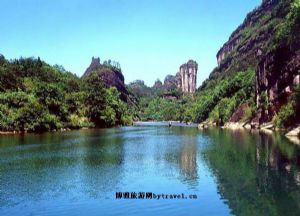
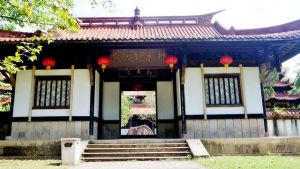
Wuyi Retreat is located at the foot of Hidden Screen Peak in Wuyi Mountain. It is an academy personally planned and constructed by the Southern Song Neo-Confucian scholar Zhu Xi in the tenth year of the Chunxi era (1183). It stands as one of the great architectural landmarks of Wuyi Mountain, hailed as “the grandest sight of Wuyi.”
The origins of constructing Wuyi Retreat trace back to the fifth year of the Chunxi era (1178). That early autumn, while traveling through Wuyi with his brother-in-law Liu Yanji and the hermit Liu Fu, Zhu Xi was struck by the winding bends of the Nine-Bend Stream and the drifting mists beneath Hidden Screen Peak—a scene that refreshed his senses and inspired the initial idea to “settle this homeland” and “welcome the immortals’ call, bestow me the yellow silk scroll, gift me twin jade pendants, when shall my thatched hut rise to banish worldly din.” After years of careful planning and preparation, construction finally began in the tenth year of the Chunxi era (1183) and reached initial completion that same year. According to Zhu Xi’s “Miscellaneous Poems on Wuyi Retreat,” the layout was roughly as follows: nestled between the embracing slopes at the foot of Hidden Screen Peak stood a three-room structure called the Benevolence and Wisdom Hall. To its left and right were two bedrooms—one for Zhu Xi himself, known as the Hidden Quest Study, and the other for receiving guests, called the Lodging Quarters. Beyond the left slope lay a secluded mountain hollow with a stone gate at the entrance, named Stone Gate Hollow. Inside were rows of rooms serving as communal quarters for scholars, called the Goodness Observing Studio. West of the Stone Gate was another room designated for Taoist practitioners, known as the Cold Perch Studio. In front of the Goodness Observing Studio stood two pavilions—the Evening View Pavilion and the Iron Flute Pavilion. Outside the Cold Perch Studio ran a fence enclosing the space between the slopes, with a wooden gate hung with a plaque reading “Wuyi Retreat.” Upon its completion, Zhu Xi invited Han Yuji, prefect of Jian Ning, and the renowned historian Yuan Shu from Jian’an (modern-day Jianyang County, Fujian), among others, to celebrate. Han Yuji wrote “Record of Wuyi Retreat.”







Share
This article is published by HowToTrip. Sharing and reposting are welcome — please credit the source.
Article URL: https://www.howtotrip.net/travel-20983
Related Articles
- Shaoxing's "Grandpa Gourd" hangs the gourds back up: "If there are too many people, we'll interact less — just take a quick look from afar"
- Chinese authorities announce "reciprocal adjustment" to Japan visa fees — single-entry visa jumps from 2,250 to 16,750 yen!
- The "health stones" carried by a traveler were found to have radiation levels exceeding safety limits by a thousand times, potentially endangering fellow passengers on the same flight. Customs issues warning!
- Shenzhen Airport Issues Late-Night Notice: Unidentified Aerial Object Detected, Causing Widespread Flight Delays!
- “They only said it cost money after I opened the box and washed it!” 200g of grapes sold for 60 yuan on a high-speed train—12306 responds!
- Can't buy an airline ticket? Denied exit? Blocked from boarding? A large number of Chinese tourists have mysteriously become "discredited individuals"
- Adverse weather and economic fluctuations impact Colombia's coffee market
- Beach bathing area responds to 2 yuan/30 seconds fee for freshwater foot rinsing: Clearly priced!
- Taking off with an improperly closed cabin door? Wing malfunction? Multiple flights made emergency returns mid-journey!
- Experience the gifts of nature! A countdown of the world’s ten most stunning coastlines