Xichun Garden
Last updated 2026-11-15 — Nestled against mountains and beside water, Xichun Garden covers an area of 38 hectares. The garden houses numerous ancient architectural ruins and scenic spots from the Song, Yuan, Ming, and Qing dynasties…
Xichun Garden
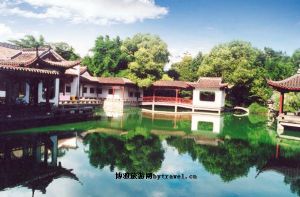
Xichun Garden is nestled against mountains and beside water, covering an area of 38 hectares. The garden features numerous ancient architectural ruins and scenic spots from the Song, Yuan, Ming, and Qing dynasties, among which the Canglang Pavilion, Xichun Morning Sun, Liuxu High Whistle, Huiying Shrine, and King Yue’s Terrace are especially renowned. The Canglang Pavilion is located east of Xichun Mountain on the outskirts of Shaowu City, overlooking the Futun River. Built during the Ming Dynasty's Wanli era, it was commonly known as the Octagonal Tower. In the early years of the Qing Yongzheng reign, it was renamed Canglang Pavilion in honor of Yan Yu, a renowned literary critic and patriotic poet of the Southern Song Dynasty. The pavilion’s courtyard is planted with boxwood, bamboo, osmanthus, and pomegranate trees, offering year-round greenery, birdsong, and floral fragrance. The pavilion also houses works by Yan Yu such as the *Canglang Collection* and *Canglang Poetic Criticism*. From the top of the pavilion, visitors can enjoy the splendid night view of the Futun River. A few dozen steps westward along the river from the Canglang Pavilion is said to be the spot where Yan Yu used to fish. Moving further ahead past Liuxu High Whistle and Huiying Shrine, you will arrive at King Yue’s Terrace, situated atop the northwest peak of Xichun Garden. This terrace was built to commemorate the achievements of the early Western Han Dynasty King of Minyue and his brothers in founding the city of Shaowu. The three golden characters “越王台” (King Yue’s Terrace) on the central plaque of the terrace wall were inscribed by General Zhang Aiping. Inside the terrace stands a stone stele inscribed with a record of Shaowu’s historical evolution. Climbing the stone stairs at the back of the terrace to the top, you can take in a panoramic view of the developing city of Shaowu.
Share
This article is published by HowToTrip. Sharing and reposting are welcome — please credit the source.
Article URL: https://www.howtotrip.net/travel-20968
Related Articles
- Shaoxing's "Grandpa Gourd" hangs the gourds back up: "If there are too many people, we'll interact less — just take a quick look from afar"
- Chinese authorities announce "reciprocal adjustment" to Japan visa fees — single-entry visa jumps from 2,250 to 16,750 yen!
- The "health stones" carried by a traveler were found to have radiation levels exceeding safety limits by a thousand times, potentially endangering fellow passengers on the same flight. Customs issues warning!
- Shenzhen Airport Issues Late-Night Notice: Unidentified Aerial Object Detected, Causing Widespread Flight Delays!
- “They only said it cost money after I opened the box and washed it!” 200g of grapes sold for 60 yuan on a high-speed train—12306 responds!
- Can't buy an airline ticket? Denied exit? Blocked from boarding? A large number of Chinese tourists have mysteriously become "discredited individuals"
- Adverse weather and economic fluctuations impact Colombia's coffee market
- Beach bathing area responds to 2 yuan/30 seconds fee for freshwater foot rinsing: Clearly priced!
- Taking off with an improperly closed cabin door? Wing malfunction? Multiple flights made emergency returns mid-journey!
- Experience the gifts of nature! A countdown of the world’s ten most stunning coastlines