Former Site of the Octagonal Tower in Yanping
Former Site of the Octagonal Tower in Yanping
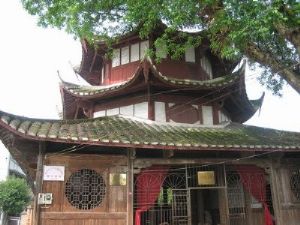
In July 1933, the “Eastern Army,” commanded by Peng Dehuai and with Teng Daiyuan as political commissar, marched eastward to secure victory on the eastern front. By mid-August, after completing the first phase of military operations in western Fujian, the Eastern Army advanced into northern Fujian. They captured Xiamao in Shaxian, Wangtai and Xiayang in Nanping, and Yangkou in Jian’ou (now part of Shunchang County), defeating three regiments of the enemy’s 56th Division under Liu Hedeng. This action gave the army control over the border areas of Shaxian, Nanping, and Shunchang counties.
The Eastern Army was not only a valiant fighting force but also a propaganda and agitation unit. After capturing Xiayang and Yangkou, Red Army soldiers took to the streets to mobilize the masses widely, spreading the message of the agrarian revolution. On the basis of leading the people in struggles such as overthrowing local tyrants and redistributing land, they established revolutionary committees in Xiayang and Yangkou. The labor movement in both areas also gained momentum at this time, with 80% of workers joining various trade unions. Workers and peasants enthusiastically volunteered for the Red Army—within just one month, over a thousand signed up, with nearly 500 enlisting in Yangkou in just five days. Guerrilla units from both towns formed the Central Fujian Independent Regiment, which continued guerrilla warfare in the region.
Just as the Eastern Army achieved major victories, a representative from the 19th Route Army, Chen Gongpei, arrived in Wangtai, Nanping, to request peace talks. The 19th Route Army was a well-known anti-Japanese force, which at that time was planning to resist Chiang Kai-shek and fight Japan. Under the heavy blows dealt by the Eastern Army, its leaders came to realize that anti-communism while resisting Japan was a dead end. They decided to shift their original strategy to a new approach of “uniting with the Communists, resisting Chiang, and fighting Japan.” When Chen Gongpei arrived in Wangtai, he was received by Peng Dehuai and Yuan Guoping. After negotiations in the Octagonal Tower, the two sides reached a temporary ceasefire agreement. This laid the foundation for the subsequent signing of the “Preliminary Agreement Against Japan and Chiang Kai-shek” between the Provisional Central Government of the Chinese Soviet Republic and the 19th Route Army. That agreement helped accelerate the early realization of the Fujian Incident and stands as a significant moment in modern Chinese history. The Octagonal Tower is now listed as a municipal revolutionary cultural relics protection unit.
Source: People’s Government of Nanping City
Share
This article is published by HowToTrip. Sharing and reposting are welcome — please credit the source.
Article URL: https://www.howtotrip.net/travel-20595
Related Articles
- Shaoxing's "Grandpa Gourd" hangs the gourds back up: "If there are too many people, we'll interact less — just take a quick look from afar"
- Chinese authorities announce "reciprocal adjustment" to Japan visa fees — single-entry visa jumps from 2,250 to 16,750 yen!
- The "health stones" carried by a traveler were found to have radiation levels exceeding safety limits by a thousand times, potentially endangering fellow passengers on the same flight. Customs issues warning!
- Shenzhen Airport Issues Late-Night Notice: Unidentified Aerial Object Detected, Causing Widespread Flight Delays!
- “They only said it cost money after I opened the box and washed it!” 200g of grapes sold for 60 yuan on a high-speed train—12306 responds!
- Can't buy an airline ticket? Denied exit? Blocked from boarding? A large number of Chinese tourists have mysteriously become "discredited individuals"
- Adverse weather and economic fluctuations impact Colombia's coffee market
- Beach bathing area responds to 2 yuan/30 seconds fee for freshwater foot rinsing: Clearly priced!
- Taking off with an improperly closed cabin door? Wing malfunction? Multiple flights made emergency returns mid-journey!
- Experience the gifts of nature! A countdown of the world’s ten most stunning coastlines