Buddha Rock
Buddha Rock
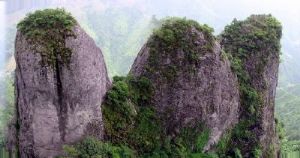
The mountain slopes within Fozishan are well-preserved with lush trees and grass, and are home to many rare and precious tree species such as yew, fragrant princess tree, ancient golden tree, and kiwi fruit. It is known as the "primeval forest" and "precious tree species base" of Zhenghe. The area boasts rich cultural landscapes, including revolutionary sites worthy of reverence, caves once used by guerrilla fighters, and Buddhist sacred sites. With cool temperatures and pleasant scenery all year round, the region also features unique local customs. A Ming Dynasty poet once praised the view here: “Riding my horse atop Choulingkeng and looking around, I clearly see a lion standing atop the ridge; a solitary peak stands tall against the blue sky, while massive rocks rest against the bluish light of dawn.”
The Fozishan Scenic Area boasts uniquely magical and stunning natural landscapes, and its abrupt and peculiar geological formations are considered one of a kind in East China. The rare 178-meter-high Shifeng Peak rises majestically, reaching towards the sky with vivid form and spirit. The area around Shifeng is covered with pristine secondary forests, offering a beautiful natural environment. The peak serves as an exceptional vantage point. The scenic area’s iconic geological formation — Fozhiyan (Buddha Rock) — is exquisitely crafted and strikingly lifelike. It earned its name due to its resemblance to a Buddhist disciple when viewed alongside Husband-and-Wife Rocks. The surroundings feature a forest of unusual peaks and lush vegetation. Together with Mile Rock, Eagle-Watching Rock, and Hanging Pillar Rock, they form a natural landscape bonsai. The steep and precipitous Bijia Mountain features uniquely shaped peaks. With cliffs over 230 meters high sloping toward the mountain face, it gets its name from its resemblance to a scholar’s inkstone stand. Here, towering peaks and steep cliffs create a uniquely rugged landform. Bijia Mountain is covered with dense forests and ancient trees. Viewed from different angles, the scenery becomes even more enchanting. In addition to these three main peaks, there are 43 other notable attractions, including famous peaks, rocks, and caves.
Source: Fujian Provincial Tourism Development Committee
Share
This article is published by HowToTrip. Sharing and reposting are welcome — please credit the source.
Article URL: https://www.howtotrip.net/travel-19852
Related Articles
- Shaoxing's "Grandpa Gourd" hangs the gourds back up: "If there are too many people, we'll interact less — just take a quick look from afar"
- Chinese authorities announce "reciprocal adjustment" to Japan visa fees — single-entry visa jumps from 2,250 to 16,750 yen!
- The "health stones" carried by a traveler were found to have radiation levels exceeding safety limits by a thousand times, potentially endangering fellow passengers on the same flight. Customs issues warning!
- Shenzhen Airport Issues Late-Night Notice: Unidentified Aerial Object Detected, Causing Widespread Flight Delays!
- “They only said it cost money after I opened the box and washed it!” 200g of grapes sold for 60 yuan on a high-speed train—12306 responds!
- Can't buy an airline ticket? Denied exit? Blocked from boarding? A large number of Chinese tourists have mysteriously become "discredited individuals"
- Adverse weather and economic fluctuations impact Colombia's coffee market
- Beach bathing area responds to 2 yuan/30 seconds fee for freshwater foot rinsing: Clearly priced!
- Taking off with an improperly closed cabin door? Wing malfunction? Multiple flights made emergency returns mid-journey!
- Experience the gifts of nature! A countdown of the world’s ten most stunning coastlines