Wuyishan Museum
Wuyishan Museum

As a local comprehensive museum, the Wuyishan Museum boasts a rich collection, particularly notable for its boat coffins, Hongqiaoban (rainbow bridge planks), stone tools, bronzeware, ancient ceramics, paintings, and calligraphy.
The Wuyishan Museum consists of three exhibition halls and corresponding auxiliary facilities.
The Historical Culture Exhibition Room has two floors, each with a 240-square-meter hall. The lower hall showcases the first part of the historical culture — “The Dawn of Human History,” displaying the early development history of Wuyishan, dating from the 21st century BC up to the period before Emperor Qin Shi Huang unified China in 221 BC. Major exhibits include a No.1 Gorge Boat Coffin, Hongqiaoban, and burial objects inside the coffin (replicas), as well as Neolithic artifacts such as stone axes, stone adzes, stone arrowheads, and stone net sinkers. There are also models of Neolithic site ruins, scaled-down models of the Gorge Boat Coffin burials, and large photos. The upper hall is divided into three sections: “The Rise of the Minyue Kingdom City,” “The Heyday of Neo-Confucian Culture,” and “The Charm of Rock Tea,” displaying the distinctive Minyue culture, Neo-Confucian culture, and rock tea culture of Wuyishan. Key exhibits include a model of the Minyue Kingdom City, pottery and ironware unearthed from the Han Dynasty Minyue Kingdom City ruins, black-glazed cups excavated from the Song Dynasty Yulin Pavilion Kiln Site, and various cultural relics unearthed from the Western Han Dynasty through the Qing Dynasty.
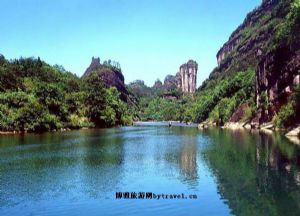
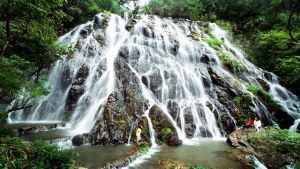
The Natural Exhibition Hall covers 140 square meters and is divided into four sections: “Wuyishan Belongs to the World,” “Emerald Waters and Red Cliffs,” “A Window on World Biodiversity,” and “Keeping Wuyishan Evergreen.” It uses numerous photos and plant and animal specimens to showcase Wuyishan’s beautiful natural scenery and abundant natural resources. The museum also features a “Wuyi Crafts” exhibition hall that displays and sells antiques, jade artifacts, calligraphy, and paintings.
“The Mysteries of Wuyi Culture” focuses on three peak cultural periods in the Wuyishan region: the ancient Yue tribal culture symbolized by the Gorge Boat Coffins (about 3,800 years ago), the Western Han culture marked by the Chengcun Ancient Han City (over 2,000 years ago), and the Song Dynasty Neo-Confucian culture represented by Zhu Xi (about 800 years ago). Showcasing cultural relics at their finest, the exhibit presents a vivid display of Wuyishan’s long history and profound culture.
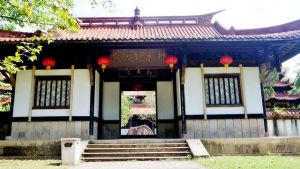
The museum was formerly the cultural relics room of the Wuyishan City Cultural Center. In 1992, it was built on the former site of the Confucian Temple in downtown Wuyishan City. It was completed and officially opened in February 1993, at which point the cultural relics room was dissolved and its collections transferred to the museum. The museum had a total investment of 1.4 million yuan, covering an area of 2,400 square meters with a construction area of 1,500 square meters. It is a five-story reinforced concrete structure with an antique architectural style, featuring six exhibition rooms and facilities such as a cultural relics storage room. The collection includes more than 600 cultural relics from the late Neolithic period to the end of the Qing Dynasty, among which 525 were appraised by experts from the Fujian Provincial Department of Culture’s Cultural Relics Appraisal Group. These include 6 national second-grade relics and 474 third-grade relics. In 1996, to expand outreach and allow more domestic and international tourists to learn about Wuyishan, the museum was relocated to its current site and officially opened to the public on May 1, 1996. The original building was handed over to the Wuyishan City Library.
From November 1998 to March 1999, to support Wuyishan’s bid for “World Heritage” status, the museum underwent comprehensive renovation and redesign, adopting advanced exhibition methods and protective measures. On the museum’s facade is the name “Wuyishan City Museum,” inscribed by the late Zhao Puchu, Vice Chairman of the National Committee of the Chinese People’s Political Consultative Conference. The couplet on both sides of the gate is taken from the poem of Cai Shangsi, a renowned contemporary historian and professor at Fudan University in Shanghai: “Ancient Chinese culture, Mount Tai and Wuyi.”






Share
This article is published by HowToTrip. Sharing and reposting are welcome — please credit the source.
Article URL: https://www.howtotrip.net/travel-18106
Related Articles
- Shaoxing's "Grandpa Gourd" hangs the gourds back up: "If there are too many people, we'll interact less — just take a quick look from afar"
- Chinese authorities announce "reciprocal adjustment" to Japan visa fees — single-entry visa jumps from 2,250 to 16,750 yen!
- The "health stones" carried by a traveler were found to have radiation levels exceeding safety limits by a thousand times, potentially endangering fellow passengers on the same flight. Customs issues warning!
- Shenzhen Airport Issues Late-Night Notice: Unidentified Aerial Object Detected, Causing Widespread Flight Delays!
- “They only said it cost money after I opened the box and washed it!” 200g of grapes sold for 60 yuan on a high-speed train—12306 responds!
- Can't buy an airline ticket? Denied exit? Blocked from boarding? A large number of Chinese tourists have mysteriously become "discredited individuals"
- Adverse weather and economic fluctuations impact Colombia's coffee market
- Beach bathing area responds to 2 yuan/30 seconds fee for freshwater foot rinsing: Clearly priced!
- Taking off with an improperly closed cabin door? Wing malfunction? Multiple flights made emergency returns mid-journey!
- Experience the gifts of nature! A countdown of the world’s ten most stunning coastlines