Longmen Mountain, Sishui
Longmen Mountain, Sishui
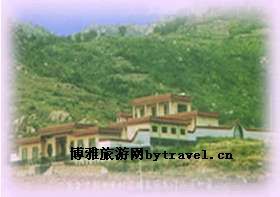
Longmen Mountain is located 16 kilometers northwest of Sishui County, at the border between Sishui and Ningyang counties. Its main peak, Keloubu, stands at an elevation of 576.6 meters, making it the second highest mountain in Sishui. The mountain features undulating peaks, steep cliffs, lush pines and cypresses, and murmuring streams, and is a historic scenic destination.
Lingguang Temple is situated on the southern foothills of Longmen Mountain. It was originally built during the Han Dynasty and renovated in the second year of the Huangtong era of the Jin Dynasty (1142 AD). Legend has it that on the fifth day of the tenth lunar month one year, Patriarch Damo Shenguang arrived here, and divine light appeared, hence the name “Lingguang Temple” (Temple of Divine Light). It is said that the temple was designed according to the Bagua principles of the I Ching, with its back against Longmen Mountain, facing Chilong Pool to the south, flanked by Xiuling Platform to the east, which connects to the Queen Mother’s Immortal Mountain, and by Bai Long Panxuan Phoenix Mountain to the west. Atop the temple are beamless treasure halls and the Guanyin Hall, as well as two stupas—the Jueling Pagoda for the remains of enlightened monks and the Putong Pagoda. In the center are the Mahavira Hall, Sangharama Hall, and Patriarch Hall, with the Heavenly King Hall at the front, all aligned along a central axis with the mountain gate. To the east and west of the Heavenly King Hall are the Bell Tower and Drum Tower, respectively. Additional structures include guest halls, incense rooms, secluded corridors, meditation halls, scripture rooms, the abbot’s dining quarters, and over a hundred storage rooms. The temple once housed more than a hundred monks. The abbot, four principal leaders, and eight administrators managed temple affairs. Most of the temple has been destroyed, leaving only the Guanyin Hall. Three Ming Dynasty steles, one Qing Dynasty stele, two damaged steles, and several Ming Dynasty epitaphs remain.
Longmen Mist, one of the Ten Scenic Spots of Sishui, is located about 10 kilometers north of Sishui City, on Longmen Mountain in Zhongce Town. The mountain has two peaks standing side by side, towering into the sky like a stone gate. In summer, auspicious clouds gather here, resembling mist rising from a dragon’s mouth. Ancients named this phenomenon “Longmen Mist” because they believed that when the mist passed through the gate, rain would follow. The Ming Dynasty poet Zhang Zuo wrote in his poem “Siping Ten Scenic Spots · Longmen Mist”: “Two peaks in the northwest pierce the shores of Sishui, rising steam like a dragon’s ford. Sweet rain brings relief to the people’s drought-stricken hopes, reviving the withered world into spring.” Inside Longmen Mountain are natural attractions such as Chilong Pool, General Rock, Chicken Crown Mountain, Story Well, and Future Fragrance. Originally located on the southern foothills of Longmen Mountain was Lingguang Temple, built during the Han Dynasty and renovated in 1142 AD during the Jin Dynasty. The temple once housed over a hundred monks, but most of it has been destroyed, with only the Guanyin Hall remaining. In recent years, Longmen Mountain has undergone preliminary development, including the construction of an entrance road and lodgings. Terraced dams have been built along the terrain to form a chain of reservoirs, adding vitality to the mountain. Over 300 acres of economic and scenic trees have been planted, making it one of the best scenic areas in the Sishui mountain region where natural beauty and agritourism blend seamlessly.
The Tomb of Prince Zouping is located on the sunny side of Longmen Mountain, west of Lingguang Temple. Historical records and inscriptions state that Prince Zouping Jing, Prince Tai Cheng, was the great-grandson of Emperor Taizu of the Ming Dynasty, Zhu Yuanzhang. Other princes buried here—Prince Zouping Zhuangding, Prince Zouping Rongan, Prince Zouping Gongjing, and Prince Zouping Kangshun—were descendants spanning four to nine generations of Zhu Yuanzhang. With seven Ming princes interred here, the site is commonly known as the Tomb of the Seven Princes. The small village to the south of the tomb is thus named Wangfen (Prince’s Tomb), now renamed Longmen Mountain Villa.
The Tomb of the General, the Ming Dynasty Auxiliary National Prince’s Tomb, is located at the foot of Huilong Mountain, north of Wangfen Village. It was discovered on February 20, 1993. The tomb is a joint burial site for Guancheng, the seventh-generation descendant of Emperor Taizu of the Ming Dynasty, Zhu Yuanzhang, and his second-rank wife, Lady Zhang. Valuable artifacts unearthed from the tomb include gold jewelry, agate and jade items, an ancient Seven-Star Sword, a hexagonal porcelain pot, and the tomb epitaph.
The Ancient Apricot of Elder ? is said to have originated in the third year of the Tianshun era (1330 AD). Elder ? from the Wan Shou Jie Tan in Beijing brought gold to Lingguang Temple and constructed two corridors and halls. To the northeast of the Guanyin Hall, he planted seven apricot pits, from which two apricot trees grew.
These trees still stand today. The apricots not only have an exceptionally delicious taste but are also said to have healing and health-strengthening properties.
In addition, the mountain also features natural wonders such as Chilong Pool, General Rock, Chicken Crown Mountain, Story Well, and Future Fragrance.
Share
This article is published by HowToTrip. Sharing and reposting are welcome — please credit the source.
Article URL: https://www.howtotrip.net/travel-18086
Related Articles
- Shaoxing's "Grandpa Gourd" hangs the gourds back up: "If there are too many people, we'll interact less — just take a quick look from afar"
- Chinese authorities announce "reciprocal adjustment" to Japan visa fees — single-entry visa jumps from 2,250 to 16,750 yen!
- The "health stones" carried by a traveler were found to have radiation levels exceeding safety limits by a thousand times, potentially endangering fellow passengers on the same flight. Customs issues warning!
- Shenzhen Airport Issues Late-Night Notice: Unidentified Aerial Object Detected, Causing Widespread Flight Delays!
- “They only said it cost money after I opened the box and washed it!” 200g of grapes sold for 60 yuan on a high-speed train—12306 responds!
- Can't buy an airline ticket? Denied exit? Blocked from boarding? A large number of Chinese tourists have mysteriously become "discredited individuals"
- Adverse weather and economic fluctuations impact Colombia's coffee market
- Beach bathing area responds to 2 yuan/30 seconds fee for freshwater foot rinsing: Clearly priced!
- Taking off with an improperly closed cabin door? Wing malfunction? Multiple flights made emergency returns mid-journey!
- Experience the gifts of nature! A countdown of the world’s ten most stunning coastlines