Tomb of Prince Huan of Lu from the Ming Dynasty
Tomb of Prince Huan of Lu from the Ming Dynasty
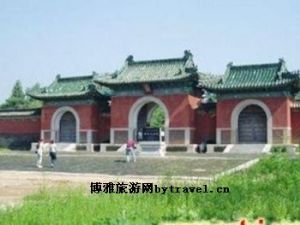
Zhu Tan, Prince of Lu, was the tenth son of Emperor Taizu of the Ming Dynasty. He was born in 1370 and became the Prince of Yanzhou at the age of fifteen. Initially, Zhu Tan was humble, respectful to scholars, knowledgeable, and much favored by Emperor Taizu. His consort, Lady Ge, came from a respectable family and entered the service of the princely household. In the 23rd year of the Hongwu reign, she was named Princess Consort of Prince Huan of Lu, and they had one son, Zhao Hui. However, later on Zhu Tan went astray—believing in Taoism, he spent his days refining “immortal elixirs” in search of eternal youth. The toxic effects damaged his eyes, and he died at just nineteen. Upon learning of this, Emperor Taizu was furious, considering his behavior absurd, and thus posthumously titled him “Prince Huan” (meaning “the extravagant or absurd prince”).
Over 1,000 cultural relics were unearthed from Zhu Tan’s tomb, vividly reflecting the exceptional craftsmanship of the laboring people during the Ming Dynasty. These artifacts also provide an authentic glimpse into the luxurious life that Prince Huan of Lu led while living in his princely manor. Among the many unearthed items, jade objects were numerous, with the finest being a jade belt composed of 25 sections of fine mutton-fat jade, inlaid with gold sheets and carved with hollow lingzhi mushroom patterns. The jade is lustrous and exquisitely carved. The first three sections of the belt are inlaid with double-layered openwork gold sheets featuring 11 sapphires, 12 rubies, 6 white jade pieces, and one rare cat’s-eye gemstone. The exceptional artistry of these items is truly rare, making them the highlights of the unearthed collection. Ming dynasty brocades are historically renowned craftworks, and those found in Zhu Tan’s tomb mainly consist of robe garments, mostly woven with gold threads. These silk textiles are of great value for understanding and researching Ming dynasty silk weaving techniques.
There is also a carved white jade cup shaped like a five-petal flower, with thin and transparent walls. Two jade tablets were also found, one made of jasper and the other of mutton-fat jade, measuring 29.6 cm in length, 6 cm in width, and 1 cm in thickness. The jade inkstone is carved from jasper, with a curved tip and oval inkwell, resting on a wooden base carved with lotus petals—both upwards and downwards—and gilded with a Sumeru pedestal. Other jade items include jade pendants, jade brush tubes, and jade brush stands. The carving and polishing craftsmanship of these jade artifacts fully demonstrate the superb skills and intelligence of the Chinese laboring people over 500 years ago.
The rich and precious unearthed cultural relics displayed in the exhibition hall of the Tomb of Prince Huan of Lu from the Ming Dynasty are splendid treasures of ancient Chinese culture and hold significant archival value for studying the politics, economy, culture, and other aspects of the Ming Dynasty.
Zhu Tan (1370~1389) Zhu Tan (1370–1389) was the tenth son of Emperor Taizu of the Ming Dynasty. In the third year of the Hongwu reign [1370], he was granted the title of Prince of Lu. In the 18th year [1385], he was enfeoffed in Yanzhou. He enjoyed literature and respected scholars, and was skilled in poetry. He consumed alchemical elixirs, which released toxins that damaged his eyes. The emperor disapproved of his behavior. He passed away in the 22nd year [1389]. ...... Details+
Share
This article is published by HowToTrip. Sharing and reposting are welcome — please credit the source.
Article URL: https://www.howtotrip.net/travel-17684
Related Articles
- Shaoxing's "Grandpa Gourd" hangs the gourds back up: "If there are too many people, we'll interact less — just take a quick look from afar"
- Chinese authorities announce "reciprocal adjustment" to Japan visa fees — single-entry visa jumps from 2,250 to 16,750 yen!
- The "health stones" carried by a traveler were found to have radiation levels exceeding safety limits by a thousand times, potentially endangering fellow passengers on the same flight. Customs issues warning!
- Shenzhen Airport Issues Late-Night Notice: Unidentified Aerial Object Detected, Causing Widespread Flight Delays!
- “They only said it cost money after I opened the box and washed it!” 200g of grapes sold for 60 yuan on a high-speed train—12306 responds!
- Can't buy an airline ticket? Denied exit? Blocked from boarding? A large number of Chinese tourists have mysteriously become "discredited individuals"
- Adverse weather and economic fluctuations impact Colombia's coffee market
- Beach bathing area responds to 2 yuan/30 seconds fee for freshwater foot rinsing: Clearly priced!
- Taking off with an improperly closed cabin door? Wing malfunction? Multiple flights made emergency returns mid-journey!
- Experience the gifts of nature! A countdown of the world’s ten most stunning coastlines