Baiyun Chan Temple
Baiyun Chan Temple
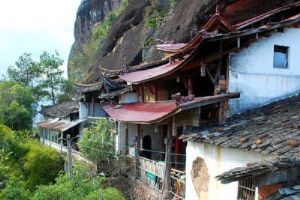
Originally named Baiyun Nunnery, the temple was once used as a study retreat by the Song Dynasty scholar Lü Zuqian, and later occupied by Taoist nuns. In the late Ming and early Qing dynasties, Monk Cijue traveled here and converted the Baiyun Nunnery into a Buddhist temple. The temple was ingeniously built against the mountain rock, blending with the surrounding landscape, and from a distance looks like a cloud nestled halfway up Lingfeng Peak. Inside the temple are the Maitreya Hall, the Three Jewels Hall, the Guanyin Hall, and the Patriarch Altar. The rear halves of these halls are embedded within rock caves, while the front halves are supported by fir wood pillars leveraging the mountain terrain, resembling structures suspended in mid-air. From inside the temple, one can look south toward the upper reaches of the Nine Bend River, with Dao Yuan Zhou stretching across the middle section. Opposite stands the majestic Flame Peak. Looking down, the houses and buildings of Xingcun Town are densely clustered, offering a uniquely beautiful scenery.
For nearly a century during the Qianlong era, the temple flourished under the leadership of Monk Pengri, several generations after its founding monk Cijue, attracting a continuous stream of worshippers. Over the centuries since its establishment, the temple has undergone cycles of prosperity and destruction.
On the rock wall of the Guanyin Hall, there is a cliff engraving from the Qianlong era that reads “Grand View.” At the end of the temple, a perilous narrow path leads to a cave that houses the relics stupa of Master Liang Shan Dongxuan from Zhangpu, erected in the 38th year of the Kangxi reign (1699). Outside the cave, on the sheer cliff face, there is a cliff engraving from the Qianlong era gifted by devotees to then-abbot Monk Pengri, inscribed with the words “Pure Land.” Baiyun Chan Temple currently has three resident monks and is gradually being developed as a new tourist attraction.
Source: Fujian Provincial Tourism Development Commission
Share
This article is published by HowToTrip. Sharing and reposting are welcome — please credit the source.
Article URL: https://www.howtotrip.net/travel-17682
Related Articles
- Shaoxing's "Grandpa Gourd" hangs the gourds back up: "If there are too many people, we'll interact less — just take a quick look from afar"
- Chinese authorities announce "reciprocal adjustment" to Japan visa fees — single-entry visa jumps from 2,250 to 16,750 yen!
- The "health stones" carried by a traveler were found to have radiation levels exceeding safety limits by a thousand times, potentially endangering fellow passengers on the same flight. Customs issues warning!
- Shenzhen Airport Issues Late-Night Notice: Unidentified Aerial Object Detected, Causing Widespread Flight Delays!
- “They only said it cost money after I opened the box and washed it!” 200g of grapes sold for 60 yuan on a high-speed train—12306 responds!
- Can't buy an airline ticket? Denied exit? Blocked from boarding? A large number of Chinese tourists have mysteriously become "discredited individuals"
- Adverse weather and economic fluctuations impact Colombia's coffee market
- Beach bathing area responds to 2 yuan/30 seconds fee for freshwater foot rinsing: Clearly priced!
- Taking off with an improperly closed cabin door? Wing malfunction? Multiple flights made emergency returns mid-journey!
- Experience the gifts of nature! A countdown of the world’s ten most stunning coastlines