Liuxiang Stream
Liuxiang Stream
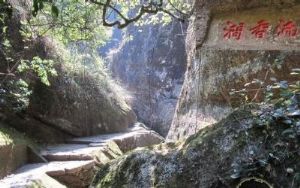
The stream is flanked by towering cliffs of crimson stone, draped with hanging vines and wild grasses, yet dotted with clusters of wild orchids, stonecalamus, and mountain sweetflag. “Falling leaves drift on the deep stream, fluttering petals chase the rushing rapids.” As you walk along, the murmuring flow of water is accompanied by drifting petals, and wafts of subtle fragrance drift through the air from time to time. The Ming Dynasty poet Xu Huotong, who visited this place, was so reluctant to leave that he renamed the stream “Liuxiang” (Flowing Fragrance). Further north along the stream lies Qingliang Gorge. The gorge is enclosed by steep cliffs on both sides, and when you look up, you’ll see jagged rocks interlocking precariously overhead, leaving only a sliver of space through which sunlight barely penetrates at noon. The streaks of water trickling down the cliff face quickly turn into droplets that fall into the stream with a pleasant, tinkling sound.
Visiting in the height of summer, sitting on the stone ledges by the stream, you’ll feel a cool breeze brushing against you, with a refreshing chill in the air—as if you’ve entered a world of pure coolness. Not far out of Qingliang Gorge, you’ll see a dark mountain peak topped with a massive slab of rock leaning forward, resembling a farmer wearing a tilted straw hat. Legend has it that this huge rock flew here from afar, hence the name “Feilai Peak” (Flying-Over Peak). Circling around Feilai Peak, you’ll come face to face with Yuzhu Peak, which rises proudly and stands like a pillar reaching from the earth to the sky.
Source: Fujian Provincial Tourism Development Commission
Share
This article is published by HowToTrip. Sharing and reposting are welcome — please credit the source.
Article URL: https://www.howtotrip.net/travel-17660
Related Articles
- Shaoxing's "Grandpa Gourd" hangs the gourds back up: "If there are too many people, we'll interact less — just take a quick look from afar"
- Chinese authorities announce "reciprocal adjustment" to Japan visa fees — single-entry visa jumps from 2,250 to 16,750 yen!
- The "health stones" carried by a traveler were found to have radiation levels exceeding safety limits by a thousand times, potentially endangering fellow passengers on the same flight. Customs issues warning!
- Shenzhen Airport Issues Late-Night Notice: Unidentified Aerial Object Detected, Causing Widespread Flight Delays!
- “They only said it cost money after I opened the box and washed it!” 200g of grapes sold for 60 yuan on a high-speed train—12306 responds!
- Can't buy an airline ticket? Denied exit? Blocked from boarding? A large number of Chinese tourists have mysteriously become "discredited individuals"
- Adverse weather and economic fluctuations impact Colombia's coffee market
- Beach bathing area responds to 2 yuan/30 seconds fee for freshwater foot rinsing: Clearly priced!
- Taking off with an improperly closed cabin door? Wing malfunction? Multiple flights made emergency returns mid-journey!
- Experience the gifts of nature! A countdown of the world’s ten most stunning coastlines