Baochan Mountain
Baochan Mountain
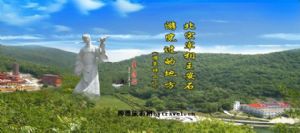
Baochan Mountain, formerly known as Huashan, is located 7.5 kilometers northeast of Hanshan County. It got its name during the Zhenguan era (627–649 AD) of the Tang Dynasty when the monk Huibao built a hut at the foot of the mountain and was later buried there. The mountain is covered in emerald haze, encircled on all sides. At its center is Qiyun Peak, which begins to gather clouds when rain is approaching, often windy in spring and summer. There are also Long Cave and Arhat Cave, with winding passages and oddly shaped rocks lining the walls, as well as stalactites hanging from above. Xiannü Spring and Bai’gui Spring offer crystal-clear water that never runs dry year-round. The mountain is dotted with wells, giving rise to the local saying: “Mount Huang has three hundred and sixty peaks, Baochan Mountain has three hundred and sixty wells.” Below the mountain lies Huikong Chan Temple (also known as Huayang Temple), built by the Ming Dynasty’s Zheng He. It is grand in scale and has undergone multiple renovations over time. The temple grounds are shaded by ancient cypresses and feature one large and one small stone pagoda, both now in ruins. The surrounding peaks rise sharply, creating beautiful scenery. Wang Anshi, a prominent Northern Song Dynasty official, once visited here and wrote the famous essay “Record of a Visit to Baochan Mountain,” in which he noted: “Baochan Mountain is also called Huashan. During the Tang Dynasty, the monk Huibao first took up residence here and was later buried here, hence the name ‘Baochan’ [meaning ‘In Praise of Huibao’]. What is now called Huikong Chan Temple was his hut and tomb. About five li to the east of the temple lies what is called the Huashan Cave, named because it is situated on the sunny side of Huashan. A hundred steps from the cave lies a fallen stele by the path, its inscriptions mostly worn away, though the character ‘Huashan’ can still be faintly recognized. Today, when people pronounce ‘Hua’ as in ‘Huashan,’ they actually mispronounce it — it should sound like ‘hua’ in ‘fruit’ [i.e., huá, not huā].” The stele remains today, and the mountain’s many caves and springs continue to attract visitors. In ancient times, the area was described as “paths lost in the clouds, meditation halls surrounded on four sides, peaks standing at will, wild plum blossoms fragrant throughout the hills.” In his essay, Wang Anshi described the Huashan Cave as spacious inside, with stone walls covered in inscriptions left by visitors. Inside the cave, emerald hues and lush trees abound, and amid the foliage one can hear the clear tinkling sounds as if someone were playing a zither. Truly, this is a sublime spot on earth.
During the Zhenguan era of the Tang Dynasty, the monk Huibao traveled here and was delighted by the sight of springs of various sizes — such as Longnu Spring and Bai’gui Spring — flowing year-round, and peaks both large and small — such as Qiyun Peak and Aoyu Ridge — standing like screens of green jade. Deeply moved, he decided to build a hut here. After his death, his disciples renamed the mountain Baochan Mountain. His humble hut was later expanded into Baochan Temple by the eminent Song Dynasty monk Zhonghui, and further renovated by the monk Yuanyu of the Song and Yuan periods, eventually taking on a more complete form. During the Southern Song Dynasty, the philosopher Ye Shi, serving as the regional commander along the Yangtze River, passed through here with troops during a severe drought. He prayed for rain at the temple, and his prayers were answered. In the sixth year of the Qingyuan era of Emperor Ningzong of the Song Dynasty (1200 AD), Wang Daguo, the prefect of Hezhou, also prayed for rain here with successful results and built the Xiyu Pavilion in gratitude. Since then, literati and artists have come in an endless stream, greatly enhancing the mountain’s fame. Baochan Mountain is associated with legends such as the Huayang Immortal Cave and Baochan Misty Rain. The Huayang Immortal Cave is said to be frequented by immortals, hence its name. Huayang Cave consists of four chambers: the Heaven Chamber, the Stele Chamber, the Gate Chamber, and the Earth Chamber. Among them, the Stele Chamber is uniquely deep, with numerous inscriptions and traces left by visitors throughout the dynasties. The two characters “Huayang” were inscribed in the Wanli year of the Ming Dynasty (1613 AD) by Fan Weimei of Haiyang.
Share
This article is published by HowToTrip. Sharing and reposting are welcome — please credit the source.
Article URL: https://www.howtotrip.net/travel-17524
Related Articles
- Shaoxing's "Grandpa Gourd" hangs the gourds back up: "If there are too many people, we'll interact less — just take a quick look from afar"
- Chinese authorities announce "reciprocal adjustment" to Japan visa fees — single-entry visa jumps from 2,250 to 16,750 yen!
- The "health stones" carried by a traveler were found to have radiation levels exceeding safety limits by a thousand times, potentially endangering fellow passengers on the same flight. Customs issues warning!
- Shenzhen Airport Issues Late-Night Notice: Unidentified Aerial Object Detected, Causing Widespread Flight Delays!
- “They only said it cost money after I opened the box and washed it!” 200g of grapes sold for 60 yuan on a high-speed train—12306 responds!
- Can't buy an airline ticket? Denied exit? Blocked from boarding? A large number of Chinese tourists have mysteriously become "discredited individuals"
- Adverse weather and economic fluctuations impact Colombia's coffee market
- Beach bathing area responds to 2 yuan/30 seconds fee for freshwater foot rinsing: Clearly priced!
- Taking off with an improperly closed cabin door? Wing malfunction? Multiple flights made emergency returns mid-journey!
- Experience the gifts of nature! A countdown of the world’s ten most stunning coastlines