Qinghua Cave
Qinghua Cave
In 1958, the abbot Han Zhixiang handed over the temple to the school and relocated the statue of Lü Dongbin to the Huoshen Temple in Banjie Pavilion for worship. Activities ceased in 1966 during the Cultural Revolution.
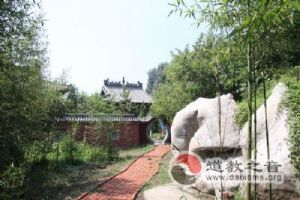
The new Qinghua Cave in Jining began construction in 2003 and took three years to complete. It is now open to the public. The new Qinghua Cave was designed entirely based on the structure and layout of the original, and is located within the Luming Mountain Villa in Rencheng District’s Nianlipu Town, covering an area of 8 mu. From south to north, the layout includes a single-eave main gate, with the Qinghua Cave stone plaque inscribed by calligrapher Master Cheng Baoyuan. On either side of the gate, red walls with blue tiles bear the inscriptions “Tao follows nature” and “Boundless Heavenly Worthy.” Inside the gate are door gods on both sides, above which hangs a plaque reading “Cave Heaven and Blessed Land.” To the east are three rooms for guest reception, and to the west, three rooms for the vegetarian kitchen. Crossing a small bridge, the central feature is the double-eave mounting platform Xiaoyingzhou, surrounded by a pool. To the east stands a stone pagoda. After crossing the bridge lies the main hall, the Chunyang Hall, with a plaque inscribed by Huang Xinyang, Vice President of the China Taoist Association. Inside is a statue of Lüzu. To the east and west are the “Tiangen” and “Yueyao” halls. Behind the Chunyang Hall is an artificial hill containing a stone chamber that forms Qinghua Cave, housing a statue of the Supreme Old Lord. To the west of the hill are two sister pavilions named “Mingde” and “Xuanjing.” To the east is an ancestral hall, and behind the hill is a two-story building called the Scripture Depository, with a plaque inscribed by calligrapher Du Huaiyi. The surrounding vegetation is lush, dominated by pines and bamboos, complemented by ginkgos and large-leaved privets. The entire architectural complex was constructed to replicate the original landscape, exuding an antique charm and embodying the Taoist cultural philosophy of “tranquility.” The rear Luming Mountain Villa is designed in the style of a Suzhou garden, featuring shaded trees, pavilions, flowing springs, waterfalls, birdsong, and floral scents—creating a veritable paradise that serves as an ideal place for Taoist practitioners to cultivate themselves and for the general public to visit and relax.
Source: Shandong Provincial Tourism Development Commission
Share
This article is published by HowToTrip. Sharing and reposting are welcome — please credit the source.
Article URL: https://www.howtotrip.net/travel-16779
Related Articles
- Shaoxing's "Grandpa Gourd" hangs the gourds back up: "If there are too many people, we'll interact less — just take a quick look from afar"
- Chinese authorities announce "reciprocal adjustment" to Japan visa fees — single-entry visa jumps from 2,250 to 16,750 yen!
- The "health stones" carried by a traveler were found to have radiation levels exceeding safety limits by a thousand times, potentially endangering fellow passengers on the same flight. Customs issues warning!
- Shenzhen Airport Issues Late-Night Notice: Unidentified Aerial Object Detected, Causing Widespread Flight Delays!
- “They only said it cost money after I opened the box and washed it!” 200g of grapes sold for 60 yuan on a high-speed train—12306 responds!
- Can't buy an airline ticket? Denied exit? Blocked from boarding? A large number of Chinese tourists have mysteriously become "discredited individuals"
- Adverse weather and economic fluctuations impact Colombia's coffee market
- Beach bathing area responds to 2 yuan/30 seconds fee for freshwater foot rinsing: Clearly priced!
- Taking off with an improperly closed cabin door? Wing malfunction? Multiple flights made emergency returns mid-journey!
- Experience the gifts of nature! A countdown of the world’s ten most stunning coastlines