Dangtu Lingyun Pagoda
Dangtu Lingyun Pagoda
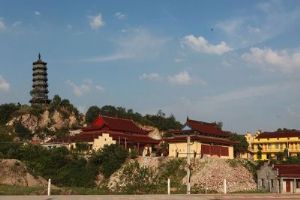
Restoring Lingyun Pagoda has been a long-cherished wish of the people of Dangtu. The “three pagodas and two floating bridges” are not only a testament to Dangtu’s long history but also a source of pride for its residents. On the outskirts of an ancient city, three historic pagodas standing in a triad around the town is a rare sight not only in Anhui but across the whole country. In the early Qing Dynasty, Johan Nieuhof, a member of the Dutch embassy to China, featured the three pagodas as the iconic symbols of Taiping Prefecture in his book *An Embassy from the East-India Company of the United Provinces, to the Grand Tartar Cham, Emperour of China*. Rebuilding Lingyun Pagoda will restore the grandeur of Dangtu County’s “three pagodas standing as a celestial triad.”
The reconstruction of Lingyun Pagoda was officially approved by the county’s Development and Reform Commission in August 2009. Professor Fang Xianda, an expert in ancient architecture from the province, was invited to design the pagoda in the style of Ming Dynasty architecture. After gathering opinions from various experts, the construction design was carried out by Ma’anshan Huihua Architectural Design Co., Ltd. The project owner was the Bureau of Culture, Sports, Radio, Television, News and Publication; the contractor was Anhui Landscape Construction Co., Ltd.; and the supervision was handled by Gushu Engineering Consulting Co., Ltd. The entire reconstruction project commenced in November 2009 and was completed in January 2011, spanning 14 months. The pagoda adopts the architectural style of the Ming Dynasty; it has seven stories and an octagonal shape; it is a reinforced concrete structure imitating wooden pavilion-style architecture; it features internal staircases that allow access to all seven floors, along with external corridors; the total height is 35.4 meters, offering panoramic views around the pagoda. The total investment was approximately 2.6 million yuan.
Share
This article is published by HowToTrip. Sharing and reposting are welcome — please credit the source.
Article URL: https://www.howtotrip.net/travel-16687
Related Articles
- Shaoxing's "Grandpa Gourd" hangs the gourds back up: "If there are too many people, we'll interact less — just take a quick look from afar"
- Chinese authorities announce "reciprocal adjustment" to Japan visa fees — single-entry visa jumps from 2,250 to 16,750 yen!
- The "health stones" carried by a traveler were found to have radiation levels exceeding safety limits by a thousand times, potentially endangering fellow passengers on the same flight. Customs issues warning!
- Shenzhen Airport Issues Late-Night Notice: Unidentified Aerial Object Detected, Causing Widespread Flight Delays!
- “They only said it cost money after I opened the box and washed it!” 200g of grapes sold for 60 yuan on a high-speed train—12306 responds!
- Can't buy an airline ticket? Denied exit? Blocked from boarding? A large number of Chinese tourists have mysteriously become "discredited individuals"
- Adverse weather and economic fluctuations impact Colombia's coffee market
- Beach bathing area responds to 2 yuan/30 seconds fee for freshwater foot rinsing: Clearly priced!
- Taking off with an improperly closed cabin door? Wing malfunction? Multiple flights made emergency returns mid-journey!
- Experience the gifts of nature! A countdown of the world’s ten most stunning coastlines