Leishan Scenic Area
Leishan Scenic Area

Long ago, this place was not called Leishan. At the summit of the eastern peak, a stone bamboo shoot suddenly sprouted, growing three feet by day and ten feet by night, piercing the clouds as if trying to rival the heavens. This alarmed the celestial soldiers, who reported it to the Jade Emperor. The Jade Emperor ordered the bamboo shoot to be cut down, but it continued to grow taller and taller. Enraged, the Jade Emperor then commanded the Thunder God to strike it with lightning. After being struck, only the “tip of the stone bamboo shoot” remained.
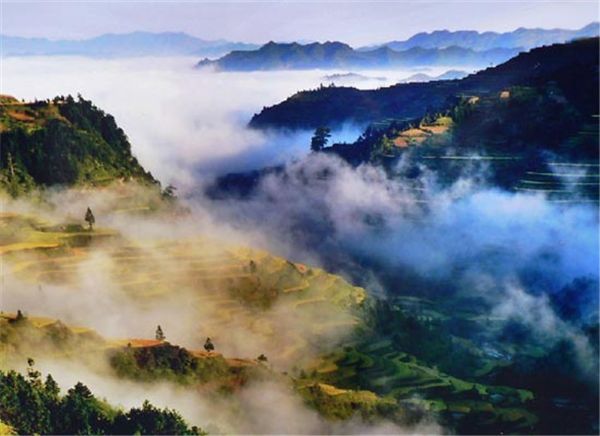
Because Leishan was struck by thunder, it came to be known as “Leishan” (Thunder Mountain). As early as the Ming Dynasty, Yuan Hongdao left verses praising Leishan: “Peak upon peak adorned with snow, winding waters cold and blue.” Leishan is a magnificent landscape painting, a magical stone city. Pagodas, pavilions, towers, temples, and hundreds of acres of bamboo groves dot the area, along with wondrous stone formations such as the Stone Pine, Stone City, Stone Bed, Stone House, Stone Waves, and Stone Beasts—each a marvel of nature, exquisitely formed.
Scenery of Xiaoleishan
The undulating Xiaoleishan is famed for its exquisite stone landscapes. Nature’s masterful craftsmanship has sculpted it into diverse forms, each with a unique charm. Xiaoleishan captivates with its distinctive brilliance and enchanting beauty. Following the stones is both an exploration and a pursuit, evoking a sense of grandeur and inspiration, leaving memories to last a lifetime. Stones can illuminate the soul;
Stones can cultivate one’s temperament. Xiaoleishan embodies the essence of stone culture. Not only are its stone landscapes unparalleled, but the land is also blessed with outstanding people and a rich literary tradition. Renowned figures such as Wan Zhizhai, known as one of Daye’s “One Sage, Two Immortals, Three Grand Secretaries,” the immortals Iron-Crutch Li and Dongfang Shuo, the Grand Secretaries Yu Bidi, Yu Yujie, Yu Shunming, as well as the Ming Dynasty Wanli-era Prime Minister Lü Tiaoyang, Qing Dynasty Kangxi-era Chancellor Yu Guozhu, and Ming Dynasty Jiajing-era Longevity Chancellor Fang Wanrong, all hailed from Xiaoleishan. Nearby are also the burial sites of famous calligraphers, scholars, and literary figures such as Zhang Yuzhao, imperial censor Ke Jin, Fan Jun, and Xiang Rihong. Modern notable figures include Ke Zhuseng, classmate of [a notable historical figure] and later an official of the Central South Military and Political Committee, his son Ke Yuqiang who became a New Fourth Army division commander, People's Liberation Army Major General Qiao Xinming and his son Qiao Xiaoyang, Vice Chairman of the National People's Congress Standing Committee Legal Affairs Committee, Qiao Taiyang, Deputy Commander of the PLA Air Force Logistics Department; and Generals Huang Weiyi, Yu Zhengdong, and Yu Liangxi, among others, also come from this land. It is a place dense with culture and generations of officials.
Legends of Xiaoleishan
Xiaoleishan, long home to renowned landscapes and great rivers, is rich in myths and legends. It is also a convergence of scenic wonders and a gathering place for heroes and elites.
Leishan Scenic Area’s beautiful scenery (14 photos) is a treasured spot where legends and talents converge. Legends say that historical figures such as Lu Ban, Jiang Ziya, Wei Zheng, Zhang Guolao, Huang Chao, Zhao Kuangyin, Yue Fei, Chen Youliang, Zhu Yuanzhang, Liu Bowen, Yuan Hongdao, Wu Guolun, Li Zicheng, Zhang Xianzhong, Yu Guozhu, Ke Jin, Lin Zexu, [a notable historical figure], and Zhang Tixue left their traces here. Countless poetic masterpieces have been composed in praise of Xiaoleishan’s stone landscapes, with the Stone City, Stone House, Stone Bed, Stone Waves, Stone Coffin, Stone Lion, Stone Pine, and Stone Bamboo Shoots frequently celebrated. Xiaoleishan is a unique city of peculiar rocks, a beautiful landscape painting, and a flowing, timeless poem of mountains and waters.
Xiaoleishan’s fame stems from its people, and where the land shines, prosperity follows. Thus, developing and constructing the Xiaoleishan tourist area has become an urgent aspiration of Daye, especially the people of Xiaoleishan. Xiaoleishan boasts both majestic natural scenery and a long, splendid cultural heritage, with potential for many uniquely designed artificial landscapes. Scenic spots are scattered like stars, with ancient trees, secluded caves, rare springs, and natural rock formations. Its folk customs are mysterious and colorful, and its bronze culture is profound. Known since ancient times as the Land of Mining and Metallurgy, ChenGui Town’s successive Party committees and governments have had the vision to transform abundant tourism resources into sustainable industries, establishing a comprehensive service system covering food, accommodation, transportation, sightseeing, entertainment, and shopping. This has yielded four major benefits: recreation, economy, society, and ecology. Leveraging the mining industry, they are developing great tourism.
Main Attractions of Xiaoleishan
Dragon and Phoenix Pool: Legend says that long ago, there were two wealthy families at the foot of the mountain. The man was named Yu Long, and the woman was named Lü Feng. They were childhood sweethearts from well-matched families. Later, the man’s family fell on hard times, and the woman’s parents demanded the engagement be broken off. Yu Long and Lü Feng pledged eternal love, defying all odds, and often met secretly in the secluded areas of Leishan. Eventually discovered by the woman’s servants, with no way out, the man died by crashing into a rock, and the woman jumped off a cliff. This devoted couple could not become intertwined branches in life, but in death, they became birds flying wing to wing. The local villagers wept and lamented for them. To commemorate their love, the pool where they often met was named “Dragon and Phoenix Pool.” Observation Deck: Also known as the Big Stone Drum. Climbing to the deck brings a refreshing and open-hearted feeling. During the Ming Dynasty’s Wanli era, the famous Gong’an Seven Masters poet Yuan Hongdao visited here and left verses praising Leishan: “Even more splendid is Great Leishan, its high peaks surrounded by water, each peak touched with snow, every winding stream cold and blue. I’ve seen it before, but now it looks like a painting from the Jade Realm.” Since then, “Leishan Adorned with Snow” has become one of Daye’s Eight Scenic Spots. Stone Bamboo Shoot Summit Stone: Legend says a giant rock once pressed down on a toad, keeping it in darkness for years. The stone bamboo shoot, unable to bear the sight, lifted the boulder, saving the toad. To repay the kindness, the toad stayed by the bamboo shoot’s side ever since. Pigsy Guards the Heavenly Gate: Passing through this heavenly gate leads to paradise. Legend says one can become immortal by crossing it. Why is Pigsy guarding this gate? It’s said that when Tang Sanzang and his disciples retrieved the Buddhist scriptures from the West and were to deposit them at Tiantai Mountain in Zhejiang, Pigsy, being lazy, took a shortcut and delivered them to Tiantai Mountain in ChenGui Town instead. Upon learning this, Tang Sanzang banished Pigsy to guard the heavenly gate here. Ancient Teachings Hall: Located in the Fangguang Cave of Leishan, the Ancient Teachings Hall is a traditional educational site. In front of the hall stand nine dragon pillars surrounded by a reflection of the Heavenly Pool. Inside are three main halls: the Confucius Hall, the Duke of Zhou Hall, and the Emperor Shun Hall. Towering pines and cypresses shade the halls, while hundred-step cloud ladders connect them. Surrounded by mist, the view is spectacular. Corridors on either side lead directly to the mountaintop and connect with the Leifeng Pagoda. Strolling along the corridors and entering the halls offers enlightenment from historical figures; ascending the pagoda provides sweeping views of the land, delighting the eyes and lifting the spirit.
Leishan Hot Spring Resort
The Daye Leishan Hot Spring Resort is located within the Leishan Scenic Area, famous for its stone landscapes and bamboo forests. Invested with 1.05 billion yuan by Guangdong Yuexiang Garments Co., Ltd., it is built around a mining and metallurgy culture theme and offers a 5A-level green hot spring resort integrating hot springs, dining, guest rooms, and entertainment. With an operating area of 120,000 square meters and a maximum daily capacity of 5,000 visitors, it is the only five-star hot spring resort in the Huangshi region and hosted the main venue of the 2011 Hubei Province New Rural Construction and Urban-Rural Integration Pilot Work Conference. The hot spring water comes from the geothermal waters deep in the valley of Xiaoleishan, a rare mineral spring—rare in the world, scarce in China—crystal clear, colorless, odorless, rich in over 50 trace elements beneficial to health such as calcium, zinc, selenium, sodium, magnesium, iodine, and radon. It has special therapeutic effects on regulating cardiovascular health, treating arthritis and stomach diseases, and improving sleep. The hot spring water temperature exceeds 56 degrees Celsius, making it an extremely rare 100% natural radon mineral spring.
Daquangou Scenic Area
Daquangou is about 10 li (5 km) long, surrounded by 14 natural villages with a population of 2,500. Year-round, its streams meander, twisting and turning, sometimes gentle, sometimes steep, forming a variety of spring-fed waterfalls. Like jade emerging from green hills or a fairy weaving brocade, features like “Rolling Oil Pot,” “Loach Back,” “Dragon Pool Moon Reflection,” and “Yellow Ox Spring” are strikingly lifelike. Walking through it, the sounds of springs, birds, and rustling woods blend into a harmonious symphony, a masterpiece of nature that inspires awe. The mingling sounds of springs, birdsong, and forest whispers create a heavenly atmosphere, refreshing the mind and lifting the spirit.
Daquangou boasts countless scenic spots. The mirror-like Shilingwu Reservoir, the historic Lotus Nunnery, and the mysterious Kechen Mountain, Turtle Mound, Fox Fairy Ridge, Eagle Rock Cave, Dagandong, Xiaogandong, and Longdong. Among them, the cliffside cliff inscriptions at “Wangyan Pavilion” on Kechen Mountain are well preserved. Inscriptions such as “A stone left in the human realm remains carefree for a thousand autumns; a spirit wandering beyond sees all worries vanish,” “Lift your head to see another world; open your eyes to take in lake and mountain,” and “Don’t look back yet” are bold and powerful, standing vividly in view. Daquangou, with its wondrous mountains, beautiful waters, lovely springs, and serene valleys, is hailed as Huangshi’s “Jiuzhaigou.”
Tiantai Mountain Scenic Area
Located 11 kilometers southwest of Daye City in ChenGui Town, Tiantai Mountain boasts beautiful scenery and a long history. It is a pristine, beautiful, and magical land awaiting development. Daye plans to invest heavily to transform Tiantai Mountain into a comprehensive scenic area integrating ecological landscapes, Buddhist culture, and red tourism, making it part of Daye’s red tourism initiatives, with an initial investment of ten billion yuan over the first three years. On September 3, 2011, Li Na, daughter of the late founding leader Chairman Mao Zedong, ascended Tiantai Mountain, which stands 580 meters above sea level, to attend the groundbreaking ceremony for the Great Buddha’s Hall—the first project of Tiantai Mountain’s tourism development—kicking off the ten-billion-yuan project to create the Tiantai Buddhist Kingdom Scenic Area.
Share
This article is published by HowToTrip. Sharing and reposting are welcome — please credit the source.
Article URL: https://www.howtotrip.net/travel-14306
Related Articles
- Shaoxing's "Grandpa Gourd" hangs the gourds back up: "If there are too many people, we'll interact less — just take a quick look from afar"
- Chinese authorities announce "reciprocal adjustment" to Japan visa fees — single-entry visa jumps from 2,250 to 16,750 yen!
- The "health stones" carried by a traveler were found to have radiation levels exceeding safety limits by a thousand times, potentially endangering fellow passengers on the same flight. Customs issues warning!
- Shenzhen Airport Issues Late-Night Notice: Unidentified Aerial Object Detected, Causing Widespread Flight Delays!
- “They only said it cost money after I opened the box and washed it!” 200g of grapes sold for 60 yuan on a high-speed train—12306 responds!
- Can't buy an airline ticket? Denied exit? Blocked from boarding? A large number of Chinese tourists have mysteriously become "discredited individuals"
- Adverse weather and economic fluctuations impact Colombia's coffee market
- Beach bathing area responds to 2 yuan/30 seconds fee for freshwater foot rinsing: Clearly priced!
- Taking off with an improperly closed cabin door? Wing malfunction? Multiple flights made emergency returns mid-journey!
- Experience the gifts of nature! A countdown of the world’s ten most stunning coastlines