Shuidonggou Tourist Area
Shuidonggou Tourist Area

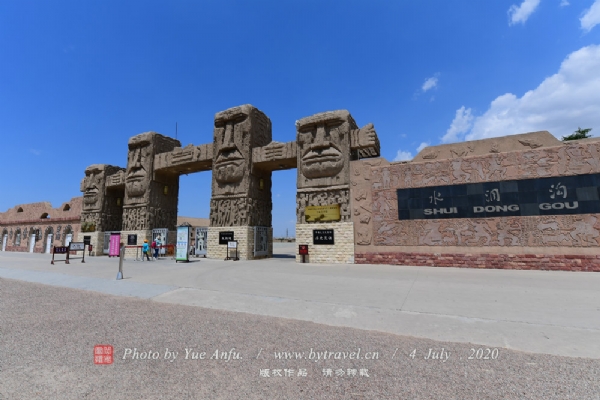
The Shuidonggou Site records the history of ancient humans thriving and battling nature, containing rich and precious prehistoric materials. It showcases the survival story of ancient humans from 30,000 years ago and is the only formally excavated Paleolithic site in China’s Yellow River region to date. Over 80 years and six archaeological excavations, more than 30,000 stone tools and 67 ancient animal fossils have been unearthed at Shuidonggou. Some of the stone artifacts, tools, and stone tool-making techniques foundational to Shuidonggou culture are comparable to those found in European, West Asian, and North African Mousterian and Aurignacian habitation sites. Notably, a large number of Levallois stone cores resemble those from Europe’s ancient Aurignacian culture. Foreign archaeology experts attribute this cultural similarity across distant regions to the “assimilative influence of long-distance human migration.” The culture represented by the Shuidonggou Site plays an important role in explaining the origins of regional stone tool technology traditions, the discovery and variation of ancient cultures, and the migration, diffusion, and interaction of Late Pleistocene humans in Northeast Asia. It holds significant importance for comparative studies of East-West cultures from over 30,000 years ago.
The Shuidonggou area is also a grand showcase of northern China’s Ming Dynasty military defense architecture, including the Great Wall, beacon towers, fortresses, trenches, and watchtowers. Within the protected zone, the meandering eastern stretch of the Great Wall, towering watchtowers, quaint and mysterious fortresses, and winding, deep trenches are a feast for the eyes, evoking visions of the heroic scenes of “armored soldiers charging battle forts with spears, generals drawing swords to chase nomadic troops.”
Located on the southern edge of the Ordos Plateau, Shuidonggou’s naturally formed yardang landforms exude a majestic and peculiar wilderness charm. After millions of years of wind and sand erosion, the area boasts over twenty unique earthen forest landscapes, including Devil’s Town, Camel Ridge, Sky-Scraping Cliff, Broken Cloud Valley, and Strange Willow Gully. These wonders inspire awe and a sense of timeless mystery.
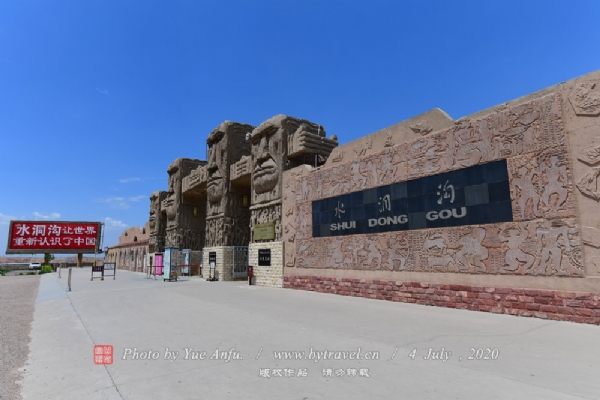
Shuidonggou is China’s earliest excavated Paleolithic cultural site, hailed as the “Birthplace of China’s Prehistoric Archaeology” and “Historical Evidence of East-West Cultural Exchange.” It has been listed by the state as one of the “100 Most Significant Archaeological Discoveries of Chinese Civilization.” It is a Major Historical and Cultural Site Protected at the National Level, a National AAAAA-level Tourist Attraction, and a National Geopark. It was awarded the Silver Prize as one of the “50 Places in China Most Worth Visiting by Foreigners.”
Shuidonggou, as one of the earliest Paleolithic cultural site excavations in China, is acclaimed as "The Birthplace of China's Prehistoric Archeology," "Historical Evidence of Cultural Exchanges between East and West," and was listed as "one of the most significant archaeological discoveries among the 100 Chinese civilization sites." The site is also known as one of the national key cultural relics protection units, a national 4A-level scenic spot, a national geopark, and awarded the Silver Prize as one of the 50 places well worth visiting by foreign tourists.
The unique yardang landforms have magically created over twenty spectacular landscapes such as Devil’s Town, Whirlwind Cave, Camel Ridge, Sky-Scraping Cliff, Broken Cloud Valley, and Strange Willow Gully. These record the continuous traces of human activity over 30,000 years, filling the land with profound and majestic ancient charm. The ancient Great Wall’s three-dimensional military defense system, consisting of the “Hengcheng Border,” beacon towers, city barriers and camps, and hidden troop caves, forms China’s only most completely preserved military defense architectural showcase.
More than 20 spectacles of enormous magnificence that include Ghost Town, Cyclone Cave, Lying Camel Ridge, Ferris Cliff, Cloud-broken Valley, and strange willow Gully were created by the unique Yadan-landform and uncanny workmanship that record the life and growth of human beings continued endlessly, making the land mysterious and vigorous.
The three-dimensional composition of the ancient Great Wall military defense system, composed of the "Cross-City Edge," beacon smoke stations, city barriers and camps, as well as the Ancient-Troop Hiding Cave, contributes to a kaleidoscope of military defensive architectures best preserved in China.
Visit prehistoric sites, view the Great Wall waterfront, traverse earth forest gorges, tour frontier fortress castles, and explore hidden troop caves. A tourist destination longed for by visitors from China and abroad—Shuidonggou.
Viewing the prehistoric sites, sightseeing the Great Wall Waterfront, passing through earth forest gorge, touring frontier fortress castles, and visiting Ancient-Troop Hiding Cave, Chinese and foreign tourists are always yearning for the tourist attraction—Shuidonggou.
Shuidonggou is China’s earliest excavated Paleolithic site, a Major Historical and Cultural Site Protected at the National Level, a National AAAAA-level Scenic Area, and a National Geopark. It is hailed as the “Birthplace of China’s Prehistoric Archaeology” and “Historical Evidence of East-West Cultural Exchange.” It has been listed by the state as one of the 100 major national cultural relic protection sites. It has also been jointly selected by National Geographic and Chinese Heritage magazines as one of China’s “100 Most Significant Archaeological Discoveries of Chinese Civilization.” Shuidonggou is also a grand showcase of China’s Ming Dynasty military defense architecture, including the Great Wall, beacon towers, fortresses, trenches, hidden troop caves, grand canyons, and watchtowers. It currently represents China’s only most completely preserved three-dimensional Great Wall military defense system.
Shuidonggou is 19 kilometers from Yinchuan, the provincial capital, and just a 15-minute drive from the airport. The Yinchuan-Qingdao Expressway and its auxiliary road run through the scenic area, providing convenient transportation and the advantage of being close to the city yet away from the hustle and bustle. Many visitors say that after traveling all over the country, it is Ningxia’s Shuidonggou that left them in awe—it’s truly a magical place, with a unique scene at every step, ranging from primitive, simple purity to desolate, eerie solitude, or beauty, tranquility, leisure, remoteness, and serenity, or ruggedness, wonder, mystery, and thrill. Even Du Yili, Deputy Director of the National Tourism Administration, remarked after visiting Shuidonggou: “I heard Shuidonggou is a cultural site, but I never expected ‘every step has a highlight, every corner has a thrill.’ The beauty of Shuidonggou may seem naturally unadorned, but it actually involves a lot of thought and wisdom, emphasizing harmony with the surrounding landscape—both beautiful and rustic.” To create an ancient atmosphere, the color tones of Shuidonggou’s architecture consist of varying shades of earthy, stony, and wooden hues. The bridges in Shuidonggou are stone-and-wood arch bridges and small wooden bridges with flowing water, together with the blue sky, light clouds, clear water, cliffs, reeds, mandarin ducks, and wild ducks, forming a serene and idyllic paradise.
If culture is the soul of Shuidonggou, then innovation is the driving force behind its development. There are many heritage-type scenic areas across the country, but only Shuidonggou integrates artistic, literary, and high-tech innovative elements on top of the traditional museum experience. The Shuidonggou Site Museum uses 270-degree ultra-large semi-scene paintings, live-action settings, and holographic imaging displays, combined with cutting-edge sound, light, electricity, and adjustable earthquake platforms, to authentically recreate the harmonious fishing and hunting life of ancient humans 30,000 years ago, their stone tool-making, as well as dramatic disaster scenes like torrential rain, floods, and earthquakes. The beauty and realism of these scenes are awe-inspiring, and the artistic concepts quickly immerse visitors into the living environment of 30,000 years ago. Though 30,000 years is a long time ago, at the Shuidonggou Museum, time is no longer a barrier—high technology lets you instantly travel back 30,000 years. It pioneers a new form of museum exhibition in China and is currently the only and largest indoor interactive dynamic experience exhibition hall in the country, becoming a major highlight of Shuidonggou.
The magic of Shuidonggou also lies in it being not only a place where ancient humans thrived 30,000 years ago but also an important military defense stronghold of China’s Ming Dynasty frontier. There are many places with the Great Wall in China, but only Shuidonggou features a three-dimensional military defense system composed of the Great Wall, trenches, fortresses, a steep grand canyon, and hidden troop caves carved along the canyon cliffs. The hidden troop caves spread across the entire canyon cliff are grand in scale and ingeniously designed, with complete facilities inside including tunnels, traps, hidden weapons, watchtowers, armories, wells, generals’ rest rooms, meeting halls, kitchens, and more. Here, you can experience firsthand the thrill and excitement of Ming Dynasty tunnel warfare, and witness up close the cruelty of war and the ingenuity of Ming Dynasty defenders, greatly satisfying visitors' curiosity and thirst for knowledge. It has become another major highlight of Shuidonggou.
The transportation in Shuidonggou is also quite distinctive—tourist boats, donkey carts, and camel carts offer a very relaxing experience. When you visit Shuidonggou, you’ll forget the noise of the city and the clutter of the mind, letting time just flow by. Beautiful, bright, serene, leisurely, remote, tranquil, and harmonious, Shuidonggou—beyond the city and the countryside—is absolutely a perfect leisure tourism destination for visitors to unwind and enjoy freedom. One scenic area in half a day takes you from 30,000 years ago to 500 years ago; from prehistoric culture to frontier military culture; from earth forest landscapes to high gorge and calm lake views; from desert frontiers to the delicate beauty of the south—it’s nothing short of magical.
Address: Linghe Town, Lingwu City, Yinchuan
Type: Cave · Historic Site · Museum · Military
Rating: AAAAA
Recommended Visit Duration: 2–4 days
Phone: 0951-5014338
Official Website: http://www.shuidonggou.com/
Opening Hours:
8:00–18:00
Ticket Information:
Does not include live experience, boat rides, horse-drawn carts (or bamboo rafts), camel carts, hidden troop caves, or sightseeing vehicles (East Gate–South Gate).
Information source: Yinchuan Municipal Government Portal
Share
This article is published by HowToTrip. Sharing and reposting are welcome — please credit the source.
Article URL: https://www.howtotrip.net/travel-14265
Related Articles
- Shaoxing's "Grandpa Gourd" hangs the gourds back up: "If there are too many people, we'll interact less — just take a quick look from afar"
- Chinese authorities announce "reciprocal adjustment" to Japan visa fees — single-entry visa jumps from 2,250 to 16,750 yen!
- The "health stones" carried by a traveler were found to have radiation levels exceeding safety limits by a thousand times, potentially endangering fellow passengers on the same flight. Customs issues warning!
- Shenzhen Airport Issues Late-Night Notice: Unidentified Aerial Object Detected, Causing Widespread Flight Delays!
- “They only said it cost money after I opened the box and washed it!” 200g of grapes sold for 60 yuan on a high-speed train—12306 responds!
- Can't buy an airline ticket? Denied exit? Blocked from boarding? A large number of Chinese tourists have mysteriously become "discredited individuals"
- Adverse weather and economic fluctuations impact Colombia's coffee market
- Beach bathing area responds to 2 yuan/30 seconds fee for freshwater foot rinsing: Clearly priced!
- Taking off with an improperly closed cabin door? Wing malfunction? Multiple flights made emergency returns mid-journey!
- Experience the gifts of nature! A countdown of the world’s ten most stunning coastlines