Hu Shi's Former Residence
Hu Shi's Former Residence

The front courtyard has a patio, with side rooms on both sides. The upper floor features a “looping corridor,” while the ground floor serves as the main hall. The rear section is an inner courtyard enclosed by railings and carved partitions, exquisitely detailed. A pair of lotus fairies on the beam brackets are vividly lifelike, and the doors and windows are decorated with orchid-carved panels crafted by Hu Guobin, a master mold-maker from the Hu Kaiwen Ink Shop. These elements reflect Hu Shi’s deep nostalgia expressed in his line, “I come from the mountains, bringing orchids with me,” and his distinctive style. This part has been converted into a nunnery.
Hung above the main gate and the central hall are two plaques inscribed with “Hu Shi’s Former Residence,” one vertical and one horizontal, both with gold characters on a black background, personally penned by the renowned Chinese calligrapher Sha Menghai. The interior of the hall remains arranged as it was originally. Below the black plaque with gold characters reading “Hu Shi’s Former Residence” at the entrance hangs a mid-life portrait of Hu Shi, flanked by a couplet: “Traveled ten thousand miles across half the world, with eyes above all under heaven.” Tea tables and armchairs are placed along the east and west walls, and family charts of Hu Shi’s immediate relatives are displayed on the walls.
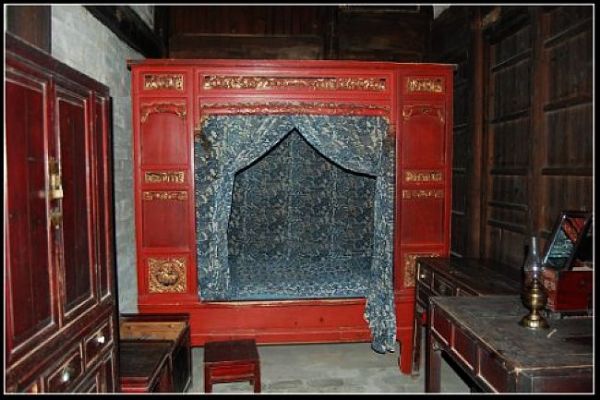
In the room where Mr. Hu Shi got married, the western section was the bridal chamber shared by Hu Shi and Jiang Dongxiu. It contains wooden beds, tables, chairs, cabinets, stools, and more. Notably, there is an elaborately carved “moon palace bed” painted red and gilded, luxurious and elegant, featuring intricate Huizhou-style carvings of operatic scenes and flowers and birds. Above the headboard is a small red lacquered box inscribed with the characters “Imperial Edict,” a relic of Hu Shi’s father, Hu Tiehua. To the right of the bed also hangs a seven-star sword that Hu Tiehua once wore.
The front side room was where Hu Shi studied in his childhood. The eastern room and connected side room were used by Hu Jue (Hu Shi’s second elder brother). The main hall and central side rooms display manuscripts handwritten by members of the Hu family, some of Hu Shi’s works, the Hu family genealogy, calligraphy and paintings gifted by distinguished figures from home and abroad, poetry, and group photos of the Hu family. The rear hall is relatively shallow, with a portrait of Hu Shi’s father, Tiehua, hanging at the front. On the east side is a photo of Hu Shi’s birth mother, Feng Shundi. Above it hangs a large red plaque with gold characters reading “Upholding Integrity and Demonstrating Authority,” written by Cheng Dongping from the county and inscribed with the dedication: “Presented by Zhu Yayun, Magistrate of Jixi County, in the 31st Year of the Republic of China.” The residence features 12 floor-to-ceiling partition doors with engraved orchid designs and four window lattice panels with floral patterns and inscriptions, crafted by master mold-maker Hu Guobin.
The residence also displays photos of Hu Shi from various periods, a vertical scroll of his handwritten essay “The Doctrine of Annihilation of Spirits” by Fan Zhen, a hat stand gifted to Hu Tiehua by Zhang Zhidong, Hu Tiehua’s seven-star sword, the imperial edict box, and a conch shell brought back from Taiwan. The side rooms exhibit Hu Shi’s family letters, along with many calligraphy and paintings dedicated by modern celebrities.
Passing through the central hall leads to the rear hall, separated by a small patio. A small hall here displays a large red plaque with gold characters reading “Upholding Integrity and Demonstrating Authority.” It was gifted by the Nationalist Government when Hu Shi served as the Ambassador to the United States.
Hu Shi (1891~1962) Hu Shi (December 17, 1891 – February 24, 1962), of Han ethnicity, was a native of Shangzhuang Village, Jixi, Anhui. He was a renowned modern scholar, poet, historian, litterateur, and philosopher. As an advocate for literary reform, he became one of the leaders of the New Culture Movement. Originally named Sizi, his formal name was Hongshi, and his courtesy name was Xijiang, later changed to Hu Shi, with the courtesy name Shizhi. His pen names included Tianfeng and Canghui. The courtesy names Shizhi and Shizhi were derived from the then-popular Darwinian idea of “survival of the fittest.” Hu Shi began his education at age five, receiving nine years of private schooling in his hometown of Jixi, laying a foundation in classical Chinese. In his early years, he attended... More +
Share
This article is published by HowToTrip. Sharing and reposting are welcome — please credit the source.
Article URL: https://www.howtotrip.net/travel-13903
Related Articles
- Shaoxing's "Grandpa Gourd" hangs the gourds back up: "If there are too many people, we'll interact less — just take a quick look from afar"
- Chinese authorities announce "reciprocal adjustment" to Japan visa fees — single-entry visa jumps from 2,250 to 16,750 yen!
- The "health stones" carried by a traveler were found to have radiation levels exceeding safety limits by a thousand times, potentially endangering fellow passengers on the same flight. Customs issues warning!
- Shenzhen Airport Issues Late-Night Notice: Unidentified Aerial Object Detected, Causing Widespread Flight Delays!
- “They only said it cost money after I opened the box and washed it!” 200g of grapes sold for 60 yuan on a high-speed train—12306 responds!
- Can't buy an airline ticket? Denied exit? Blocked from boarding? A large number of Chinese tourists have mysteriously become "discredited individuals"
- Adverse weather and economic fluctuations impact Colombia's coffee market
- Beach bathing area responds to 2 yuan/30 seconds fee for freshwater foot rinsing: Clearly priced!
- Taking off with an improperly closed cabin door? Wing malfunction? Multiple flights made emergency returns mid-journey!
- Experience the gifts of nature! A countdown of the world’s ten most stunning coastlines