Belize
The only country in Central America with English as its official language, known for its ecological wonders including the Great Blue Hole, the world’s second-largest barrier reef, and ancient Maya ruins.
Belize
| Capital | Belmopan |
|---|---|
| Continent | North America |
| Languages | English |
| Currency | Belize dollar (BZD BZ$) |
| Time Zone | UTC-6 |
| Dialling Code | +501 |
| Area / Population | Approximately 23,000 square kilometers / Approximately 410,000 |
| Visa | Most foreign visitors need a visa to enter Belize; travelers holding valid multiple-entry visas for the United States, Canada, or the Schengen Area may typically enter visa-free for up to 30 days. Visa policies are subject to change—please check with the Belize Immigration Department before traveling. |
| Best Season | The dry season from November to April is ideal for diving and visiting archaeological sites; the rainy season from May to November is hot and humid, with the hurricane season lasting from June to November. |
| Main Cities | Belize City, San Pedro (Ambergris Caye), Caye Caulker, San Ignacio (Cayo District), Dangriga, Placencia, Punta Gorda |
Belize in Detail
Overview of Belize
Belize is located on the eastern coast of Central America, bordered by Mexico’s Yucatán Peninsula to the north, Guatemala to the west and south, and the Caribbean Sea to the east. With a land area of about 23,000 square kilometers and a population of just around 410,000, it is the least populous and most sparsely populated country in Central America. Its constitutional capital is the inland town of Belmopan, while the economic and transportation hub is the coastal city of Belize City. Belize is the only country in Central America where English is the official language, though Spanish, Creole, and Garifuna are also widely spoken, giving the country a cultural blend of Caribbean and Latin American influences.
Belize gained independence from Britain in 1981 and is a member of the Commonwealth, operating under a parliamentary system. Eco-tourism and marine vacations are the backbone of its economy, with tourism revenue consistently ranking among the top sources of foreign exchange.
Geography and Climate
Belize’s terrain is generally higher in the southwest and lower in the northeast: the interior consists of Maya Mountain hills and tropical rainforest, with the highest peak, Victoria Peak, reaching about 1,122 meters; the coastal area features mangrove plains and lagoons; and there are approximately 450 coral cays scattered offshore. The Belize Barrier Reef, the world’s second-largest, stretches about 300 kilometers and, along with the famous deep blue holes nearby, has been designated a UNESCO World Heritage Site. The country also has an extensive cave system, especially in the limestone regions of the south and west, offering unique experiences like cave tubing.
The climate is a transitional type between tropical rainforest and savanna, with an average annual temperature of 25–28°C. The dry season from November to April offers clear skies and calm seas, making it the best time to visit. The rainy season from June to November coincides with hurricane season, and inland roads can be affected by heavy rain. Mosquitoes and sun protection are year-round concerns.
Historical Background
Belize was a core area of the ancient Maya civilization, with over 600 known Maya sites within its borders. In the 7th century, Caracol in the southern mountains was a major city-state with a population of tens of thousands, rivaling Tikal. Its Caana pyramid remains the tallest man-made structure in Belize. The western site of Xunantunich features exquisite stone-carved friezes. Although the Spanish arrived in the 16th century, they never established effective control. From the 17th century, British loggers ventured inland along rivers to harvest mahogany and logwood—the name “Belize” is derived from the logwood dye trade. In 1862, Britain formally established British Honduras, which was renamed Belize in 1973 and gained independence in 1981. Its territorial dispute with Guatemala persisted for years but has gradually eased in recent times.
Economy and Currency
Belize’s economy relies on agriculture (sugarcane, citrus, bananas), fishing (lobster, conch), and tourism, with some offshore oil production in the past. The official currency is the Belize dollar (BZD), which has been pegged at a fixed rate of 2:1 to the U.S. dollar since 1978—meaning 2 Belize dollars equal 1 U.S. dollar. U.S. dollars are widely accepted in tourist areas, making transactions straightforward, but always check whether prices are listed in U.S. dollars or Belize dollars to avoid confusion.
Culture and Society
Belize is a cultural crossroads in Central America, with a diverse society composed of Creoles, Mestizos, Maya, and Garifuna people. Garifuna drumming and dance are recognized as intangible cultural heritage by UNESCO, celebrated nationwide on November 19, Garifuna Settlement Day. Inland villages maintain traditional Maya diets based on corn and beans. The widespread use of English makes Belize the most accessible travel destination in Central America in terms of language. The pace of life is slow, the people are friendly, and Rastafarian culture and reggae music are common in coastal towns.
Tourism Overview
Belize is a global destination for divers and eco-travelers: the Great Blue Hole, a massive marine sinkhole over 300 meters wide and 120 meters deep, is a stunning “blue eye” on the ocean’s surface, best explored by scenic flight or scuba dive. San Pedro on Ambergris Caye and Caye Caulker offer affordable diving and snorkeling, with highlights including shark and ray encounters in Hol Chan Marine Reserve. Inland, the Cayo District allows for climbing at Caracol, river crossings by hand-cranked ferry to visit Xunantunich, and immersive experiences like cave tubing or the famed ATM Cave adventure. The Cockscomb Basin Wildlife Sanctuary in the southeast is Central America’s first jaguar preserve. A typical trip can combine island hopping, rainforest exploration, and Maya ruins, making Belize a unique and rewarding Central American destination.
Local Currency: Belize dollar (BZD)
Currency Overview
The official currency of Belize is the Belize dollar (currency code BZD, symbol BZ$), issued by the Central Bank of Belize. One Belize dollar is equal to 100 cents. Since 1978, the Belize dollar has been fixed at a 2:1 exchange rate with the U.S. dollar (2 BZ$ = 1 USD), a rate that has remained stable for decades, making currency conversion straightforward for travelers. U.S. dollar cash is widely accepted in tourist areas, and many resorts and dive shops quote prices in both U.S. dollars and Belize dollars. The fixed exchange rate provides rare predictability for costs and makes cross-border spending and currency exchange nearly effortless.
Denominations
Paper bills come in denominations of 2, 5, 10, 20, 50, and 100 Belize dollars. Older versions feature Queen Elizabeth II and depict landmarks, birds, and rainforest scenes in Belize City. Newer polymer banknotes highlight native wildlife and cultural heritage, with vibrant colors. Coins are issued in 5, 10, 25, and 50 cents, as well as 1 Belize dollar, featuring the national coat of arms, the Great Blue Hole, and the toucan. The 1-dollar coin is the most commonly used.
Cash and Payment Habits
Hotels, restaurants, and dive shops in Belize City and San Pedro generally accept credit cards, but inland villages, water taxis, local eateries, and street vendors often deal only in cash. ATMs are mainly found in Belize City, San Ignacio, and San Pedro. Withdrawing cash on smaller islands like Caye Caulker can be difficult, so it’s advisable to carry enough U.S. dollar cash. Most merchants add a 3%–5% fee for card transactions, so paying in U.S. dollars is often more economical. Due to the fixed exchange rate, U.S. dollars are usually converted at a 1:2 ratio, with small change often given in Belize dollar coins.
Tips for Travelers
- Remember the 2:1 fixed exchange rate: to convert BZ$ prices to USD, simply divide by 2 to avoid overestimating costs.
- Cash is essential on outlying islands and in small villages—stock up on U.S. dollars and small-denomination Belize dollars in Belize City or San Pedro before heading out.
- Card payments often incur 3%–5% fees; negotiating or using cash can sometimes waive these charges.
- Restaurant tips are around 10%; for dive guides and boatmen, 5–10 USD per outing is appropriate.
Flag Meaning
Flag Design
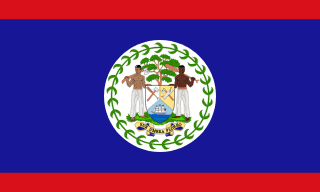
The Belize flag has a 3:2 aspect ratio, with a blue background and thin red stripes along the top and bottom edges. At the center is a white circle containing the Belize coat of arms: beneath a lush mahogany tree, a mixed-race and a Creole logger stand on either side of a shield, each holding an axe. The shield depicts tools of logging and sailing—paddles, hatchets, and saws. Fifty green leaves encircle the circle, and the Latin motto “Sub Umbra Floreo” (“Under the Shade I Flourish”) appears below.
Meaning
The blue color originates from the People’s United Party, which led Belize before independence, symbolizing the sky and sea. The red stripes, adopted from the opposition United Democratic Party, represent unity between the two major political forces and national solidarity. The white circle stands for peace. The coat of arms honors Belize’s long history in the timber industry—timber trade played a crucial role in the nation’s formation. The two loggers of different ethnicities standing together signify a multicultural society working collectively to build the nation.
History and Legal Status
The design of the current Belize flag traces back to the blue party flag of the People’s United Party in the 1950s. Over time, the coat of arms and red stripes were added, and the flag was officially adopted upon independence on September 21, 1981. It is one of the few national flags in the world that still prominently displays a full coat of arms. The proportions and colors are specified in the government gazette and are widely used at government buildings, schools, border crossings, and during Independence Day celebrations. Due to its intricate design, Belizean flags are typically printed, with fine details in the central emblem requiring high-quality printing to remain clearly visible—making it one of the most distinctive flags in Central America.
Belize Travel Guide
All Guides »Belize Travel Quick Guide: Visa, Seasons, Budget & Etiquette
The Only English-Speaking Country in Central America: Visa-Free Entry with U.S.,...
Classic Belize 6-Day Itinerary: San Pedro — Xunantunich — Great Blue Hole — Cave Adventure 6 Days
Island, Maya, and caves all in one trip: start with Caribbean snorkeling, ventur...
Belize 4-Day Itinerary: Island vs Rainforest Highlights 4 Days
Don’t try to do too much in just four days: split your time between the “islands...
Must-visit attractions in Belize: The Great Blue Hole, Barrier Reef, and Maya Ruins
This small country with a population of just 410,000 is home to world-class mari...
Belize Food Guide: Rice and Beans, Fry Jack, and Garifuna Flavors
The Belizean table is a blend of Caribbean and Central American influences: hear...
Complete Guide to Transportation in Belize: Water Taxis, Domestic Small Planes, and Inland Connections
Belize has no railways. Islands are accessed by boat or 15-minute small planes, ...
10 Practical Tips for Traveling in Belize
From exchange rates at 2:1, visa-free entry requirements to gear rules for ATM C...