A dreamy dessert that only lasts 30 minutes—taste water jelly mochi infused with Japanese cherry blossoms!
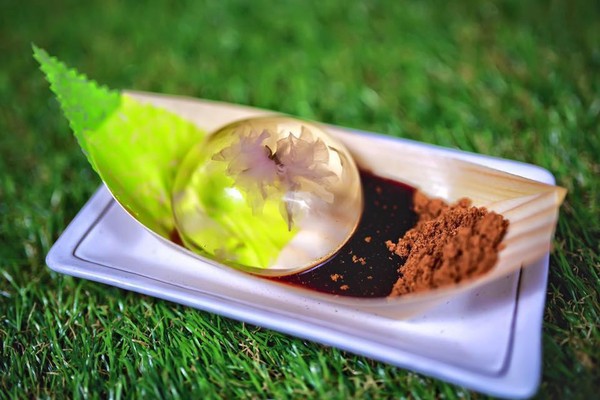
▲Taiwan’s mizu shingen mochi features domestically imported double-petal cherry blossoms, beautifully suspended in the center of the sphere. (Photo provided by Sakura Mizu Shingen Mochi; applies to all following images)
By Li Ziyi, Reporter / Interview & Report
With its magical hues and crystal-clear transparency, Japan’s popular Yamanashi Prefecture dessert “mizu shingen mochi” is now available in Taiwan. The Taiwanese version of this dessert uses imported ingredients from Japan, and its signature flavor includes edible cherry blossom petals. The delicate pink petals are enveloped within the mizu shingen mochi, as if freezing beauty in time—utterly enchanting.
The owner of the dreamy water cake “Sakura Mizu Shingen Mochi,” Mr. Zeng, says the shop offers three products: the signature Sakura Mizu Shingen Mochi, and two original flavors, Snow Taro and Illusionary Butterfly Princess. The Sakura Mizu Shingen Mochi primarily uses agar, an extract derived from seaweed and imported from Japan. The cherry blossom petals inside are also carefully selected—imported pickled “double-petal cherry blossoms” (yaezakura) from Japan—with a salty-sour taste that leaves a sweet aftertaste. Snow Taro is made with fresh milk to create a texture that falls between pudding and cheese. Its snow-white appearance and taro powder base inspired its name. Illusionary Butterfly Princess is made using the currently super-popular “butterfly pea flower.” Leveraging the flower’s natural properties, it presents dreamy shades of blue, purple, and red.
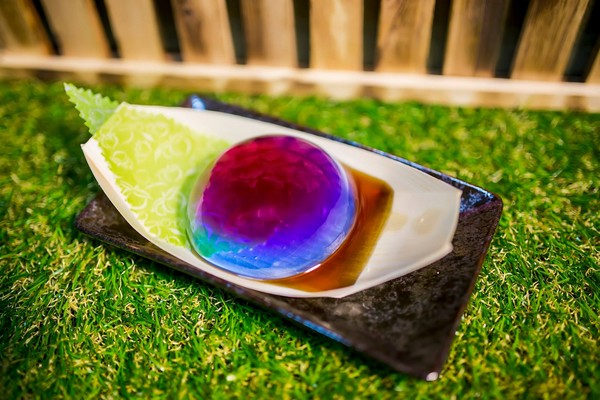
▲The dessert “Illusionary Butterfly Princess,” made from the natural plant butterfly pea flower, displays a psychedelic coloration.
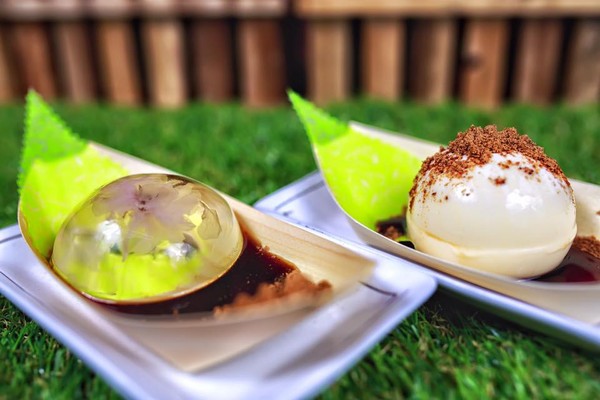
▲Sakura Mizu Shingen Mochi and Snow Taro.
Mr. Zeng, who was already working in the food and beverage industry, happened upon the popular Yamanashi Prefecture dessert mizu shingen mochi in Japan. He then apprenticed under a Japanese chef he knew, visiting nearly every day for about a year before finally being accepted as a disciple and learning how to make the dessert. Mr. Zeng says he also learned the value of “persistence” from the Japanese chef—persistence in doing things well, and the principle that anything he wouldn’t eat himself must never be served to customers. Guided by this belief, even the handmade syrups that accompany the mizu shingen mochi (regular flavors include brown sugar and matcha, with seasonal fruit flavors) are all made in-house.
He begins making the next day’s mizu shingen mochi as soon as the night market closes, often not finishing until 5 or 6 a.m. Depending on the location, he prepares about 100 to 600 pieces a day. Each piece, regardless of flavor, is priced at NT$40. The packaging is also thoughtfully designed, with the mizu shingen mochi served on wooden boat-shaped trays for a traditional Japanese aesthetic. Mr. Zeng especially advises that because the dessert has high water content and starts releasing moisture once removed from the mold, it should ideally be consumed within 30 minutes for the best experience.
Mr. Zeng emphasizes that the water used in mizu shingen mochi is very important, so he specifically uses mountain spring water from Puli. There are three ways to enjoy it:
1. Taste the main body on its own to appreciate its original flavor and the subtle aroma of cherry blossoms.
2. Dip the Sakura Mizu Shingen Mochi in your chosen syrup to enjoy the fragrance brought by various handmade syrups.
3. Dip the Sakura Mizu Shingen Mochi in various handmade syrups along with roasted soybean flour to savor a rich and unique texture.
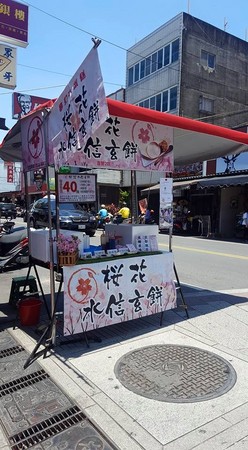
▲Sakura Mizu Shingen Mochi stall.
Dreamy water cake “Sakura Mizu Shingen Mochi” is currently available at stalls in Taichung Yizhong Street, Fengjia Night Market, Changhua Lukang Old Street, Changhua Jincheng Night Market, and Kenting Street. Stall hours vary; check theshop’s official Facebook pagefor details.
Share
This article is published by HowToTrip. Sharing and reposting are welcome — please credit the source.
Article URL: https://www.howtotrip.net/views-6747
Related Articles
- Shaoxing's "Grandpa Gourd" hangs the gourds back up: "If there are too many people, we'll interact less — just take a quick look from afar"
- Chinese authorities announce "reciprocal adjustment" to Japan visa fees — single-entry visa jumps from 2,250 to 16,750 yen!
- The "health stones" carried by a traveler were found to have radiation levels exceeding safety limits by a thousand times, potentially endangering fellow passengers on the same flight. Customs issues warning!
- Shenzhen Airport Issues Late-Night Notice: Unidentified Aerial Object Detected, Causing Widespread Flight Delays!
- “They only said it cost money after I opened the box and washed it!” 200g of grapes sold for 60 yuan on a high-speed train—12306 responds!
- Can't buy an airline ticket? Denied exit? Blocked from boarding? A large number of Chinese tourists have mysteriously become "discredited individuals"
- Adverse weather and economic fluctuations impact Colombia's coffee market
- Beach bathing area responds to 2 yuan/30 seconds fee for freshwater foot rinsing: Clearly priced!
- Taking off with an improperly closed cabin door? Wing malfunction? Multiple flights made emergency returns mid-journey!
- Experience the gifts of nature! A countdown of the world’s ten most stunning coastlines