Taiwan’s Blue Cave Captivates Japan: Penghu’s Xiji Islet “Stove Cage” Like a Lost Fairyland
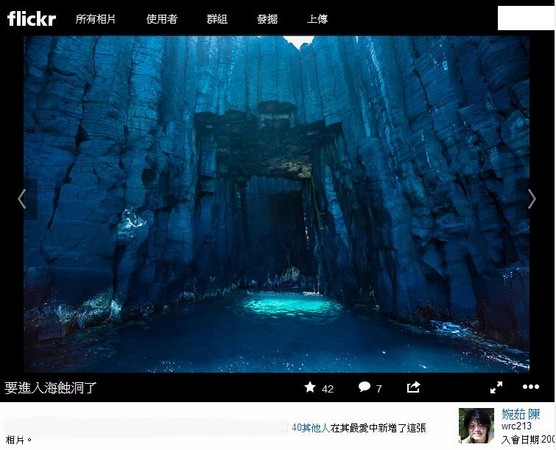
▲ The unique natural beauty of Penghu — Xiji Islet’s “Stove Cage,” a sea cave that seems to lead into an unknown blue world when viewed from the entrance. (Photo / Screenshot fromChen Wan-ru’s Flickr)
Tourism Center / Comprehensive Report
If Penghu’s Dongji Islet is known as the “forgotten island,” then its nearby neighbor, Xiji Islet, could be called Penghu’s “lost fairyland.” Japanese websiteDDN JAPAN, last year (2013), shared a series of beautiful photos of the renowned sea erosion cave “Stove Cage” on Xiji Islet taken by Taiwanese photographerChen Wan-ru (Chen Wan-ru’s Flickr), which amazed Japanese netizens. Many expressed a strong desire to venture there for an adventure, and these photos have recently resurfaced online, sparking lively discussions among Taiwanese netizens.
Xiji Islet’s “Stove Cage” is a one-of-a-kind open-top sea cave in Penghu. As the islet has long been uninhabited, coupled with treacherous sea currents and poor harbor conditions making transportation difficult, its pristine natural landscape has been well preserved. This mysterious site, rarely approached even by locals, is rumored to be haunted due to a serious shipwreck in the past, with frequent tales of ghosts and zombies. Additionally, with the sharp decline in the local population, the entire village was relocated to Dongji and Magong during the 1970s under government arrangement. Nowadays, Xiji Islet is home only to flocks of sheep, numerous snakes, and remnants of wells and residences left behind by former residents—factors that deter even more people from visiting.
But through the photos, azure seawater flows gently between majestic basalt columns, with nature’s force carving out a semi-open, open-top sea cave. Viewed from above, it resembles a blue pearl on the island, crystal clear under the sunlight. From the cave entrance to its center, the surrounding dark basalt pillars reflect the color of the seawater, as if the water is climbing up the basalt, dyeing the rock walls in varying shades of blue. This marvel of nature has captivated many who’ve seen the photos, drawing them into this blue spectacle, with some praising it as Taiwan’s “Blue Hole.”
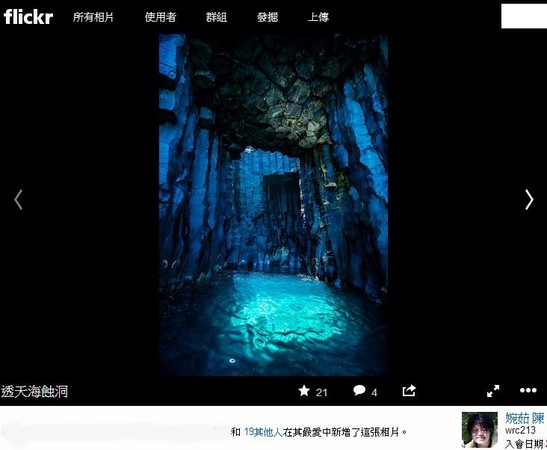
▲ Sunlight showers down from above, as if casting a spell on the seawater, making the already azure water even more transparent. (Photo / Screenshot from Chen Wan-ru’s Flickr)
A netizen from Penghu commented that they had no idea Xiji Islet harbored such beauty, but in light of the recent incident whereShili Beach nearly became the site of a resort hotel construction,some also expressed that although it’s beautiful, it might be better to keep it less known, lest it be spoiled.
This comment garnered much agreement, with many exclaiming, “The government must never find out!” Some netizens recalled the recent heated discussions about the Fourth Nuclear Power Plant, “Didn’t the Minister of Economic Affairs just mention relocating nuclear waste to some uninhabited island? I wonder which one...” Others playfully “spoke kindly” to the island’s ghosts: “If the government ever sends people to leave stuff here, make sure you chase them away!” All hoping that this beautiful scenery can remain untouched by human interference.
>>>>>>> For more stunning photos, visit Chen Wan-ru’s Flickr
Share
This article is published by HowToTrip. Sharing and reposting are welcome — please credit the source.
Article URL: https://www.howtotrip.net/views-23216
Related Articles
- Shaoxing's "Grandpa Gourd" hangs the gourds back up: "If there are too many people, we'll interact less — just take a quick look from afar"
- Chinese authorities announce "reciprocal adjustment" to Japan visa fees — single-entry visa jumps from 2,250 to 16,750 yen!
- The "health stones" carried by a traveler were found to have radiation levels exceeding safety limits by a thousand times, potentially endangering fellow passengers on the same flight. Customs issues warning!
- Shenzhen Airport Issues Late-Night Notice: Unidentified Aerial Object Detected, Causing Widespread Flight Delays!
- “They only said it cost money after I opened the box and washed it!” 200g of grapes sold for 60 yuan on a high-speed train—12306 responds!
- Can't buy an airline ticket? Denied exit? Blocked from boarding? A large number of Chinese tourists have mysteriously become "discredited individuals"
- Adverse weather and economic fluctuations impact Colombia's coffee market
- Beach bathing area responds to 2 yuan/30 seconds fee for freshwater foot rinsing: Clearly priced!
- Taking off with an improperly closed cabin door? Wing malfunction? Multiple flights made emergency returns mid-journey!
- Experience the gifts of nature! A countdown of the world’s ten most stunning coastlines