Humei Village
Humei Village
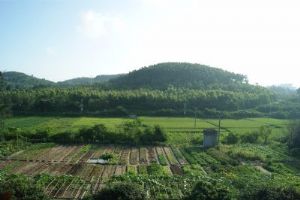
Humei Village in Zhangtang Town is situated along the county’s main Xitong Highway, by the picturesque Jinluan Bay. It encompasses four natural villages with a total population of 2,177 across 550 households. Since last year, leveraging its status as a provincial-level "Beautiful Countryside" model village, the village has focused on its unique cultural resources — including ancient trees, ancient water sources, old wells, ancestral halls, and temples. Guided by the philosophy of "seeing the mountains, viewing the waters, and remembering the nostalgia of home," the village has effectively preserved, protected, and restored these elements. Integrating ancient architecture culture, farming culture, and revolutionary history, over 7 million yuan has been invested in more than 10 supporting infrastructure projects such as roads, public toilets, greening, lighting, and beautification, painting a beautiful picture of rural revitalization.
At the entrance of Xiashanqian Natural Village stands an ancient banyan tree over 200 years old. Towering more than ten meters high with a canopy nearly ten meters wide, its sturdy trunk and twisted roots form three naturally occurring tree gates of varying sizes. These three gates symbolize "prosperity, beauty, and harmony." Significant funds have also been invested to build the Banyan Rhyme Park around the theme of this "ancient tree," creating a scenic attraction.
In 1962, Dongshan County suffered from severe drought. Then-County Party Secretary Gu Wenchang led the people in a determined fight against the drought, declaring: “If there's no rain from the sky, we'll find it on the ground; if there's no water on the surface, we'll dig for it underground.” This initiated a campaign to locate underground water sources, which eventually led to the discovery of abundant groundwater in the sandy areas around Humei Village. Later, based on this ancient water source, the village collected artifacts from the historical groundwater project and established the Gu Wenchang Spirit Cultural Education Park. The park showcases the spirit and dedication of Secretary Gu Wenchang — known as the “Four-Haves” Secretary — who governed for the people and strove through hardship. It serves as an educational site for party members and cadres to practice the “Three Stricts and Three Honests,” forming a key point of red tourism.
Under the shade of trees lies the "Octagonal Well," dug in the mid-Ming Dynasty, exuding a strong sense of antiquity. Built with blue bricks, the well is eight meters deep with an octagonal rim. The village’s ancestral temple, Ciji Palace, covers an area of about 500 square meters and was first built during the Qing Dynasty’s Qianlong era. On the annual temple festival held on the 15th day of the third lunar month, villagers gather to perform solemn rituals for peace and prosperity, making it a renowned local folk event. The Guangyuan Hall, an ancestral hall at the foot of Hulu Mountain in Humei, was constructed during the Ming Dynasty in the iconic Minnan-style flagtower architectural style. With deep historical roots and high cultural value, it holds significant potential for research, sightseeing, and tourism. Currently, the hall is complemented by the construction of Xutan Park, where grand ancestor worship ceremonies are held on the 10th days of the second and eighth lunar months — another highlight of local folk tourism.
Humei Village was also the site where the first battle of the Dongshan Defense Campaign took place. The battlefield park still preserves four former military barracks totaling 2,500 square meters, about 15 bunkers, trenches stretching approximately two kilometers, and underground air-raid shelter bunkers covering around 2,200 square meters. Today, it features attractions such as an underground bunker tour route, a trench combat experience zone, and an observation post on Hill 30.9.
Aside from its idyllic rural scenery, Humei Village boasts a 1,200-meter-long coastline with gentle sandy beaches. In summer, visitors can witness the traditional and ancient method of mountain-net fishing. The crystal-clear seawater is perfect for swimming and bathing. The Golden Bay Scenic Area and Dongshan County’s first five-star hotel under construction are both located along our village’s shoreline. Together with 200 acres of woods, they form a stunning natural landscape of blue skies, green trees, and golden sands — a truly refreshing and unforgettable scene.
Source: Fujian Provincial Tourism Development Commission
Share
This article is published by HowToTrip. Sharing and reposting are welcome — please credit the source.
Article URL: https://www.howtotrip.net/travel-9169
Related Articles
- Shaoxing's "Grandpa Gourd" hangs the gourds back up: "If there are too many people, we'll interact less — just take a quick look from afar"
- Chinese authorities announce "reciprocal adjustment" to Japan visa fees — single-entry visa jumps from 2,250 to 16,750 yen!
- The "health stones" carried by a traveler were found to have radiation levels exceeding safety limits by a thousand times, potentially endangering fellow passengers on the same flight. Customs issues warning!
- Shenzhen Airport Issues Late-Night Notice: Unidentified Aerial Object Detected, Causing Widespread Flight Delays!
- “They only said it cost money after I opened the box and washed it!” 200g of grapes sold for 60 yuan on a high-speed train—12306 responds!
- Can't buy an airline ticket? Denied exit? Blocked from boarding? A large number of Chinese tourists have mysteriously become "discredited individuals"
- Adverse weather and economic fluctuations impact Colombia's coffee market
- Beach bathing area responds to 2 yuan/30 seconds fee for freshwater foot rinsing: Clearly priced!
- Taking off with an improperly closed cabin door? Wing malfunction? Multiple flights made emergency returns mid-journey!
- Experience the gifts of nature! A countdown of the world’s ten most stunning coastlines