Aojiao Village
Aojiao Village
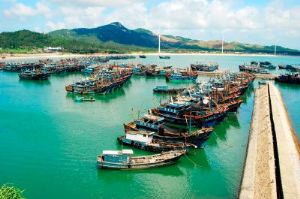
Aojiao Village is surrounded by the sea on three sides, featuring two crescent-shaped bays in the north and south that form a beautiful “X” shape. The area is accentuated by four islands — Dragon, Tiger, Lion, and Elephant — earning it the reputation of a “marine zoo.” It is a renowned fishing village known for its thriving fishing industry and picturesque natural scenery. The village was awarded the title of “National Civilized Village” for three consecutive terms in 2005, 2009, and 2011. Over the years, it has also been recognized as Fujian Province’s “Socialist New Countryside Construction Demonstration Village,” “Green Well-Off Village,” “National Democratic and Legal System Demonstration Village,” “National Model Village for Loving the People and Consolidating Borders,” and one of “Zhangzhou’s Top Ten Most Beautiful Villages.”
I. A Long and Rich History. The village was established in the mid-to-late Ming Dynasty and has a history of over 500 years. The area’s Daomao Mountain is a Neolithic site — a shell mound site — that bears witness to the lives of early human ancestors in Dongshan and the prehistoric cultural exchanges between Fujian and Taiwan. According to the records in the Zhao’an County Annals: “Daomao Mountain lies to the south of Wudu, at the highest point of Bopu Village’s mountain. During the Song Dynasty, Chancellor Lu Xiufu once moored the imperial boat here while escorting the young emperor in exile,” documenting the historical event of the Southern Song Dynasty when Chancellor Lu Xiufu fled with the young emperor to this area. In the late Ming Dynasty, the national hero Zheng Chenggong, while reclaiming Taiwan, trained naval forces along the Fujian coast and stationed a battalion of navy soldiers here. He also dug a well in the beach area of Aojiao’s rear bay, historically known as the “Guoxing Well.” During the Qing Dynasty, Aojiao Wo served as an important base for General Shi Lang’s fleet for training, docking, and resupply.
II. Naturally Unique Scenery. Aojiao Village lies against mountains and by the sea, boasting beautiful landscapes with golden beaches stretching for dozens of miles. There are crescent-shaped bays in both the north and south (Aojiao Bay and Wuji Bay), forming a stunning “X” shape, while the four islands — Dragon, Tiger, Lion, and Elephant — are scattered throughout, earning the area the nickname “marine zoo.” The film and television industry has recognized its natural charm, using it as an ideal shooting location. Numerous films and TV dramas, such as “Panshi Bay,” “Kinship,” “Widow Village,” “The 13th Well Area,” and “Qiu Jin,” have filmed exteriors here. Hong Kong’s Asia Television also shot the scenic program “Wow, Aojiao…” in the village. Renowned writers such as Wang Meng, poets Cai Qijiao and Shu Ting, among others, have visited Aojiao multiple times for inspiration, sketching, and experiencing life.
III. Highly Developed Fishing Industry. The village integrates marine fishing, precious seafood farming, and aquatic product processing. It currently has 220 trawling fishing boats, 38 abalone farms, 25 aquatic product processing companies, and 14 enterprises including shipyards, repair shops, fishing gear factories, and fuel supply stations. In 2013, the village’s total economic income reached 511.75 million yuan, with a per capita net income of 26,040 yuan.
Among these, the Fishermen’s Wharf is widely renowned. Whenever fishing boats dock, the wharf becomes livelier. Boats laden with fresh seafood are moored at the pier, and fishermen pile up their catches — fish, shrimp, crabs, and more — on the boats for visitors to choose from. Many tourists specifically come here to buy seafood, and it’s the perfect place to enjoy fresh seafood and abalone.
IV. Rich Cultural Atmosphere. The village has produced well-known “cultural figures” such as fisherman poet Xu Haiqin, fisherman painter Chen Jieding, and fisherman sculptor Shen Xikun. It is home to the Straits Art Museum and a gallery dedicated to fishermen’s poetry and photography.
(Image source: Aojiao Village Official Website)
Information source: Fujian Provincial Tourism Development Commission
Share
This article is published by HowToTrip. Sharing and reposting are welcome — please credit the source.
Article URL: https://www.howtotrip.net/travel-9165
Related Articles
- Shaoxing's "Grandpa Gourd" hangs the gourds back up: "If there are too many people, we'll interact less — just take a quick look from afar"
- Chinese authorities announce "reciprocal adjustment" to Japan visa fees — single-entry visa jumps from 2,250 to 16,750 yen!
- The "health stones" carried by a traveler were found to have radiation levels exceeding safety limits by a thousand times, potentially endangering fellow passengers on the same flight. Customs issues warning!
- Shenzhen Airport Issues Late-Night Notice: Unidentified Aerial Object Detected, Causing Widespread Flight Delays!
- “They only said it cost money after I opened the box and washed it!” 200g of grapes sold for 60 yuan on a high-speed train—12306 responds!
- Can't buy an airline ticket? Denied exit? Blocked from boarding? A large number of Chinese tourists have mysteriously become "discredited individuals"
- Adverse weather and economic fluctuations impact Colombia's coffee market
- Beach bathing area responds to 2 yuan/30 seconds fee for freshwater foot rinsing: Clearly priced!
- Taking off with an improperly closed cabin door? Wing malfunction? Multiple flights made emergency returns mid-journey!
- Experience the gifts of nature! A countdown of the world’s ten most stunning coastlines