Wuzhai Mountain Village
Wuzhai Mountain Village
Its proximity to the airport provides rare and superior convenience for developing a distinctive tourism village. Jining Airport serves Jining, Tai’an, Zaozhuang, Heze, Shangqiu, Puyang, Huaibei, and eight cities across four provinces in the Shandong-Lu-Yu-Wan region, covering nearly 40 million people. It is an important civil aviation hub in Shandong Province and the only one in southwestern Shandong. The airport's operation is significant for improving infrastructure conditions in southern and southwestern Shandong, forming an integrated three-dimensional transportation network of land, water, and air routes, boosting regional economic development, and promoting the exploitation of Jining’s tourism resources. Currently, Jining Qufu Airport has opened six major hub routes to Beijing, Shanghai, Guangzhou, Chengdu, Shenyang, and Qingdao, initially establishing an air network connecting key domestic cities. As more planned routes are introduced, the airport is gradually becoming an aerial bridge linking the hometown of Confucius and Mencius with the rest of the world. Wuzhai Mountain Village lies just north of Jining Airport, separated only by a road.
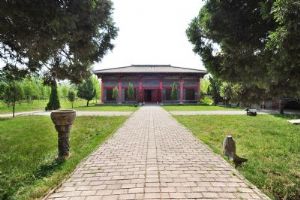
Rich cultural and natural tourism resources provide a solid foundation for developing a distinctive tourism village. To the north of Wuzhai Mountain Village lies the Wu Family Tomb Cluster Stone Carvings, designated among China’s first batch of Major Historical and Cultural Sites Protected at the National Level. These are stone carvings from the tomb complex of the Wu family during the Eastern Han Dynasty. Today, three exhibition rooms are preserved: the Watchtower Room, the Wu Family Shrine Stone Relief Exhibition Room, and the West Corridor. Major artifacts include 46 stone reliefs, two Han Dynasty steles, 11 Qing Dynasty steles, one pair of stone lions, one pair of stone watchtowers, and one stone tablet. In addition, 77 other stone reliefs unearthed in Jiaxiang County, one Sui Dynasty stele, four Qing Dynasty epitaph boxes, and four Ming Dynasty stone carvings of Huang Tingjian’s calligraphy are also preserved. The Wu family tomb complex was likely established during the late Eastern Han Dynasty, during the reigns of Emperors Huan and Ling. The content of the Wu Family Shrine stone reliefs is rich and diverse, covering themes such as social life, historical stories, mythical immortals, and auspicious beings, making them valuable materials for studying various aspects of Han Dynasty society, politics, economy, ideology, culture, and art. Particularly notable are the historical story-themed carvings depicting emperors, sages, disciples of Confucius, loyal ministers, righteous warriors, filial sons, and chaste women. These images are numerous and concentrated, often accompanied by inscribed labels that reflect the political ideologies and ethical morals promoted at the time. The carving technique used in the Wu Family Shrine stone reliefs is mainly relief line engraving with background removed, leaving fine parallel chisel marks around the figures. This raised relief technique maintains smooth wall surfaces while making the images stand out vividly and distinctly. Among them, a pair of stone lions—heads held high, necks twisted forward, mouths open and eyes fierce—are strikingly lifelike. Their main skeletal structures and even fur lines are clearly discernible. They are the earliest existing stone lions in China, possessing significant historical and artistic value.
During the Japanese invasion of China, a horrifying and appalling massacre, known historically as the “Wuzhai Mountain Massacre,” took place in Zhai Mountain Village, shocking southwestern Shandong. In a village of just over 500 people, 127 were brutally killed, including individuals as young as 13 and as old as 75.
To the south of Wuzhai Mountain Village lie Ziyun Mountain and Wuzhai Mountain, where vegetation coverage exceeds 95%. The mountains are covered mainly with orchards of peach, apricot, persimmon, and walnut trees, making them ideal spots for fruit-picking activities. The village preserves a large number of well-maintained stone residential buildings from the Republican era, characterized by strong local features. To the south of the village flows the Zhu-Zhao New River system. The entire village enjoys beautiful surroundings, clean streets, simple and honest folk customs, and a civilized atmosphere.
Address: Wuzhai Mountain Village in Zhifang Town is located 12.8 kilometers south of Jiaxiang County and 3.3 kilometers southeast of Zhifang Town.
Supporting Facilities:
Dining is available, with an average consumption of 60 RMB per person. No guest rooms are provided, but parking is available.
Share
This article is published by HowToTrip. Sharing and reposting are welcome — please credit the source.
Article URL: https://www.howtotrip.net/travel-20501
Related Articles
- Shaoxing's "Grandpa Gourd" hangs the gourds back up: "If there are too many people, we'll interact less — just take a quick look from afar"
- Chinese authorities announce "reciprocal adjustment" to Japan visa fees — single-entry visa jumps from 2,250 to 16,750 yen!
- The "health stones" carried by a traveler were found to have radiation levels exceeding safety limits by a thousand times, potentially endangering fellow passengers on the same flight. Customs issues warning!
- Shenzhen Airport Issues Late-Night Notice: Unidentified Aerial Object Detected, Causing Widespread Flight Delays!
- “They only said it cost money after I opened the box and washed it!” 200g of grapes sold for 60 yuan on a high-speed train—12306 responds!
- Can't buy an airline ticket? Denied exit? Blocked from boarding? A large number of Chinese tourists have mysteriously become "discredited individuals"
- Adverse weather and economic fluctuations impact Colombia's coffee market
- Beach bathing area responds to 2 yuan/30 seconds fee for freshwater foot rinsing: Clearly priced!
- Taking off with an improperly closed cabin door? Wing malfunction? Multiple flights made emergency returns mid-journey!
- Experience the gifts of nature! A countdown of the world’s ten most stunning coastlines