Shemihu Village
Shemihu Village
In 2013, it was listed among China’s Traditional Villages.
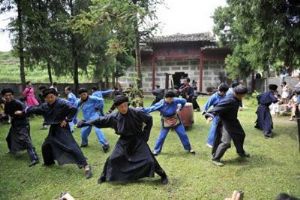
Shemihu, meaning “sunny hillside” in the Tujia language, is an authentically preserved Tujia village. Its 170 households and over 600 residents are all Tujia people, with over 90% surnamed Peng. Peng Chengrong, the village Party branch secretary, says they are descendants of Peng Xianglong, a Peng ancestor who migrated here during the late Tang Dynasty. The villagers have been farmers for generations, known for their simple and honest folkways—free from gambling or drugs, and passionate only about the Hand-Waving Dance.
To the southwest of Shemihu Village stands a Hand-Waving Hall. Set apart from the village, it rises on a slope and is nestled among ancient pine and cypress trees. In front of the hall are two stone steles, erected respectively during the Qing Dynasty’s Daoguang era by the Peng family and in the second year of the Tongzhi reign for its restoration. The hall faces due south. Its surrounding wall is built with mountain stones, consisting of double-layered hollow structures that are solid and soundproof. At the entrance is a tall, pillar-like stone memorial archway, with half-moon-shaped stone teeth embedded on both sides where vertical pillars meet the horizontal beam. Entering, one finds a stone path leading to the hall. In front of the hall lies a courtyard exceeding 500 square meters, dotted with five tall ancient cypresses. On the main eaves of the shrine, the three characters “Hand-Waving Hall” are inscribed in solemn, rounded strokes—the calligrapher remains unknown. The hall is linear in layout, with three rooms: the central room enshrines life-sized deities of the Tujia ancestors Peng Gongjue, Xiang Laoguan, and Tian Haohan; the side rooms have pine floors and fir-beamed ceilings. Without ornate carvings or upturned eaves, it looks entirely different from typical temples, monasteries, or ancestral halls.
Lu Xunzhong said that after the discovery of the Shemihu Hand-Waving Hall during an investigation in 1956, Laifeng County fully committed to excavating Hand-Waving Dance culture, laying the foundation for recognition as “China’s No. 1 Hand-Waving Hall” and the “Hometown of Hand-Waving Dance.” As a result, the dance entered refined cultural circles. Researchers from Japan, Singapore, and other countries came specifically to Shemihu for field studies, and professional art troupes such as the Wuhan Opera House conducted on-site research. This led to the dance being performed in Wuhan and even Beijing.
The Hand-Waving Dance of Shemihu is distinctive, novel, and captivating. Its techniques involve swinging hands on the same side, stepping with the same-side foot, synchronized movement, trembling, bending at the waist and knees with slight sinking, alternating between “single wave,” “double wave,” and “spiral wave” movements. The forms often mimic actions such as “chopping firewood,” “digging soil,” “planting corn,” “weeding,” “transplanting rice seedlings,” “harvesting grain,” and “weaving fabric.” The primary accompaniment is percussion (gongs and drums), occasionally interspersed with Hand-Waving Songs. The integration of song, dance, and music creates a unified experience.
Share
This article is published by HowToTrip. Sharing and reposting are welcome — please credit the source.
Article URL: https://www.howtotrip.net/travel-18545
Related Articles
- Shaoxing's "Grandpa Gourd" hangs the gourds back up: "If there are too many people, we'll interact less — just take a quick look from afar"
- Chinese authorities announce "reciprocal adjustment" to Japan visa fees — single-entry visa jumps from 2,250 to 16,750 yen!
- The "health stones" carried by a traveler were found to have radiation levels exceeding safety limits by a thousand times, potentially endangering fellow passengers on the same flight. Customs issues warning!
- Shenzhen Airport Issues Late-Night Notice: Unidentified Aerial Object Detected, Causing Widespread Flight Delays!
- “They only said it cost money after I opened the box and washed it!” 200g of grapes sold for 60 yuan on a high-speed train—12306 responds!
- Can't buy an airline ticket? Denied exit? Blocked from boarding? A large number of Chinese tourists have mysteriously become "discredited individuals"
- Adverse weather and economic fluctuations impact Colombia's coffee market
- Beach bathing area responds to 2 yuan/30 seconds fee for freshwater foot rinsing: Clearly priced!
- Taking off with an improperly closed cabin door? Wing malfunction? Multiple flights made emergency returns mid-journey!
- Experience the gifts of nature! A countdown of the world’s ten most stunning coastlines