Xujia Village
Xujia Village
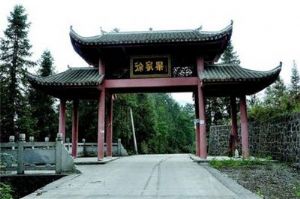
In 2012, it was listed as a model village for ethnic minority characteristic settlements. In 2013, it was included in the list of China’s Traditional Villages.
Most villagers in Xujia Village are surnamed Xu, and they claim to be descendants of Xu Maozong and Xu Jingye from the Tang Dynasty, as well as Xu Da from the Ming Dynasty. According to 93-year-old Xu Ketao, Xu Da’s grandson, Xu Shixiu, fled from imperial pursuit and searched for a place to hide. After three migrations, he arrived at the uninhabited Wudaoshui and settled there. Nearly 600 years have passed since then. Though in his nineties, the elderly man can still clearly recite his family genealogy: “Shang Zheng Tong Sheng Xiu, Qi Ke Chao Gong Xun, … Mi Ke Wei Rui … Yi Zi Yun Huai San.” He said the character “Shi” represents the 6th generation. Calculating 20 years per generation, the Xus have lived here for about 500 years. However, the family genealogy was destroyed in a fire, so the history of Xujia Village may be even deeper and more mysterious in local lore.
Xujia Village is located in a remote corner and was largely isolated from the outside world in ancient times. Its front is guarded by a mountain like a screen, while behind the village lies the vast Wudaoling Mountain, about 700 meters above sea level. From the newly built economic loop road of Laifeng County descending from the back mountains, winding mountain paths flank the area where farmland, orchards, and rice paddies intermingle—clear waters and green hills paint a scene of abundance. Inside the village, the houses are uniformly Tujia-style, all featuring gray tiles, blue bricks, and upturned eaves. The layout is neat, with consistent tones filling the serpentine-like arrangement. Walking through it, one truly loses their sense of direction.
The ancient village faces south, with a mountain ahead known as Qinglong Mountain. Actually, Qinglong Mountain is a ravine, stretching two kilometers. Towering ancient trees grow within the ravine, their height surpassing that of the village. They resemble a giant dragon lying peacefully: curving from the east toward the south and then west in a crescent shape, half-embracing the village. In the rustling autumn wind, the branches sway, as if a green dragon is dancing in front of Xujia Village. Zhang Xiuwu says although Qinglong Mountain spans only about 200 acres, it has hundreds of ancient trees, averaging over 200 years old, with the largest trunks exceeding 100 centimeters in diameter and heights between 30 and 50 meters. It is truly an original forest community.
Looking west from the gate of Xujia Ancient Village, Qinglong Mountain appears vividly, its head and tail in view. On the stone slabs that the Wudaoshui water flows over, 800 acres of terraces display green crops, yellow stalks, or bare earth, adding vibrant colors to the ancient village under the sunlight.
The legendary first ancient terraced fields created by moving soil and fertilizing in Hubei are built on the massive, sloping stone slab of Wudaoling. The stone slab connects Wudaoling uphill and Qinglong Mountain downhill. There is a Dragon Cave on the ridge, with a spring that flows year-round. The Wudaoshui water flows down the stone slabs and converges at Qinglong Mountain below. When the Xus settled here, they built fields and channeled water for sustenance. They cut stones from the mountain to build terraced edges, laid fine sand at the base, carried soil to form foundations, and burned wild grass to create fertilizer. Utilizing the natural conditions of Wudaoling, they constructed dikes and dams, diverting the ever-flowing Wudaoshui water through aqueduct channels into the terraces. Within three years, the cultivated layer—mixed with infertile yellow earth and fertile black soil—yielded abundant rice harvests.
In the years that followed, the descendants of the Xus expanded the land endlessly, transforming all the sloping ridges into layered terraces, stretching from the foot of Qinglong Mountain to the peak of Wudaoling. Zhang Xiuwu said, “Back in the 1960s and 70s, during the collective farming era, early spring would see terraces of all shapes filled with clear spring water. By March and April, the terraces turned lush green, resembling green carpets. In late summer and early autumn, when the rice ripened, golden expanses stretched as far as the eye could see. City folks said it was like a landscape painting changing with the seasons. It’s a pity that these fields are now abandoned.”
A person in charge of the Laifeng County Housing and Urban-Rural Development Bureau sighed, saying that terraced fields are common, but those like the ancient terraces of Xujia Village, built entirely on a single stone slab, are extremely rare. From the mountain ridges where streams trickle down to the verdant cliffs of Qinglong Mountain, the terraces span a vertical height of 1.5 kilometers and extend horizontally for 1 kilometer, their grandeur comparable to the Longji Terraces of Guilin.
Zhang Xiuwu said that according to the tourism protection and development plan for Xujia Village, the village will leverage its ancient dwellings, forests, and terraced fields to create a landscape belt for both land and water sightseeing. In the future, visitors will be able to embark on photography tours and farming experience journeys across the 800-acre ancient terraces.
Address: Wudaoshui Village, Dahe Town, Laifeng County, Enshi Tujia and Miao Autonomous Prefecture, Hubei Province
Share
This article is published by HowToTrip. Sharing and reposting are welcome — please credit the source.
Article URL: https://www.howtotrip.net/travel-18542
Related Articles
- Shaoxing's "Grandpa Gourd" hangs the gourds back up: "If there are too many people, we'll interact less — just take a quick look from afar"
- Chinese authorities announce "reciprocal adjustment" to Japan visa fees — single-entry visa jumps from 2,250 to 16,750 yen!
- The "health stones" carried by a traveler were found to have radiation levels exceeding safety limits by a thousand times, potentially endangering fellow passengers on the same flight. Customs issues warning!
- Shenzhen Airport Issues Late-Night Notice: Unidentified Aerial Object Detected, Causing Widespread Flight Delays!
- “They only said it cost money after I opened the box and washed it!” 200g of grapes sold for 60 yuan on a high-speed train—12306 responds!
- Can't buy an airline ticket? Denied exit? Blocked from boarding? A large number of Chinese tourists have mysteriously become "discredited individuals"
- Adverse weather and economic fluctuations impact Colombia's coffee market
- Beach bathing area responds to 2 yuan/30 seconds fee for freshwater foot rinsing: Clearly priced!
- Taking off with an improperly closed cabin door? Wing malfunction? Multiple flights made emergency returns mid-journey!
- Experience the gifts of nature! A countdown of the world’s ten most stunning coastlines