Tiejianggou
Tiejianggou
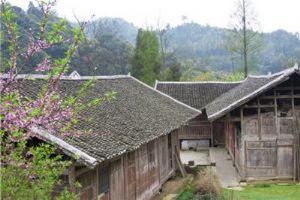
There are currently seven old houses remaining from the Republican era, while nearly 30 others, though only about 30 years old, are already in disrepair. Only about 40 elderly residents over the age of 60 still live here.
In 2013, it was listed in the Catalog of China’s Traditional Villages.
Gelerche Township is the only township in Hubei named in the Tujia language. Gelerche means “fierce river” in Tujia. Here, the Gelerche River system flows from north to south, while the Shengxi River system from the west and several seasonal streams converge into the Gelerche River, giving the Gelerche town area a layout surrounded by water on three sides and backed by a mountain on the fourth. Whenever mountain torrents occur, the rapid and towering waters make this “fierce river” as vicious as a wild beast—hence its name.
Tiejianggou is located on the mountainside of a valley in Gujia Mountain Village in western Gelerche. It is surrounded by rolling hills and crisscrossing valleys, with one north-south gully dividing it into two parts. The eastern part is called Wachangping, and the western part is called Dayuanba. The two residential areas on the east and west are separated by a gully about 50 meters wide.
The Yao family is the predominant clan in Tiejianggou. Legend has it that the Yao ancestors were once renowned blacksmiths in Guizhou. Forced by hardship, they fled famine from Tongren Prefecture in Guizhou to Gelerche. Seeing the area’s dense forests and high mountains—and noticing that local farming households had few knives or axes—they gathered ore, built furnaces, and forged iron tools for a living. Later, they married local Tujia women, settled down, and started families. Hence the name “Tiejianggou,” or Blacksmith Valley.
Time has passed. Three hundred years of Tiejianggou have become a memory, and the skills of the Yao blacksmiths have long been lost. Nowadays, no iron furnaces can be found in Tiejianggou, but there are stone enclosures built with bluestone, as well as stone pestles, stone mills, and stone rollers used for hulling rice.
Yao Youming, 64, says that the mountains and forests around Tiejianggou are full of excellent bamboo. Many years ago, the ancestors shifted from heavy labor to fine craftsmanship and took up bamboo weaving. The Yao family’s bamboo wares became a well-known local brand. Every Yao family here possesses inherited bamboo-weaving skills—sieves, baskets, winnowing trays, bamboo chairs, and even some handicrafts. Once a Yao family member sets their eyes on it, they can weave it vividly and durably.
Thirty years ago, when some of the older houses in the village were renovated, their original appearance was largely preserved—the shiny “cold benches” at the door, the thick main beams inside, the ancestral altars in the main halls where family tablets are enshrined, the “Liuhemen” (Six Harmonies Doors) on the front doors symbolizing “brotherly harmony,” the pounding stones for making glutinous rice cakes during lunar December, and the stones used for weaving baskets during the farming off-season…
Yao Youqiang, a former village committee official, spoke with sorrow about the current desolation: “The two courtyards of Tiejianggou used to house over 200 people. Now there are only 40. The young adults go out to work, the children move to the cities with them, and those left behind are elderly who can’t bear to leave their hometown. With no one living in the houses, the village naturally loses its vitality. In a few more years, these houses will all collapse.”
Share
This article is published by HowToTrip. Sharing and reposting are welcome — please credit the source.
Article URL: https://www.howtotrip.net/travel-18540
Related Articles
- Shaoxing's "Grandpa Gourd" hangs the gourds back up: "If there are too many people, we'll interact less — just take a quick look from afar"
- Chinese authorities announce "reciprocal adjustment" to Japan visa fees — single-entry visa jumps from 2,250 to 16,750 yen!
- The "health stones" carried by a traveler were found to have radiation levels exceeding safety limits by a thousand times, potentially endangering fellow passengers on the same flight. Customs issues warning!
- Shenzhen Airport Issues Late-Night Notice: Unidentified Aerial Object Detected, Causing Widespread Flight Delays!
- “They only said it cost money after I opened the box and washed it!” 200g of grapes sold for 60 yuan on a high-speed train—12306 responds!
- Can't buy an airline ticket? Denied exit? Blocked from boarding? A large number of Chinese tourists have mysteriously become "discredited individuals"
- Adverse weather and economic fluctuations impact Colombia's coffee market
- Beach bathing area responds to 2 yuan/30 seconds fee for freshwater foot rinsing: Clearly priced!
- Taking off with an improperly closed cabin door? Wing malfunction? Multiple flights made emergency returns mid-journey!
- Experience the gifts of nature! A countdown of the world’s ten most stunning coastlines