Memorial Hall of Liu Yong
Memorial Hall of Liu Yong
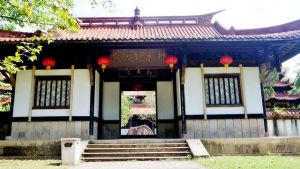
In front of the Memorial Hall of Liu Yong, lush trees stand gracefully. Looking up, you can see the stone gate of the memorial hall inscribed with the words “Gradually Entering a Beautiful Scene” (taken from the "Book of Jin · Biography of Gu Kaizhi"). On both sides of the stone gate are the famous couplets: “Among such renowned mountains, which rank is fitting?” and “Comparatively, meandering streams are inherently rare.” Inside the gate, two crape myrtles stand tall, as if resonating with one's inner thoughts.
In front of the main gate of the memorial hall stands a full-body bronze statue of Liu Yong. Beside it, a large rock is inscribed with an introduction to Liu Yong’s tomb: “Earth Returned to Hometown – Stele Record. In September 2004, coinciding with the inauguration of the new building of the Wuyishan Memorial Hall of Liu Yong, earth from the tomb of Liu Yong on Beigu Mountain in Zhenjiang was relocated here. A thousand-year wandering soul returns home today, and the master of ci poetry is laid to rest in his native land.” The bronze statue of Liu Yong holds a scroll in one hand, donning a Confucian scholar’s cap and traditional robe, exuding a graceful and serene demeanor.
Upon entering the memorial hall, a large calligraphy work by Mao Zedong of Liu Yong’s famous ci poem “Watching the Tidal Bore” (Wanghai Chao) is displayed on the screen wall. Behind the screen wall are two exhibition halls, eastern and western, each spanning 54 square meters.
The eastern hall is the “Life of Liu Yong” exhibition area, divided into eight sections: Scholarly Family Background and Happy Childhood, Wasted Youth and Young Adulthood, Frustrations in Officialdom and Life of Hardship, Painstaking Composition and the Immortal “Music Chapters,” The Beauty of Liu’s Ci Poetry and Widespread Praise, Mao Zedong on Liu’s Ci Poetry, Timeless Music Passed Down Through Generations, and Promoting the Study of Liu’s Ci Poetry to Uphold Wuyi Culture. Using 23 display boards, numerous images, and concise text, it showcases Liu Yong’s life, the profound impact of his ci poetry, and the high praise it has received through the ages.
The western hall is the “Liu Yong’s Ci Poetry in Calligraphy and Painting” exhibition area, displaying over 30 artworks related to Liu Yong. Display cabinets and shelves in both halls feature books and paintings from ancient to modern times, both domestic and foreign, related to Liu Yong’s ci poetry, including “Bi Ji Man Zhi,” “Neng Gai Zhai Man Lu,” “Song Yuan Famous Ci Poets,” “Mao Zedong’s Handwritten Calligraphy of Classical Poems,” and “Along the River During the Qingming Festival.”
The rear hall of the memorial hall is dedicated to the artistic illustrations inspired by Liu Yong’s ci poems “Wushan Yiduan Yun” and “Zhuhai Ge,” covering a total area of 34 square meters. Each section displays the full text of the ci poem along with 11 illustrations that capture their meaning. On the third floor of the illustration gallery is a tea room where visitors can overlook the clear bends of the Nine Twist Stream and peaks such as Jade Maiden Peak, Great King Peak, Curtain Pavilion Peak, Iron Plate Peak, Bridle-Reining Peak, and Lion Peak. This space combines scenic appreciation with tea tasting, offering a delightful and immersive experience. The back of the memorial hall borders a small bamboo grove and lies adjacent to the Nine Twist Stream, making it an ideal leisure spot for visitors to enjoy tea and observe tea ceremonies and the art of tea.
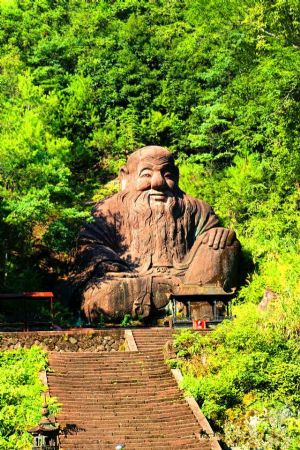
Liu Yong (987~1053) Liu Yong (circa 984 – circa 1053), originally named Sanbian, courtesy name Jingzhuang, later changed his name to Liu Yong and courtesy name Qiqing. Because he was the seventh son, he was also called Liu Qi. A native of Chongan, Fujian, he was a renowned ci poet of the Northern Song Dynasty and a representative figure of the delicate and restrained ci poetry style. Liu Yong was the first poet to comprehensively reform Song ci poetry and the one who created the most ci tunes in the history of Song ci poetry. He vigorously developed the slow ci form, transplanted the narrative techniques of prose into ci poetry, and made extensive use of colloquial language. With his unique artistic style — using relatable imagery, vivid and thorough exposition, and unadorned description — he exerted a profound influence on the development of Song ci poetry. Biography Early Years...... More+




Share
This article is published by HowToTrip. Sharing and reposting are welcome — please credit the source.
Article URL: https://www.howtotrip.net/travel-18127
Related Articles
- Shaoxing's "Grandpa Gourd" hangs the gourds back up: "If there are too many people, we'll interact less — just take a quick look from afar"
- Chinese authorities announce "reciprocal adjustment" to Japan visa fees — single-entry visa jumps from 2,250 to 16,750 yen!
- The "health stones" carried by a traveler were found to have radiation levels exceeding safety limits by a thousand times, potentially endangering fellow passengers on the same flight. Customs issues warning!
- Shenzhen Airport Issues Late-Night Notice: Unidentified Aerial Object Detected, Causing Widespread Flight Delays!
- “They only said it cost money after I opened the box and washed it!” 200g of grapes sold for 60 yuan on a high-speed train—12306 responds!
- Can't buy an airline ticket? Denied exit? Blocked from boarding? A large number of Chinese tourists have mysteriously become "discredited individuals"
- Adverse weather and economic fluctuations impact Colombia's coffee market
- Beach bathing area responds to 2 yuan/30 seconds fee for freshwater foot rinsing: Clearly priced!
- Taking off with an improperly closed cabin door? Wing malfunction? Multiple flights made emergency returns mid-journey!
- Experience the gifts of nature! A countdown of the world’s ten most stunning coastlines