Peach Blossom Spring Cave in Mount Wuyi
Peach Blossom Spring Cave in Mount Wuyi
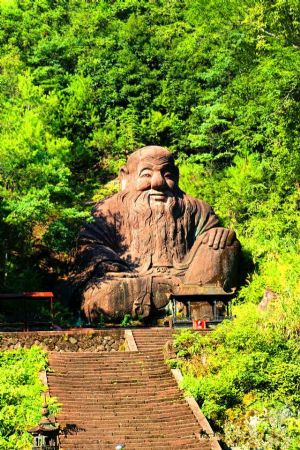
To the east of Peach Blossom Spring Cave lies Yuban Peak, to the south are Cangping Peak and Tianhu Peak, to the west is SanYang Peak. Surrounded by mountains on all sides, the area is tranquil and elegant, with uniquely beautiful scenery. It earned its name due to its resemblance to the Peach Blossom Spring of Wuling. This region is mostly characterized by towering cliffs and precipices, with the Squirrel Stream rushing down the valley. About a mile into the valley along the stream, rocks block the flow of water, and huge stones lean against each other forming a cave.
Hidden deep within Mount Wuyi, Peach Blossom Spring Cave can be reached by following the Squirrel Stream between Cangping Peak and Beilang Rock. Passing through a crevice in the rock and crossing the stone gate, a sudden expanse of flat fields and well-arranged buildings comes into view — cottages, peach orchards, bamboo groves, stone pools, and small streams — it’s just like the Peach Blossom Spring depicted by Tao Yuanming. Surrounded by Cangping Peak, SanCeng Peak, Tianhu Peak, and Beilang Rock, the cave also houses the Kaiyuan Hall, an important center for Taoist activities in Mount Wuyi. Other sites include the Peach Blossom Hermitage, the former site of Kaiyuan Hall, as well as attractions like Shoutao Stone, Golden Brick Stone, Li Quan (Separation Spring), and Wu Gong Cave. To the north, you can climb SanYang Peak.
The Taoist temple was first built during the Tianbao era of the Tang Dynasty (742–756 AD), a time when the legendary tales of immortals in Mount Wuyi attracted many scholars and hermits. The Daoist nuns Kong, Zhuang, and Ye from Kuaiji (later revered as the Three Imperial Goddesses) came to Mount Wuyi together and later settled in Peach Blossom Spring Cave, developing it into a paradise for recluses. Peach trees flourished here. Confucian scholars Chen Shitang and the hermit Wu Zhengli also resided here for cultivation and writing, while Bai Yuchan, the fifth master of the Southern School of Taoism, practiced alchemy in seclusion at Peach Blossom Spring. During the Yuan Dynasty, the Liu Wenjian Ancestral Temple and Sanyuan An were expanded, dedicated to deities such as the Three Officials and Liu Wenjian. By the Ming Dynasty, Peach Blossom Taoist Temple had become widely renowned as one of the major temples in Mount Wuyi.
At that time, halls such as the Sanqing Hall, the Three Imperial Goddesses Hall, the Three Officials Hall, the Zhenwu Hall, the Goddess Hall, and the Merit Shrine were constructed, covering an area of over two thousand square meters. Many Taoist cultivators chose to reside here. The Ming Dynasty poet Wu Shi wrote in his poem “Visiting a Taoist in Little Peach Blossom Spring Cave”: “... Following the stream to its source, there lies an ancient village with two or three recluses; they do not hide from the Qin Dynasty, but rather to cultivate their spirit and essence; they farm the spring fields themselves, needing no external provisions for food or clothing; the wind stirs and coconut blossoms fall, after the rain they pick medicinal herbs.” Over time, especially during the Qing Dynasty, the temple fell into decline and many halls collapsed. In 1936 (the 25th year of the Republic of China), the famous overseas Chinese Hu Wenhu, together with Navy Commander Sa Zhenbing, visited the mountain. Seeing the dilapidated state of the temple, Mr. Hu immediately donated 500 silver dollars for its restoration and co-inscribed the plaque “Little Peach Blossom Spring” hung above the mountain gate. The temple suffered further damage during the Cultural Revolution, leaving only the shell of the central hall.
In 1990, Peach Blossom Taoist Temple was approved as an officially open Taoist site. The Religious Affairs Bureau of Fujian Province placed great importance on revitalizing Taoism and assigned three Taoist priests from Fujian Province, who had graduated from the China Taoist College, to carry out religious activities at Peach Blossom Taoist Temple in Mount Wuyi, listing it as one of the province’s key temples. In 1991, resident Taoists renovated the main hall and carved sacred statues of the Three Pure Ones from the precious Nanmu fir (Hongdou Shan) of northern Fujian. The statues, standing 2.15 meters tall, are exquisitely crafted. They were also furnished with Hongdou Shan altars, bronze incense burners, candleholders, and other ritual items, enabling regular religious activities. In 1993, the temple was officially registered and certified in accordance with the “Interim Regulations on the Registration of Religious Activity Sites in Fujian Province” issued by the provincial government, leading to the full-scale development of Taoist cultural activities. In July 1995, Peach Blossom Taoist Temple and the Mount Wuyi Scenic Area pooled funds to carve the world’s largest Laojun Rock Sculpture, which was grandly consecrated on March 4, 1996. Leaders from the Chinese Taoist Association, as well as provincial, regional, and municipal authorities, presided over the ceremony, with over 3,000 believers from home and abroad attending. The Laojun statue stands 16 meters high, 11 meters wide, and 10 meters thick. The sculpture is lifelike and solemn, with a kind and amiable expression, smooth and unrestrained lines, exuding a transcendent aura.
Xu Xiake once wrote in his travelogue: “Surrounded by mountains, there lies a flat field with winding streams, enclosed by verdant pines and bamboos. The crowing of roosters and the sound of people’s voices all emerge from within the emerald haze.” To the north of Peach Blossom Spring Cave are two old houses, the former sites of Peach Blossom Hermitage and Kaiyuan Hall, with a statue of the Supreme Old Lord enshrined inside. Next to the house leans a rock known as Golden Brick Stone. A spring gushing from a crack in the rock is called Golden Brick Spring. The clear spring water flows past the houses into the fields, gathering beside the moss-covered Shoutao Stone to form a pool. The stone basin by the pool is spotless, making it a perfect spot for tea and rest.




Share
This article is published by HowToTrip. Sharing and reposting are welcome — please credit the source.
Article URL: https://www.howtotrip.net/travel-18118
Related Articles
- Shaoxing's "Grandpa Gourd" hangs the gourds back up: "If there are too many people, we'll interact less — just take a quick look from afar"
- Chinese authorities announce "reciprocal adjustment" to Japan visa fees — single-entry visa jumps from 2,250 to 16,750 yen!
- The "health stones" carried by a traveler were found to have radiation levels exceeding safety limits by a thousand times, potentially endangering fellow passengers on the same flight. Customs issues warning!
- Shenzhen Airport Issues Late-Night Notice: Unidentified Aerial Object Detected, Causing Widespread Flight Delays!
- “They only said it cost money after I opened the box and washed it!” 200g of grapes sold for 60 yuan on a high-speed train—12306 responds!
- Can't buy an airline ticket? Denied exit? Blocked from boarding? A large number of Chinese tourists have mysteriously become "discredited individuals"
- Adverse weather and economic fluctuations impact Colombia's coffee market
- Beach bathing area responds to 2 yuan/30 seconds fee for freshwater foot rinsing: Clearly priced!
- Taking off with an improperly closed cabin door? Wing malfunction? Multiple flights made emergency returns mid-journey!
- Experience the gifts of nature! A countdown of the world’s ten most stunning coastlines