Site of the Imperial Tea Garden
Site of the Imperial Tea Garden

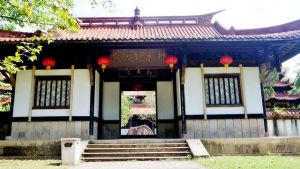
Tea fields were constructed on both the left and right sides of the garden, and the water used for tea processing was drawn from mountain springs, channeled into wells, and covered with a Dragon Pavilion. On the day of Jingzhe (Insects Awaken) each year, the county magistrate presided over a sacrificial ceremony to the gods before the tea harvest could commence. Legend has it that after the ceremony, attendants would beat drums and gongs while collectively shouting, “The tea buds are sprouting!” At that moment, the well water would rise and overflow, hence the mountain spring was called “Shouting Spring,” the wellspring “Summoned Spring,” and the well itself Tongxian Well. A high platform was built beside the well, known as the Shouting Mountain Platform. The buildings of the tea garden had fallen into ruin by the mid-Ming Dynasty, but the well and spring remain, with the spring still yielding clear and delicious water. A teahouse, the Imperial Tea Garden Teahouse, has been built on the site of the ruins.
According to the Chong’an County Annals, during the Zhenyuan era of the Tang Dynasty (785–805 AD), the Wuyi Mountain area already produced “Yingao” tea, which was steamed, baked, ground, and molded into cake shapes. This was the earliest form of Wuyi Rock Tea. The great Song Dynasty literary figure Su Dongpo praised it in his tea poem: “Grain-like buds by Wuyi Stream, blended by Ding and Cai in esteem.” The submission of Wuyi Rock Tea as tribute began in the Song Dynasty, but the establishment of the Imperial Tea Garden occurred in the sixth year of the Yuandade era (1302 AD).
According to historical records, the Imperial Tea Garden was once extremely prosperous in its early days. The general layout of the garden’s structures was as follows: the Renfeng Gate at the front, the Baifa Hall (also called the First Spring Hall), the Qingshan Hall at the rear, surrounded by the Sijing Pavilion, the Beifang Pavilion, the Yanjia Pavilion, the Yiji Pavilion, the Fuguang Pavilion, and others. Additionally, there were the Bitian Bridge and the Tongxian Well. Two field officials were appointed to manage the garden, which annually contributed 360 jin of tribute tea. In the fifth year of the Taiding era (1328 AD), Zhang Ruiben, the magistrate of Chong’an County, built a tea field on each side of the garden.
In the third year of the Zhishun era (1332 AD), Andulu, the governor of Jianing, built a five-foot-high, sixteen-square-foot platform beside the Tongxian Well, named the “Shouting Mountain Platform.” There was also a pavilion on the platform, called the “Shouting Spring Pavilion.” It is said that every year on the day of Jingzhe (Insects Awaken), the magistrate of Chong’an County would hold a grand mountain-opening ceremony here. As the magistrate burned incense, knelt in prayer, and finished reciting the sacrificial text, attendants would beat drums and gongs while loudly shouting, “The tea is sprouting, the tea is sprouting!” Only after the ceremony could the tea gardens be opened for harvesting.
The rise and fall of the Imperial Tea Garden were lamented by the renowned Qing Dynasty scholar Dong Tiangong in his poem “Reflections on Tribute Tea”: “Wuyi’s grain-like buds, plucked and offered to heaven’s house. Fired in one or two stages, spring’s first pick is purest. Hard to match the valley springs, no need to boast like Beiyuan. Tribute began with joyous heights, but forever stained by the Bright Scholar’s touch.” The Imperial Tea Garden made outstanding contributions to the transformation of oolong tea production techniques in China.






Share
This article is published by HowToTrip. Sharing and reposting are welcome — please credit the source.
Article URL: https://www.howtotrip.net/travel-18114
Related Articles
- Shaoxing's "Grandpa Gourd" hangs the gourds back up: "If there are too many people, we'll interact less — just take a quick look from afar"
- Chinese authorities announce "reciprocal adjustment" to Japan visa fees — single-entry visa jumps from 2,250 to 16,750 yen!
- The "health stones" carried by a traveler were found to have radiation levels exceeding safety limits by a thousand times, potentially endangering fellow passengers on the same flight. Customs issues warning!
- Shenzhen Airport Issues Late-Night Notice: Unidentified Aerial Object Detected, Causing Widespread Flight Delays!
- “They only said it cost money after I opened the box and washed it!” 200g of grapes sold for 60 yuan on a high-speed train—12306 responds!
- Can't buy an airline ticket? Denied exit? Blocked from boarding? A large number of Chinese tourists have mysteriously become "discredited individuals"
- Adverse weather and economic fluctuations impact Colombia's coffee market
- Beach bathing area responds to 2 yuan/30 seconds fee for freshwater foot rinsing: Clearly priced!
- Taking off with an improperly closed cabin door? Wing malfunction? Multiple flights made emergency returns mid-journey!
- Experience the gifts of nature! A countdown of the world’s ten most stunning coastlines