Mor Monastery Ruins
Mor Monastery Ruins

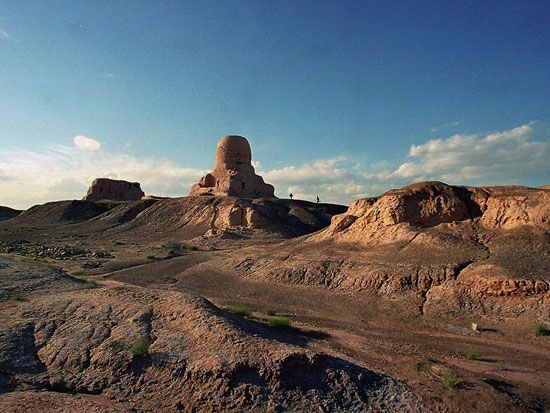
The ruins include temple and stupa remains, making them one of the westernmost Buddhist sites in China. They are iconic structures of the Hanuo Yi Ancient City, an early surviving Buddhist relic along the Silk Road, and a strong testament to the prevalence of Buddhist culture in the Kashgar region. They hold significant importance for studying the initial spread of Buddhism into Xinjiang and the flourishing of Buddhism in the Kashgar area during the Tang Dynasty.
In June 2001, they were designated as part of the fifth batch of Major Historical and Cultural Sites Protected at the National Level by the State Council.
"Mor" means "chimney" in the Uyghur language. The site is named after the tall, chimney-like stupas that have been preserved here, which are among the best-preserved and westernmost stupas in China. Remains of the monastery and monks' quarters are also still present.
Originally built in the 3rd century, the site was in use until the end of the Tang Dynasty. Due to gradually diminishing local water sources, people began to migrate elsewhere. At the same time, there were major shifts in the religious beliefs of the residents of the Kashgar region, with Islam gradually replacing Buddhism as the dominant religion. As a result, the monastery was eventually abandoned.
The stupa was constructed from earthen bricks made with straw, shaped into squares and trapezoids. The western side of the stupa body was once artificially damaged, but the base and main body are still preserved, with a remaining height of 10.8 meters. The base is divided into three tiers, each successively narrowing. The bottom tier is nearly square, eroded by wind and rain into a sloped shape with indistinct boundaries, standing 0.8 meters high; the second and third tiers are also roughly square: the second tier is 2 meters high, 12.8 meters wide east-west, and 13.2 meters long north-south; the third tier is 1.5 meters high, 10.55 meters wide east-west, and about 11 meters long north-south. The stupa body has two levels: the lower part is a circular base with a circumference of 24 meters and a height of 1.5 meters. The upper stupa body is an egg-cylinder-shaped domed structure, about 5 meters high. This form is now quite rare in Xinjiang and is relatively well-preserved, showing remnants of ancient Indian stupa architectural styles.
About 16 meters north of the stupa are the remains of monks’ quarters. The monks' residence ruins are rectangular, measuring 13 meters east-west and 9.3 meters north-south, with a remaining height of 1.5 meters. At the southeast corner of the ruins, there are five or six layers of earthen bricks, with some areas only slightly above ground level, scattered with gravel from the Gobi Desert and sporadic pottery shards. The pottery pieces are made of red clay.
The monastery ruins are a square trapezoidal structure wider at the bottom and narrower at the top: about 8 meters high, with a base 25 meters long east-west and 24 meters wide north-south. The top of the monastery is relatively flat, forming an irregular square, 14.2 meters long east-west and 13 meters wide north-south. The base and western side of the monastery building show relatively clear traces of a niche. On the southern wall, there is a vertical groove about 1 meter deep, with intact earthen bricks visible in parts of the eastern and western sections. At the bottom of the western wall, 10 rows of earthen bricks have also been found.
Share
This article is published by HowToTrip. Sharing and reposting are welcome — please credit the source.
Article URL: https://www.howtotrip.net/travel-17739
Related Articles
- Shaoxing's "Grandpa Gourd" hangs the gourds back up: "If there are too many people, we'll interact less — just take a quick look from afar"
- Chinese authorities announce "reciprocal adjustment" to Japan visa fees — single-entry visa jumps from 2,250 to 16,750 yen!
- The "health stones" carried by a traveler were found to have radiation levels exceeding safety limits by a thousand times, potentially endangering fellow passengers on the same flight. Customs issues warning!
- Shenzhen Airport Issues Late-Night Notice: Unidentified Aerial Object Detected, Causing Widespread Flight Delays!
- “They only said it cost money after I opened the box and washed it!” 200g of grapes sold for 60 yuan on a high-speed train—12306 responds!
- Can't buy an airline ticket? Denied exit? Blocked from boarding? A large number of Chinese tourists have mysteriously become "discredited individuals"
- Adverse weather and economic fluctuations impact Colombia's coffee market
- Beach bathing area responds to 2 yuan/30 seconds fee for freshwater foot rinsing: Clearly priced!
- Taking off with an improperly closed cabin door? Wing malfunction? Multiple flights made emergency returns mid-journey!
- Experience the gifts of nature! A countdown of the world’s ten most stunning coastlines