Hanqian Village
Hanqian Village
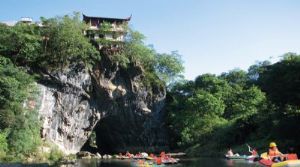
The village has a total of 720 mu of arable land and 13,000 mu of forested land, including 1,750 mu of bamboo forests, 850 mu of Longmen black tea plantations, and 135 mu of Jianxuan-35 ecological tribute lotus. In 2011, it was recognized as a provincial-level eco-village, a provincial new rural residential demonstration area, a provincial rural waste management model village, a municipal new rural construction demonstration village, and a municipal comprehensive party-building demonstration site. In March 2013, it was listed among the first batch of provincial "Beautiful Villages" demonstration sites. On April 11, 2013, it passed the national-level eco-village assessment, and in November 2013, Longmen Farmhouse was rated as a three-star rural tourism operation unit.
Hanqian Village is home to the Longmen, a universally acknowledged iconic and magical landscape at the source of the Ting River, widely recognized by the global Hakka community. Known for the phrase "Only my Longmen spans the Ting River," it is hailed as "the Source of the Hakka People, an Eco-Village, and a Tourist Destination."
Longmen consists of three parts: the Longmen Gorge Cave, karst caves, and a stone forest. Approaching Hanqian Village from the mountain’s edge, one is greeted by a towering, steep mountain that seems to descend from the clouds, presenting a majestic sight. Beneath hundred-foot cliffs arches a massive cave shaped like a half-moon gate. The cave walls, riddled with cracks and vibrant colors, strikingly resemble a dragon’s head, horns, eyes, and claws, while its body winds along the mountain, with the Ting River flowing right through the cave. On the cave’s back wall, two seal-script characters “Longmen” (Dragon Gate) are engraved, now faint due to years of wind and rain erosion. Longmen connects to the azure Longmen Pool, with stone steps leading up to the mountaintop. Along the way lies the large “Tiger Tongue” karst cave, and at the summit stands the “Shennong Temple,” built during the Song Dynasty. The hillside features a spectacular stone forest.
Kang Yong, an official from the Qing Dynasty’s Grand Secretariat, once wrote a poem: “Since when was this cave carved? The river roars daylong. Twin cliffs enclose sun and moon, a lone isle divides shade and light. Dragons slumber at the pool’s bottom, thunder startles the mountaintop. In time past, cold sweat spread wide—yet all was but a journey to the north.” “All mountain streams converge into one creek,” which flows to Hanqian, passes through the Longmen Gorge, and continues down to Changting City. Aside from the Longmen scenic area, Hanqian Village also includes the Tiger Cave scenic area, the ancient Hakka villages of Zhenxia and Santangbei, and the Anbali Taiji Island scenic area.
The area boasts beautiful ecological surroundings and enchanting pastoral scenery. Here, you can admire the magical natural beauty of the Ting River source, savor uniquely flavored Hakka cuisine, taste authentic Longmen black tea, participate in local traditional farming activities, shop for green, eco-friendly farm specialties, and experience tranquil rural life.
Source: Fujian Provincial Tourism Development Commission
Share
This article is published by HowToTrip. Sharing and reposting are welcome — please credit the source.
Article URL: https://www.howtotrip.net/travel-16062
Related Articles
- Shaoxing's "Grandpa Gourd" hangs the gourds back up: "If there are too many people, we'll interact less — just take a quick look from afar"
- Chinese authorities announce "reciprocal adjustment" to Japan visa fees — single-entry visa jumps from 2,250 to 16,750 yen!
- The "health stones" carried by a traveler were found to have radiation levels exceeding safety limits by a thousand times, potentially endangering fellow passengers on the same flight. Customs issues warning!
- Shenzhen Airport Issues Late-Night Notice: Unidentified Aerial Object Detected, Causing Widespread Flight Delays!
- “They only said it cost money after I opened the box and washed it!” 200g of grapes sold for 60 yuan on a high-speed train—12306 responds!
- Can't buy an airline ticket? Denied exit? Blocked from boarding? A large number of Chinese tourists have mysteriously become "discredited individuals"
- Adverse weather and economic fluctuations impact Colombia's coffee market
- Beach bathing area responds to 2 yuan/30 seconds fee for freshwater foot rinsing: Clearly priced!
- Taking off with an improperly closed cabin door? Wing malfunction? Multiple flights made emergency returns mid-journey!
- Experience the gifts of nature! A countdown of the world’s ten most stunning coastlines