Shuhuai Hall
Shuhuai Hall
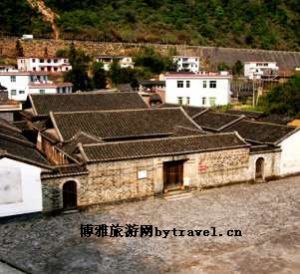
In October 1929, the Special Committee of the CPC in Western Fujian moved from Shanghang City to Sujia Slope, setting up its headquarters in Shuhuai Hall. From there, it led various tasks of the local party in Western Fujian, carried out the agrarian revolution, assisted the Fourth Red Army, and continued its work until March 1930, making significant contributions to establishing and consolidating the revolutionary base in Western Fujian.
Mao Zedong, who came to Sujia Slope with the Special Committee, and his wife He Zizhen lived in a small room on the left side of the rear hall of Shuhuai Hall. In this small room, while recovering from malaria, Mao represented the Front Committee of the Fourth Red Army in guiding the work of the Special Committee in Western Fujian. He lived and worked here for over 40 days. Using the alias “Mr. Yang,” he often went deep into the countryside to conduct research, promptly identifying and solving problems.
To help the people of Sujia Slope achieve cultural empowerment, Mao founded a “Commoners’ Primary School” in the rear hall of Shuhuai Hall and painstakingly wrote teaching materials and gave lessons himself. Concerned about the well-being of the people, many touching stories about him are still passed down among the locals.
One day, Mao learned that Yang Dongdong, the cook for the Special Committee, had given the family’s only quilt to his son who joined the Red Guards, leaving himself with only a palm-fiber coat to sleep under. Mao then gave one of his own military blankets to Yang Dongdong, which deeply moved him. When Mao left Sujia Slope to return to the Fourth Red Army, he also left the cotton-padded quilt provided by the Special Committee for his health to a local poor peasant.
The virtues of “Mr. Yang” were widely celebrated among the people of Sujia Slope.
During his time in Sujia Slope, Mao paid close attention to the early Party school of our Party—the Cadre Training Class for the Three Provinces of Fujian, Guangdong, and Jiangxi—located in the nearby “Hongyutang” not far from Shuhuai Hall. In addition to regularly inquiring about the class’s progress, Mao personally lectured the students on Marxism-Leninism.
One day, during a conversation with Deng Zihui, Secretary of the Special Committee of Western Fujian, Mao asked, “Comrade Zihui, what do you think is the task of a leader?” Deng Zihui was momentarily unable to answer. Mao patiently explained, “In my view, the task of a leader is to act as a ‘messenger’ for the people.” He added that being a good messenger is no easy task; it requires promptly reflecting the opinions and demands of the majority of the people to the Party and government bodies, then summarizing and analyzing them, making corresponding decisions, and conveying those decisions to the people for implementation. Deng Zihui found this perspective very reasonable, targeted, and creative, so he publicly conveyed the spirit of Mao’s speech at a Special Committee meeting. Later, the Special Committee quickly disseminated this message to the Party and government departments of all counties in Western Fujian, educating the majority of leading cadres, changing the bureaucratic work style of the time, and further strengthening the relationship between the Party and the people.
On the mountainside to the right of Shuhuai Hall lies a natural cave—Zhenbei Cave. The cave remains cool in summer and warm in winter, with a fresh and tranquil environment, and was where Mao rested and read during that time. Locals now call it the “Chairman’s Cave.”
In May 2005, the People’s Government of Fujian Province designated Shuhuai Hall as a Provincial Cultural Relics Protection Unit in the sixth batch.
Mao Zedong (1893~1976) Mao Zedong (December 26, 1893 – September 9, 1976), courtesy name Runzhi (originally Yongzhi, later changed to Runzhi), pen name Ziren. A native of Xiangtan, Hunan. He was the leader of the Chinese people, a Marxist, a great proletarian revolutionary, strategist, and theorist, as well as a principal founder and leader of the Communist Party of China, the Chinese People's Liberation Army, and the People's Republic of China. He was also a poet and calligrapher. From 1949 to 1976, Mao served as the paramount leader of the People's Republic of China. His development of Marxism-Leninism, contributions to military theory, and theoretical contributions to the Communist Party are collectively known as Mao Zedong Thought. Because Mao... Details+
Deng Zihui (1896~1972) Deng Zihui, originally named Shaoji, was born on August 17, 1896, in Dengcu Village, Dongxiao Town. His father, Deng Hongbi, practiced medicine before being hired as the principal of Tonggang Primary School. Deng Zihui attended Tonggang Primary School in his childhood and enrolled in Longyan Middle School (later renamed the Ninth Provincial Middle School) at the age of seventeen. In the fourth year of the Republic of China (1915), he organized and delivered speeches protesting Yuan Shikai’s acceptance of Japan’s humiliating “Twenty-One Demands.” That same year, he secretly joined the Chinese Revolutionary Party while in middle school. In the sixth year of the Republic of China, he qualified for a government-sponsored study-abroad program in Japan with outstanding academic performance. The following May, he participated in protests by overseas students against the warlord government of the Beiyang regime signing an agreement with Japan... Details+
Share
This article is published by HowToTrip. Sharing and reposting are welcome — please credit the source.
Article URL: https://www.howtotrip.net/travel-15310
Related Articles
- Shaoxing's "Grandpa Gourd" hangs the gourds back up: "If there are too many people, we'll interact less — just take a quick look from afar"
- Chinese authorities announce "reciprocal adjustment" to Japan visa fees — single-entry visa jumps from 2,250 to 16,750 yen!
- The "health stones" carried by a traveler were found to have radiation levels exceeding safety limits by a thousand times, potentially endangering fellow passengers on the same flight. Customs issues warning!
- Shenzhen Airport Issues Late-Night Notice: Unidentified Aerial Object Detected, Causing Widespread Flight Delays!
- “They only said it cost money after I opened the box and washed it!” 200g of grapes sold for 60 yuan on a high-speed train—12306 responds!
- Can't buy an airline ticket? Denied exit? Blocked from boarding? A large number of Chinese tourists have mysteriously become "discredited individuals"
- Adverse weather and economic fluctuations impact Colombia's coffee market
- Beach bathing area responds to 2 yuan/30 seconds fee for freshwater foot rinsing: Clearly priced!
- Taking off with an improperly closed cabin door? Wing malfunction? Multiple flights made emergency returns mid-journey!
- Experience the gifts of nature! A countdown of the world’s ten most stunning coastlines