Shangqiu Chongfa Temple Pagoda
Shangqiu Chongfa Temple Pagoda

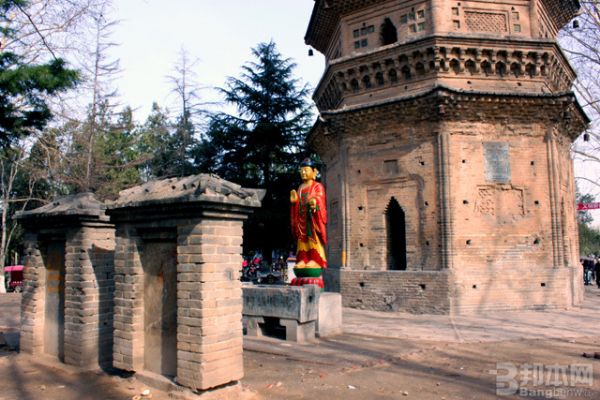
Located within the Revolutionary Martyrs' Cemetery in the northeast corner of Yongcheng County’s old town, at the former site of Chongfa Temple (now the Revolutionary Martyrs' Cemetery). The temple was built in the Tang Dynasty, and the pagoda was built in the second year of the Shaosheng era of the Song Dynasty (1095). The temple has long been abandoned, and the spire of the pagoda no longer exists. In 1958, it was renovated and restored to its original appearance from the Song Dynasty. The pagoda currently stands 34.6 meters tall and is a provincial-level key cultural relics protection unit.
Chongfa Temple Pagoda is located in the Revolutionary Martyrs' Cemetery in the northeast corner of Yongcheng’s old town, at the former site of Chongfa Temple, from which the pagoda gets its name. "Pagoda Amongst the Clouds" is one of the ancient Eight Scenic Spots of Yongcheng.
Chongfa Temple was built before the Tang Dynasty. Construction of the Chongfa Temple Pagoda began on March 25 of the eighth year of the Yuanyou era (1093) with the excavation of the underground palace. The main structure of the pagoda was built starting in the second year of the Shaosheng era (1095) and completed in the fifth year of the Shaosheng era (1098). The pagoda stands 34.6 meters tall, with a base diameter of 7.7 meters. From bottom to top, the eaves gradually taper, and the height of each level decreases successively, giving the entire structure a graceful parabolic outline. The pagoda has an octagonal floor plan and consists of a base, body, and spire, forming a nine-story pavilion-style building. In June 1963, it was designated as one of the first batch of provincial-level cultural relics protection units by the People's Committee of Henan Province. In May 2006, it was listed as a sixth-batch national key cultural relics protection unit by the State Council.
The underground palace of Chongfa Temple is square-shaped, with a caisson ceiling. At the center of the underground palace is a brick-lined lotus pedestal coffin platform, upon which rests a rectangular stone sarcophagus. Unfortunately, the underground palace was looted, and its true appearance was only revealed during later cleaning efforts. According to inscriptions on stone tablets, the stone sarcophagus enshrined Buddhist relics and was adorned with treasures such as gold, silver, agate, crystal, and jade, along with copper coins and rice grains from the Tang and Song Dynasties. This indicates that the pagoda was specifically built to house the Buddha’s physical relics. The base of the pagoda contains wooden framework, supporting the upper pagoda while protecting the underground palace, making it solid and stable. Together with the pagoda body and spire, it forms a harmonious, solemn, and elegant whole, representing a masterpiece of pavilion-style ancient pagodas. The pagoda body is...
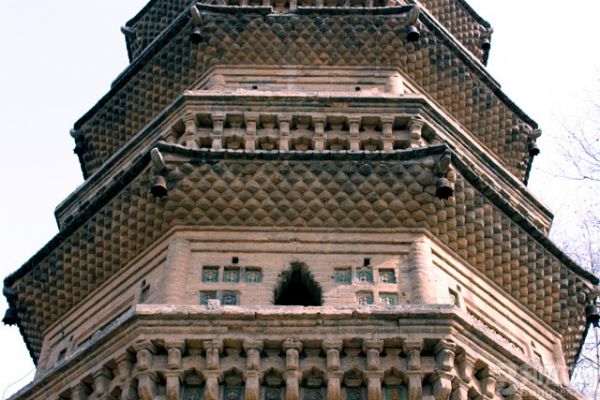
Constructed in brick, pavilion-style, with eight sides and nine stories. The grey bricks are stacked to mimic wooden structures, with eaves protruding at each level and gradually tapering inward. Each level features brick pillars mimicking wooden columns at the corners, and the outer eaves are adorned with carved wooden-style openwork railings, enhancing the aesthetic appeal and creating a varied silhouette. The eaves are made of lotus petal-shaped stone slabs, and the balconies are supported by bracket sets, adding layers of decorative detail. The roof corners are fitted with stone-carved dragon heads, each holding a wind chime in their mouths. When the breeze blows, the chimes tinkle melodiously, refreshing the spirit and clearing the mind. The first level of the pagoda is 5 meters high with a diameter of 7.7 meters, featuring one lintel-shaped door each on the east, west, south, and north sides. The east, south, and west doors contain Buddha niches, while the north door serves as the entrance to the pagoda. Entering through this door leads to the inner core, where one can ascend spirally to the top. The interior employs various structural techniques such as through-hall, corridors, square inner walls with turns, and solid masonry, making it very sturdy. Each level of the pagoda has windows, aligned in direction and shape with the lintel doors. Above and at both ends of the exterior of these windows and doors are 651 yellow-green glazed Buddha tiles, along with five glazed tiles inscribed with the pagoda’s name and donor names, adorning the pagoda beautifully. These windows not only allow light and offer views but also help reduce strong wind pressure, showcasing ingenious design. At the very top is the spire, made of metal, with its tip pointing towards the clouds. Connected directly to the spire is an umbrella-like cover, followed by seven tiered wheels, decreasing in size from bottom to top, supported by a central spire pole. The lower part of the spire is a metal base, which connects the pole to the ancient pagoda, forming a unified whole.
Having withstood over 900 years of wind and rain erosion, the pagoda underwent several restorations during the Ming and Qing Dynasties but still suffered damage. It was struck by lightning in the late Qing Dynasty, leaving cracks, and was further damaged by Japanese artillery fire in 1938, leaving only eight stories standing at a height of 28.9 meters. To restore the pagoda to its original appearance, repair preparations were approved by the Henan Provincial Department of Culture in 1972. In September 1983, engineers Fang Xianda and Ge Jilu from the Anhui Provincial Cultural Relics Work Team were hired to conduct measurements and drawings. After approval by Zhang Yuhuan, associate researcher at the Institute for the History of Natural Sciences of the Chinese Academy of Social Sciences, restoration work began in April 1984 and was completed in 1985, passing inspection by the Henan Provincial Cultural Relics Bureau and the Ancient Architecture Research Institute. The major renovation restored the pagoda to its original form, added a lightning rod, and once again showcased the brilliance of ancient Chinese high-rise architectural art and the ingenuity of the laboring people.
Share
This article is published by HowToTrip. Sharing and reposting are welcome — please credit the source.
Article URL: https://www.howtotrip.net/travel-14898
Related Articles
- Shaoxing's "Grandpa Gourd" hangs the gourds back up: "If there are too many people, we'll interact less — just take a quick look from afar"
- Chinese authorities announce "reciprocal adjustment" to Japan visa fees — single-entry visa jumps from 2,250 to 16,750 yen!
- The "health stones" carried by a traveler were found to have radiation levels exceeding safety limits by a thousand times, potentially endangering fellow passengers on the same flight. Customs issues warning!
- Shenzhen Airport Issues Late-Night Notice: Unidentified Aerial Object Detected, Causing Widespread Flight Delays!
- “They only said it cost money after I opened the box and washed it!” 200g of grapes sold for 60 yuan on a high-speed train—12306 responds!
- Can't buy an airline ticket? Denied exit? Blocked from boarding? A large number of Chinese tourists have mysteriously become "discredited individuals"
- Adverse weather and economic fluctuations impact Colombia's coffee market
- Beach bathing area responds to 2 yuan/30 seconds fee for freshwater foot rinsing: Clearly priced!
- Taking off with an improperly closed cabin door? Wing malfunction? Multiple flights made emergency returns mid-journey!
- Experience the gifts of nature! A countdown of the world’s ten most stunning coastlines