The Tomb Cluster of the Han Princes of Liang
The Tomb Cluster of the Han Princes of Liang

In 1992, archaeological excavations were carried out on Tomb 2 of Bao'an Mountain and the discovered residential palace of Prince Xiao of Liang, revealing the architectural layout of the mausoleum and the residential palace, as well as the arrangement of all Liang royal tombs from Prince Xiao onward. The mausoleum and residential palace of Prince Xiao of Liang and his queen are situated around Bao'an Mountain, enclosed by mausoleum walls, with the overall layout nearly square.
The residential palace of Prince Xiao of Liang is located slightly north of the eastern side of the tomb. The palace has a rectangular layout, measuring 110 meters from north to south and 60 meters from east to west. It consists of walls, corridors, the main resting chamber, courtyards, and rooms. The southernmost section is an outer courtyard outside the residential palace, referred to in historical texts as the "outer court." Inside the main gate of the residential palace lies a large rectangular courtyard surrounded by corridors, with a nearly square high-platform structure—the resting chamber—on the northern side. The resting chamber is the main building of the residential palace, built on a rammed earth platform surrounded by corridors. The platform features neatly arranged column bases, which served as wall pillars around the resting chamber. Behind the resting chamber are rows of rooms, reflecting the architectural layout of "front court, rear chambers." On the protective walls on either side of the eastern gate of the residential palace, there are square stone blocks used in the wall construction. Five inscribed characters have been found on these stones, including “the 8th day of the 2nd month,” “the 8th day of the 3rd month,” “the 15th day of the 5th month,” and “the 2nd day of the 1st month.” Based on this, it can be inferred that the construction of the residential palace of Prince Xiao of Liang began in 150 BC. The residential palace belongs to the early Western Han period. Its architectural style retains the ritualistic design traditions dating back to the Warring States period but also shows evolution, playing a transitional role in the history of Chinese architecture.
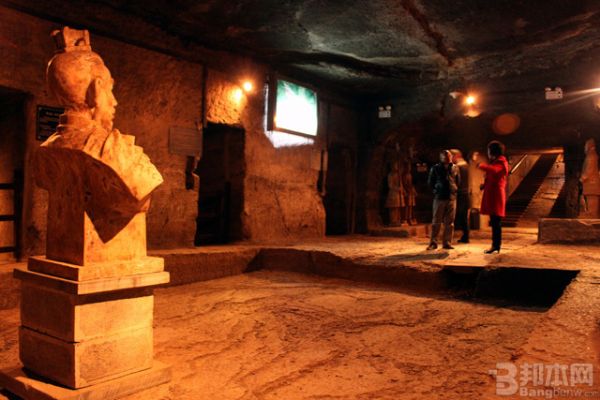
The Tomb of Queen of Prince Xiao of Liang is located 200 meters north of the Tomb of Prince Xiao of Liang. It is a large cliff tomb, where the burial chamber penetrates through the northern peak of Bao'an Mountain, forming two entrances on the eastern and western sides. The tomb is 210 meters long, with an interior area of 1,600 square meters, consisting of two passages, three corridors, and thirty-four chambers. The entire tomb resembles an underground palace and is currently the largest and most structurally complex large-scale tomb discovered. The tomb contains several thousand stone plugs, each weighing about one ton, most of which are inscribed, providing important information for studying the tomb’s structure and period. A burial pit was discovered to the south of the queen’s tomb, yielding nearly two thousand artifacts, including gold-plated bronze horse and chariot fittings, jade artifacts, and weapons. The horse and chariot fittings are practical items, large in size and exquisitely crafted, representing the highest level of craftsmanship in the Han Dynasty. A bronze seal inscribed with “Liang Hou Yuan” (Garden of the Queen of Liang) was also unearthed, providing direct evidence for identifying the tomb owner.
The Shiyuan Tomb derives its name from its location behind Shiyuan Village. Judging from the tomb’s structure, it likely belonged to a prince of Liang. The ceiling and sides of the main chamber feature a large mural with vibrant colors and smooth lines, making it one of the earliest and best-preserved large murals discovered in China.
The Xishan Tomb is located at the summit of Xishan Mountain northeast of the Tomb of Prince Xiao of Liang. It is a vertical rock-cut tomb. The tomb entrance faces east, and the front section of the tomb passage yielded a large number of exquisite jade artifacts, including over seventy jade discs, twenty-four jade sword and knife ornaments, as well as jade halberds, jade tablets, jade pigs, jade doves, and jade figurines of male and female dancers. Over a thousand jade fragments unearthed in the tomb have been restored into a complete jade burial suit threaded with gold wire. This is the second relatively intact jade burial suit discovered after the one in the Mancheng Han Tombs.
In 1996, the Tomb Cluster of the Han Princes of Liang was designated as part of the fourth group of Major Historical and Cultural Sites Protected at the National Level by the State Council.
Liu Wu (?~144) Liu Wu (unknown–144 BC) was a feudal prince of the Liang Kingdom during the Western Han Dynasty. He was the second legitimate son of Emperor Wen of Han (Liu Heng) and the younger full brother of Emperor Jing of Han (Liu Qi), with Empress Dou as their mother. In 178 BC (the 2nd year of Emperor Wen’s reign), he was enfeoffed as the Prince of Dai. In 176 BC (the 4th year of Emperor Wen’s reign), he was transferred to be the Prince of Huaiyang. In 168 BC (the 12th year of Emperor Wen’s reign), after the death of Prince Xiao of Liang (Liu Yi) without an heir, Liu Wu succeeded as the Prince of Liang. During the Rebellion of the Seven States, Liu Wu led troops to resist the allied forces of Wu and Chu, defending Suiyang (present-day Shangqiu, Henan), the capital of Liang, thereby protecting the imperial capital Chang’an. His contributions were immense. Later, relying on the favor of Empress Dou and the strength of the Liang Kingdom, he attempted to succeed Emperor Jing of Han but died of illness before succeeding. He was posthumously honored with the title “Filial King...” More details +
Share
This article is published by HowToTrip. Sharing and reposting are welcome — please credit the source.
Article URL: https://www.howtotrip.net/travel-14843
Related Articles
- Shaoxing's "Grandpa Gourd" hangs the gourds back up: "If there are too many people, we'll interact less — just take a quick look from afar"
- Chinese authorities announce "reciprocal adjustment" to Japan visa fees — single-entry visa jumps from 2,250 to 16,750 yen!
- The "health stones" carried by a traveler were found to have radiation levels exceeding safety limits by a thousand times, potentially endangering fellow passengers on the same flight. Customs issues warning!
- Shenzhen Airport Issues Late-Night Notice: Unidentified Aerial Object Detected, Causing Widespread Flight Delays!
- “They only said it cost money after I opened the box and washed it!” 200g of grapes sold for 60 yuan on a high-speed train—12306 responds!
- Can't buy an airline ticket? Denied exit? Blocked from boarding? A large number of Chinese tourists have mysteriously become "discredited individuals"
- Adverse weather and economic fluctuations impact Colombia's coffee market
- Beach bathing area responds to 2 yuan/30 seconds fee for freshwater foot rinsing: Clearly priced!
- Taking off with an improperly closed cabin door? Wing malfunction? Multiple flights made emergency returns mid-journey!
- Experience the gifts of nature! A countdown of the world’s ten most stunning coastlines