Quguang Park
Quguang Park
In 1957, the Shanghai Municipal Bureau of Culture allocated funds for restoration and designated it as a municipal cultural heritage site. During the Cultural Revolution, parts of the site were occupied, and the stone relics were further damaged. In 1978, the Shanghai Revolutionary Committee reclaimed the occupied land, funded renovations, and opened it to the public as Nandan Park on May 1st of that year. In 1981, the tomb was reconstructed into a large elliptical Ming-style grave. In November 1983, to mark the 350th anniversary of Xu Guangqi’s death, Nandan Park was renamed Quguang Park in his honor. On January 13, 1988, it was listed as a National Key Cultural Relics Protection Unit by the State Council. Major Attractions (Areas)
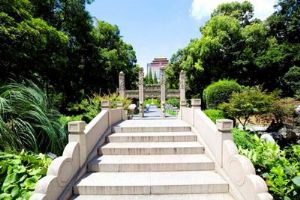
Quguang Park is a commemorative park. The northern section is the tomb area, the eastern part is a leisure zone, and the western area is designated for youth activities. The park features distinctive Dutch-style umbrella pavilions and waterside gazebos. A bust of Xu Guangqi stands in front of the tomb, with an inscription corridor displaying his calligraphy to the left. The tomb is surrounded by evergreen pines and cypresses. The park is filled with winding paths, lush trees, koi in lotus ponds, and green lawns. It is well-maintained, tranquil, and offers a peaceful retreat in the bustling city. The surroundings are planted with resilient evergreens such as metasequoia, oleander, privet, and black pine. Along the paths, pond edges, and near the tomb, podocarpus, dragon juniper, metasequoia, ginkgo, and camphor trees are widely planted, interspersed with flowering trees and shrubs like magnolia, silk tree, and wintersweet to enrich seasonal scenery and enhance the landscape. The park hosts nearly 100 species of trees, with seasonal flowers rotated throughout the year.
Xu Guangqi’s Tomb: Located in the northern part of the park, the tomb is elliptical, standing 2.2 meters high and encased in granite. The top is covered with lush green grass. In front of the tomb are planted large camphor trees, dragon junipers, cedars, and oleanders, while a forest of metasequoia trees stands behind. A tombstone inscribed with the five characters “Ming Xu Guangqi Tomb” (written by Su Buqing) is erected at the front. Stone benches are placed on both sides, with a Qing Dynasty stone horse preserved on the right.
Transportation
Routes 732, 920, 205, 830, and others
Admission
Free
Opening Hours
05:00–18:00
Location
No. 17, Nandan Road, Xuhui District, Shanghai
Xu Guangqi (1562~1633) Xu Guangqi (April 24, 1562 – November 10, 1633) was a scientist, agronomist, and politician of late Ming China, and one of the pioneers of East-West cultural exchange. His courtesy name was Zixian, and his pseudonym was Xuanhu. His baptismal name was Paul. He was of Han ethnicity, from Shanghai County, Songjiang Prefecture, Nanzhili (modern-day Shanghai), a Catholic, and revered as the foremost of the “Three Pillars of the Holy Faith.” He passed the imperial examination in the 32nd year of the Wanli reign (1604). Proficient in astronomy, calendrical science, and firearms, he converted to Catholicism and studied with the Italian missionary Matteo Ricci. In the 40th year of Wanli, he served as an official compiling almanacs and collaborated with the missionary Johann Adam Schall von Bell to create celestial and terrestrial globes and other observational instruments. The following year, he was accused of misconduct, claimed illness, and resigned to farm in Tianjin. In his forties... Details+
Share
This article is published by HowToTrip. Sharing and reposting are welcome — please credit the source.
Article URL: https://www.howtotrip.net/travel-14166
Related Articles
- Shaoxing's "Grandpa Gourd" hangs the gourds back up: "If there are too many people, we'll interact less — just take a quick look from afar"
- Chinese authorities announce "reciprocal adjustment" to Japan visa fees — single-entry visa jumps from 2,250 to 16,750 yen!
- The "health stones" carried by a traveler were found to have radiation levels exceeding safety limits by a thousand times, potentially endangering fellow passengers on the same flight. Customs issues warning!
- Shenzhen Airport Issues Late-Night Notice: Unidentified Aerial Object Detected, Causing Widespread Flight Delays!
- “They only said it cost money after I opened the box and washed it!” 200g of grapes sold for 60 yuan on a high-speed train—12306 responds!
- Can't buy an airline ticket? Denied exit? Blocked from boarding? A large number of Chinese tourists have mysteriously become "discredited individuals"
- Adverse weather and economic fluctuations impact Colombia's coffee market
- Beach bathing area responds to 2 yuan/30 seconds fee for freshwater foot rinsing: Clearly priced!
- Taking off with an improperly closed cabin door? Wing malfunction? Multiple flights made emergency returns mid-journey!
- Experience the gifts of nature! A countdown of the world’s ten most stunning coastlines