Kubuqi Desert
Kubuqi Desert
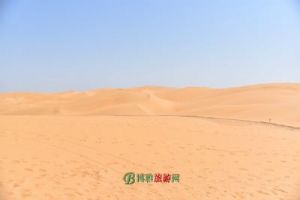
The Kubuqi Desert, located within the Hanggin Banner of Ordos City, is one of China’s seven major deserts. Known as the “world’s largest ovoo,” it is situated here.
Looking up, the grandeur and magnificence of the ovoo are truly breathtaking, and its top is difficult to take in at a single glance. The lotus vase at its peak is cast from 5.6 tons of pure copper, symbolizing the 56 ethnic groups of China, and the engraved lotus patterns carry unique symbolic meanings in Buddhism.
Compared to the ovoos scattered across the depths of the Inner Mongolian grasslands, this world’s largest ovoo in the desert shows significant differences in architectural form. Most ovoos on the grasslands are built from stones, whereas this one is constructed from 99,999 stones gathered from the Daqing Mountain in Inner Mongolia, standing 20 meters high and 45 meters in diameter.
Worshiping and praying for blessings in front of the ovoo
Ovoo, in Mongolian, translates to “pile” or “heap” in Chinese. Ancient Mongolian herders often piled up stones to form ovoos, placing them at crossroads to indicate directions. Later, Genghis Khan would worship the ovoo before each military campaign to pray for victory. Nowadays, ovoos have gradually evolved into altars for worshipping deities, ancestors, and heroes.
Address: Within the Hanggin Banner of Ordos City
Share
This article is published by HowToTrip. Sharing and reposting are welcome — please credit the source.
Article URL: https://www.howtotrip.net/travel-11896
Related Articles
- Shaoxing's "Grandpa Gourd" hangs the gourds back up: "If there are too many people, we'll interact less — just take a quick look from afar"
- Chinese authorities announce "reciprocal adjustment" to Japan visa fees — single-entry visa jumps from 2,250 to 16,750 yen!
- The "health stones" carried by a traveler were found to have radiation levels exceeding safety limits by a thousand times, potentially endangering fellow passengers on the same flight. Customs issues warning!
- Shenzhen Airport Issues Late-Night Notice: Unidentified Aerial Object Detected, Causing Widespread Flight Delays!
- “They only said it cost money after I opened the box and washed it!” 200g of grapes sold for 60 yuan on a high-speed train—12306 responds!
- Can't buy an airline ticket? Denied exit? Blocked from boarding? A large number of Chinese tourists have mysteriously become "discredited individuals"
- Adverse weather and economic fluctuations impact Colombia's coffee market
- Beach bathing area responds to 2 yuan/30 seconds fee for freshwater foot rinsing: Clearly priced!
- Taking off with an improperly closed cabin door? Wing malfunction? Multiple flights made emergency returns mid-journey!
- Experience the gifts of nature! A countdown of the world’s ten most stunning coastlines