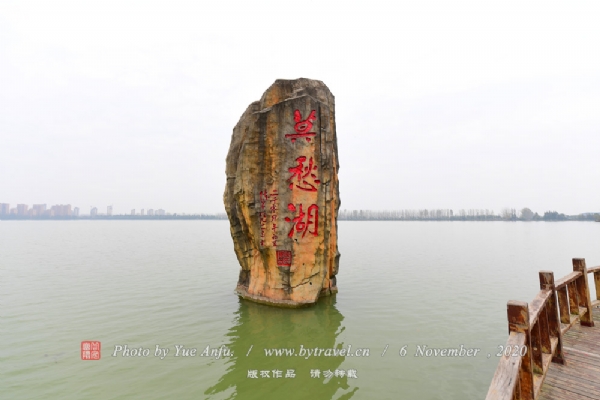
Zhongxiang Mochou Lake
Zhongxiang Mochou Lake

"The Han River flows close to Stone City, towering above the riverside towers; beauties reside on the lake of Stone City, with peach blossoms drifting as Mochou smiles." The ancient city of Zhongxiang, also known as Stone City, is the hometown of the legendary Chu songstress Mochou. According to *Geographical Interpretations*, "Three sides of the Yingzhou inner city walls are naturally formed, with a sheer cliff to the west overlooking the Han River—hence the name Stone City." Mochou, surnamed Lu and named Mochou, was beautiful as a fairy and passionate about song and dance. In her mid-teens, she was summoned to the Chu king’s palace to become a court dancer. Despite hardships, she eventually returned to the people. For over two millennia, countless beautiful stories have been passed down in ancient Jingchu, centered around Mochou and scenic spots like Mochou Village, Mochou Lake, Mochou Ferry, as well as the melodies *Yangchun Baixue* (Spring Snow), Yangchun Terrace, and Bai Xue Tower.
Mochou’s birth and death dates remain uncertain. She was a Chu songstress from the late Warring States period, hailing from Zhongxiang. Surnamed Lu and named Mochou, she was born around the 3rd century BCE, with beauty like a celestial being and a love for music and dance. At sixteen or seventeen, she was recruited into the Chu king Xiang Yuan’s palace as a court dancer, thereby introducing folk songs and dances into royal courts. There, she met and was mentored by Qu Yuan, Song Yu, and Jing Cha, refining her artistry. She later blended ancient high melodies with the works of Qu Yuan and Song Yu, composing and performing iconic pieces such as *Yangchun Baixue* (Spring Snow), *Xialiba Ren* (The Commoners), *Yang’a*, *Jielu*, *Caiwei Ge* (Song of Picking Ferns), and *Maixiu Ge* (Song of Wheat Harvest). The unmatched *Yangchun Baixue* became a timeless masterpiece, profoundly influencing future musical compositions. Legend says she drowned herself in the Han River after her fiancé was exiled to Yangzhou, but was saved by a fisherman and vanished without a trace.
Mochou is remembered for her songs and dances. As noted in *Rongzhai Notes*: "Mochou was from Shicheng in Yingzhou; portraits of her were painted by local artists and widely circulated." Historical records of Mochou appear in ancient *Yuefu* poetry and songs like *Shicheng Yue* (Music of Shicheng) and *Mochou Yue* (Music of Mochou). The *Tang Book·Music Chronicles* states: "*Shicheng* was composed by Song Zangzhi when he served as governor of Jjingling. From atop the city walls, he heard youths singing joyfully and penned this tune." *Mochou Yue* originates from *Shicheng Yue*. It tells of a woman named Mochou in Shicheng skilled in song, with echoes of her voice in the lyrics: "Where is Mochou? West of Shicheng she dwells; two oars paddle swiftly, bringing Mochou near." In the 11th year of the Tianjian era (512), Emperor Wu of Liang modified the "Western Melodies," reducing the dancers of *Mochou* (also called *Man Yue*) from sixteen to eight. Mochou’s legends spread from Western Chu to Eastern Wu, leaving behind cultural landmarks in Zhongxiang like Mochou Village, Mochou Lake, and Mochou Ferry. The Song scholar Wang Zhiwang wrote in *Geographical Triumphs*: "Mochou Village lies west of the Han River, abundant with peach blossoms whose spring fragrance perfumes the waters." The *Zhongxiang County Annals·Historical Sites* note: "Mochou Village is two li west of the Han River; ancient waterways once flowed through the city site, with the village west of it being Mochou’s home. North of the city lies a lake, contiguous with the village, called Mochou Lake." These sites have long drawn poets and scholars. Originally, Mochou’s village was not named so—its peach trees bloomed crimson, earning it the moniker Peach Blossom Village. Adjacent Mochou Lake was anciently called Canglang Lake. Across the river, the snowy Bai Xue Tower on the cliffs of Shiji Ferry faced Yangchun Terrace, while the three Canglang Lakes connected via the river to the village.
Mochou’s father, Lu Gong, made a living ferrying across the Han River; her mother tended mulberry trees and peach orchards. On a stormy day during King Xiang of Chu’s early reign, Mochou was born in a boat at Peach Blossom Village’s river crossing. She cried incessantly at birth until her father soothed her: "Don’t cry, don’t cry, don’t grieve, don’t grieve, don’t worry, don’t worry!" Hearing "don’t worry," she quieted instantly. Thus, he named her Mochou. "Golden sparrow hairpins, born to be called Mochou" (*Ming Dynasty·Zhang Ning*). Raised amid storms, drinking Han River water and eating Peach Blossom Village grain, Mochou often gathered lotus seeds with village girls in Canglang Lake, sold peaches with her parents in town, rowed boats, or practiced dance and song at Yangchun Terrace and Bai Xue Tower. With a clear, melodious voice, she mastered all local tunes effortlessly.
By fifteen or sixteen, Mochou blossomed like a lotus in Canglang Lake—graceful and radiant, her golden voice resonating like jade, her dancing sleeves flashing rainbow hues. Her fame reached the Chu palace, where King Xiang enlisted her as a court dancer and exiled her fiancé, Wang Xiangge, to distant Yangzhou. The ancient *Mochou Yue* laments their tearful Han River farewell: "Hearing you’re bound for Yangzhou, I see you off atop Chu’s hills; clutching your waist, I watch as the river’s flow seems to halt!" The surging waves couldn’t wash away her sorrow. Enraged, she leaped from Bai Xue Tower into the Han River.
To honor her, Peach Blossom Village became Mochou Village, Canglang Lake became Mochou Lake, and the ferry below Bai Xue Tower where she moored her boat was named Mochou Ferry. "Grief lies in parting, joy in new bonds" (*Qu Yuan·Nine Songs·Lesser Minister of State*). Legends say Mochou wasn’t lost—rescued by fishermen, she sought Qu Yuan and Wang Xiangge, wandering the rivers and lakes, returning to the people. *Mochou Yue* sings: "Every home welcomes Mochou, everyone speaks her name; each word of her song etches deep in the heart!" Countless poems, odes, and songs across eras recount her legacy. Tang poet Li Shangyin wrote: "Amid snow and flowers, who keeps her company? Myriad plum and snow blossoms bloom. Were there no boat at Stone City, Mochou’s sorrow would remain." Tang’s Zheng Gu penned: "Stone City, once Mochou’s land, now lies desolate; sails come and go, winds vast, flowers bloom and fade in mournful springs." Song’s Wang Zhiwang mused: "At Canglang Ferry, Mochou’s homeland, vast mist veils frost-laden woods; cherish your host’s kindness, drink dusk away." Zhou Mi’s *Apricot Blossom Sky·Ode to Mochou* describes: "Auspicious clouds crown her brow; tender brows can’t hold sorrow. Who revives her spirit with brushstrokes? After she left, willows stayed green; dance dreams vanish without trace. Grief follows oar strokes north and south, as winds rage at Stone City." Ming’s Wang Shizhen wrote: "Leaning on my whip, past white-nosed steeds, I circle peach-blossomed ferries—no time for delays, first I seek Mochou’s home." Qing’s Liu Zehong added: "West of Stone City lies Mochou Lake—who’d guess the woman was Lu? Trying to dispel sorrow at Mochou Lake, sorrow remains unresolved." Qing’s Li Su’s *Peach Blossoms at Mochou Village* reads: "The southern belle named Mochou still thrives here; her spirit stirs peach petals one by one."
Once, Mochou Lake spanned thousands of acres of azure waters. Over time, the Han River shifted five li westward, altering the lake. *Records of Regional Prosperity and Decline* notes: "The Han River’s old course pressed close to the city; by the early Ming Jiajing era, it moved east along mountain bends, farther from town." The *Zhongxiang County Annals·Geography* states: "Post-Xianling Mausoleum construction, Ming emperor Wuzong, influenced by feng shui, blocked the Ao outlet, forcing the Han River southward. Ao waters now join the Han directly, no longer reaching Mochou Lake." The former lake spanning both Han River banks, along with peach-blossomed Mochou Village, now lies entirely east of the river. The western bank’s Wenji Town retains Chu customs—riverbank peach groves and the heritage dance *Phoenix Dance*. Mochou Lake, reduced by land reclamation, now spans roughly 2 square kilometers with 10 million cubic meters of water. Modern cotton mills and water plants stand on the old riverbed, where a new generation of "Mochou girls" contribute to the nation’s development.
Mochou Lake enjoys pleasant weather year-round, with boundless scenery. Its hundred islets are picturesque, blending water and sky. On Yangchun Baixue Isle, Bai Xue Tower and Yangchun Terrace face each other across the water, evoking Mochou’s spirit; Lan Tai Palace relives Chu’s courtly dances. On Xialiba Ren Isle, scenes of farming, fishing, and lively mountain songs unfold.
Passing a lake branch reveals *Bai Xue Tower*, named alongside Yangchun Terrace for the melodies *Yangchun* and *Baixue*. Originally a military watchtower in the Warring States period, it became a haunt for scholars and poets, gaining enduring fame. From the Spring and Autumn to Tang and Song dynasties, literary giants like Qu Yuan, Song Yu, Li Bai, Du Fu, Bai Juyi, Wang Wei, Meng Haoran, Li Shangyin, Ouyang Xiu, Sima Guang, and Wang Anshi frequented it, leaving behind timeless verses.
Northeast of Mochou Lake lies the Ming Dynasty’s Fifteen Tombs—Xianling Mausoleum, connected to the lake by a winding river. Each spring, peach blossoms flourish along its shores; in summer and autumn, girls gather to wash, sing, and harvest lotus. South of the lake, a willow-lined dike offers idyllic fishing spots.
Suggested Duration
1–2 hours
Admission
15.00 RMB
Opening Hours
Summer (March 1 – September 1): 06:00–22:00
Winter (September 1 – February 1): 06:00–23:00
Summer (March 1 – September 1): 06:00–22:00
Winter (September 1 – February 1): 06:00–23:00
Location
Yingzhong Town, Zhongxiang, Jingmen, Hubei Province
Share
This article is published by HowToTrip. Sharing and reposting are welcome — please credit the source.
Article URL: https://www.howtotrip.net/travel-11857
Related Articles
- Shaoxing's "Grandpa Gourd" hangs the gourds back up: "If there are too many people, we'll interact less — just take a quick look from afar"
- Chinese authorities announce "reciprocal adjustment" to Japan visa fees — single-entry visa jumps from 2,250 to 16,750 yen!
- The "health stones" carried by a traveler were found to have radiation levels exceeding safety limits by a thousand times, potentially endangering fellow passengers on the same flight. Customs issues warning!
- Shenzhen Airport Issues Late-Night Notice: Unidentified Aerial Object Detected, Causing Widespread Flight Delays!
- “They only said it cost money after I opened the box and washed it!” 200g of grapes sold for 60 yuan on a high-speed train—12306 responds!
- Can't buy an airline ticket? Denied exit? Blocked from boarding? A large number of Chinese tourists have mysteriously become "discredited individuals"
- Adverse weather and economic fluctuations impact Colombia's coffee market
- Beach bathing area responds to 2 yuan/30 seconds fee for freshwater foot rinsing: Clearly priced!
- Taking off with an improperly closed cabin door? Wing malfunction? Multiple flights made emergency returns mid-journey!
- Experience the gifts of nature! A countdown of the world’s ten most stunning coastlines