Zambia
A landlocked highland nation famed for Victoria Falls and South Luangwa walking safaris, shaped by the Zambezi River and copper mines that define both its natural landscape and economy.
Zambia (Republic of Zambia)
| Capital | Lusaka |
|---|---|
| Continent | Africa |
| Languages | English |
| Currency | Zambian Kwacha (ZMW ZK) |
| Time Zone | UTC+2 |
| Dialling Code | +260 |
| Area / Population | 752,612 square kilometers / Approximately 19.6 million |
| Visa | Most foreign visitors can apply for an e-visa online in advance or obtain a visa on arrival at major entry points; for combined trips to Victoria Falls with Zimbabwe, check the KAZA Uni-Visa policy; a yellow fever vaccination certificate and valid travel documents are required upon entry. |
| Best Season | The dry season from May to October is ideal for walking safaris and wildlife viewing; the rainy season from March to May offers the most spectacular waterfall views, while the low-water period from August to December allows access to Devil’s Pool; some dirt roads may become impassable during the rainy season starting in November. |
| Main Cities | Lusaka, Livingstone, Kitwe, Ndola, South Luangwa National Park, Lower Zambezi National Park, Kafue National Park, Lake Kariba |
Zambia in Detail
Zambia Overview
Zambia (officially the Republic of Zambia) is one of Southern Africa’s largest landlocked countries, covering approximately 753,000 square kilometers and bordered by eight nations: the Democratic Republic of the Congo, Tanzania, Malawi, Mozambique, Zimbabwe, Botswana, Namibia, and Angola. The capital, Lusaka, located on the central plateau, has a population of about 2.8 million and serves as the political and economic hub. The Copperbelt Province, home to Kitwe and Ndola, is the mining heartland. With a population of roughly 19.6 million, English is the official language, while over seventy local languages including Bemba, Nyanja, and Lozi are widely spoken.
In 1964, under the leadership of Kenneth Kaunda, Zambia became one of Africa’s first countries to gain peaceful independence. Over the following decades, it maintained political stability with multiple peaceful transitions of power, earning recognition as a model of democratic governance in Africa.
Geography and Climate
Lying entirely on a plateau 1,000–1,400 meters above sea level, Zambia features gentle undulations and is largely covered by tropical savanna and sparse miombo woodlands. The southern border is formed by the Zambezi River, which it shares with Zimbabwe to form Victoria Falls (locally known as "Mosi-oa-Tunya," meaning "The Smoke That Thunders"), a waterfall nearly 1.7 kilometers wide with a drop of over 100 meters—one of the largest in the world. The middle reaches of the Zambezi also create Lake Kariba, one of the world’s largest artificial reservoirs by volume. The Luangwa and Kafue river systems nourish three flagship national parks: South Luangwa, Lower Zambezi, and Kafue.
The climate is divided into three seasons: the warm, wet rainy season from November to April; the cool, dry season from May to August; and the hot, dry season from September to October. The dry season, when vegetation is sparse and animals gather around water sources, is the prime time for walking safaris. During the rainy season, the falls are at their most powerful, while the low-water period allows access to the edge of Devil’s Pool. Some dirt roads may become difficult to navigate from November onward.
Historical Background
Prehistoric hunter-gatherers, including the San people, were the earliest inhabitants of Zambia. Later, during the Bantu migrations, kingdoms such as the Maravi Empire and the Lozi Kingdom emerged. The Lozi people continue to celebrate the annual Kuomboka festival, marking the king’s relocation to higher ground. In the late 19th century, the area came under the control of the British South Africa Company (Cecil Rhodes’ colonial enterprise) and became the British protectorate of Northern Rhodesia in 1924, attracting migrant laborers due to large-scale copper mining. From 1953 to 1963, it was part of the short-lived Federation of Rhodesia and Nyasaland before gaining independence on October 24, 1964, as the Republic of Zambia.
In its early years, Zambia enjoyed relative prosperity due to high copper prices but faced challenges from nationalization policies and fluctuating copper markets. In the 1970s, the Tanzam Railway, built with international assistance and connecting Kapiri Mposhi to Dar es Salaam, provided Zambia—a landlocked nation—with an alternative route to the sea, bypassing Rhodesia. This project remains a landmark of regional cooperation and a symbol of enduring bilateral friendship.
Economy and Currency
Zambia is rightfully known as the "Copperbelt Country," with copper exports historically accounting for around 70% of total exports. Mining towns in the Copperbelt Province, such as Kitwe and Ndola, form the country’s second-largest urban agglomeration. Agriculture focuses on maize, tobacco, cotton, and soybeans. Hydroelectric power from the Zambezi River’s Kariba and Kafue Gorge dams supplies most of the nation’s electricity, with surplus energy exported to neighboring countries during wet years. The official currency is the Zambian Kwacha (ZMW), which underwent a redenomination in 2013 to remove three zeros (1 new kwacha = 1,000 old kwacha). The word "kwacha" means "dawn" in Nyanja, while "ngwee" (the coin unit) means "brightness"—reflecting post-independence aspirations. Recent years have seen continued investment in mining expansion and infrastructure, though the economy remains highly sensitive to global copper prices.
Culture and Society
Zambia’s over seventy ethnic groups share a strong national identity. English is the official language, and urban areas feature relatively high education levels. Traditional ceremonies are vibrant: the Lozi people’s Kuomboka Festival includes the symbolic voyage of King Lubosi Imwiko II aboard the royal barge Nalikwanda to the highland palace. The Ngoni people’s Incwala Festival reenacts ancestral migration through traditional war dances. Staple foods include nshima (a thick porridge made from white maize meal), typically served with vegetable relishes like ifisashi, lake fish, or grilled chicken. Christianity is the dominant religion, coexisting with traditional tribal beliefs. Zambians are known for their warmth and politeness, often greeting visitors with "Muli shani" (How are you?).
Tourism Highlights
Zambia is a top destination for immersive African safaris. South Luangwa National Park is the birthplace of walking safaris, where armed and eco-guides lead treks to approach elephants, lions, and giraffes up close—an experience far more raw and thrilling than game drives. Lower Zambezi National Park is renowned for canoe safaris and riverside camps, offering close encounters with hippos, crocodiles, and elephants. Kafue National Park, larger than the Serengeti yet far less visited, hosts dramatic lion hunts on the Busanga Plains in the late dry season. Livingstone, the Adventure Capital, provides adrenaline with Victoria Falls Bridge bungee jumps, Zambezi sunset cruises, and white-water rafting during the dry season. Daily flights and comfortable long-distance buses connect Lusaka to Livingstone, while small charter planes and 4x4 vehicles serve the parks. Most foreign visitors can enter with an e-visa.
Local Currency: Zambian Kwacha (ZMW)
Currency Overview
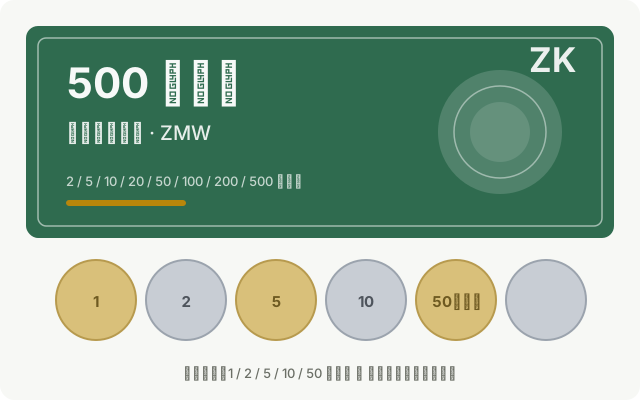
The official currency of Zambia is the Zambian Kwacha (currency code: ZMW, symbol: ZK), issued by the Bank of Zambia. The subunit is the ngwee, with 100 ngwee equal to 1 kwacha. The term "kwacha" means "dawn" in Nyanja and Bemba, while "ngwee" means "brightness," reflecting the hopes for the nation’s future at independence. In January 2013, Zambia redenominated its currency by removing three zeros—1 new kwacha equals 1,000 old kwacha. The kwacha floats freely against other currencies, with an approximate exchange rate of 1 US dollar to 4–5 ZMW (subject to real-time rates). Copper prices and U.S. dollar cycles significantly influence its value, which has seen considerable fluctuations in recent years.
Denominations
Current banknotes come in six denominations: 2, 5, 10, 20, 50, and 100 kwacha. The obverse features national symbols such as the African fish eagle, waterfalls, and the Parliament building, along with portraits of Zambia’s three post-independence leaders. Coins include 5, 10, 50 ngwee, and 1 kwacha, though banknotes are more commonly used for daily transactions. While "thousands" remain a common unit in speech (e.g., "K10" or "K50"), always confirm the exact amount when dealing with vendors.
Cash and Payment Practices
Urban areas in Zambia are rapidly adopting digital payments: shopping malls, supermarkets, and gas stations in Lusaka and Livingstone widely accept Visa/Mastercard, while mobile money services (MTN Mobile Money, Airtel Money) are prevalent in smaller shops. However, cash remains essential in rural areas, near national parks, and at bus stations. ATMs are readily available in Lusaka, Ndola, and Livingstone, with machines from Zanaco, Stanbic, and FNB being more foreign-card friendly. UnionPay coverage is limited. While the U.S. dollar is commonly used for tourism-related fees (visa fees, park entry, and waterfall charges), it is generally not accepted for everyday purchases. Exchange money only at authorized dealers or banks in Lusaka or Livingstone—the airport offers less favorable rates.
Traveler Tips
- Carry both pristine U.S. dollar bills and a credit card for visa fees and park entry, which are often payable in USD.
- The kwacha is volatile; exchange small amounts at a time and convert leftover cash back to USD at the airport before departure.
- Avoid displaying valuables in Lusaka’s suburbs or at night, and agree on taxi fares before boarding (most taxis are unmetered).
- ATMs have withdrawal limits (approximately 2,000–5,000 ZMW per transaction) and may run out of cash during peak hours.
- Most adventure activities in Livingstone (bungee jumping, rafting, helicopters) can be paid for directly with USD cards—no need to pre-exchange currency.
Flag Meaning
Flag Design
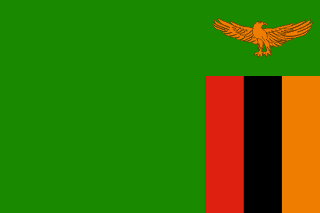
The Zambian flag was adopted on October 24, 1964, the day of independence, and designed by Gabriel Ellison. It is rectangular with a 2:3 ratio, predominantly green. On the right side (hoist side), three equal vertical stripes in red, black, and orange are displayed. Above these stripes, on a green background, is an orange African fish eagle in flight. The eagle and stripes are positioned slightly off-center to the right—a rare design choice among world flags.
Symbolism
Officially, green represents the country’s vegetation and agricultural wealth, as well as the color of the highland landscape. Red symbolizes the struggle for freedom, black stands for the Zambian people, and orange signifies the nation’s key mineral resource: copper, the lifeblood of the Copperbelt economy. The soaring African fish eagle, common along Zambia’s lakes and rivers, embodies the nation’s resilience and aspirations to rise above adversity—its image also echoes the eagle on the national coat of arms.
History and Legal Status
This flag was selected by a government committee just before independence, encapsulating the nation’s anti-colonial struggle, ethnic identity, and copper-driven economy. It is one of the few flags in newly independent Africa designed by a local artist. Under Zambia’s National Emblems Act, the flag’s use is protected by law and must be displayed at government buildings, border posts, and schools. It is prominently featured during national holidays such as Independence Day and Africa Day. Misuse or disrespect toward the flag carries legal penalties. The Zambian flag is also a textbook example of the "eagle plus vertical stripes" flag design in vexillology.
Zambia Travel Guide
All Guides »Zambia Travel Quick Guide: e-Visa, Dry-Season Safaris, Budget & Etiquette Tips
When are Victoria Falls at their most spectacular? When is Devil’s Pool open? Ho...
Classic 7-Day Zambia Itinerary: South Luangwa Walking Safari + Victoria Falls in Livingstone 7 days
Experience both walking safaris and waterfall adventures: explore the untamed wi...
Zambia 4-Day Livingstone Short Break: Both Sides of the Falls, the Zambezi River & White Rhinos 4 days
A compact adventure itinerary based in adventure capital Livingstone: Zambia-sid...
A must-visit attractions list in Zambia: Victoria Falls, wilderness parks, and the Lozi Kingdom
From Victoria Falls to the Busanga Plains, this guide outlines Zambia’s top 10 a...
Zambia Food Guide: Nshima with Ifisashi — From Market Eateries to Riverside Restaurants
Cornmeal nshima is the true soul food of Zambia: how to eat it the local way, wh...
Complete Guide to Transportation in Zambia: Domestic Flights, Long-Distance Buses, and Riverside Transfers
How to get from Lusaka to Livingstone, how to fly to South Luangwa, choosing bet...
10 Practical Tips for Traveling in Zambia: Malaria Prevention and Victoria Falls Devil’s Pool Booking Info
Malaria prevention, booking slots for Devil’s Pool, how to split your cash betwe...