South Korea
A Northeast Asian country known as the birthplace of Hallyu culture, famous for its fast-paced cities, mountain hot springs, island scenery, and deep Confucian traditions.
South Korea (Republic of Korea)
| Capital | Seoul |
|---|---|
| Continent | Asia |
| Languages | Korean |
| Currency | South Korean Won (KRW ₩) |
| Time Zone | UTC+9 |
| Dialling Code | +82 |
| Area / Population | 100,400 square kilometers / Approximately 51.7 million |
| Visa | Most foreign visitors need a visa (tourist visa C-3) to enter South Korea; transit visas are available in cities like Seoul Incheon and Busan. Jeju Island offers visa-free entry for eligible tourists. |
| Best Season | The most comfortable weather is from April to June and September to November; winter is ideal for skiing and visiting spas, while spring cherry blossoms and autumn foliage are peak travel seasons. |
| Main Cities | Seoul, Busan, Jeju Island, Gyeongju, Jeonju, Gangwon Province, Daegu |
South Korea in Detail
Overview of South Korea
South Korea (Republic of Korea) is located on the southern half of the Korean Peninsula in Northeast Asia, surrounded by sea on three sides. It faces China across the Yellow Sea to the west, borders the Sea of Japan to the east, and is separated from North Korea by the Military Demarcation Line to the north. The country covers an area of approximately 100,400 square kilometers, with mountains and hills accounting for about 70% of the land. The capital, Seoul, is situated in the Han River basin and serves as the political, economic, cultural, and technological hub of South Korea, with its metropolitan population exceeding half of the national total.
South Korea is a presidential republic with a global top-ten economy. Its shipbuilding, automotive, semiconductor, display panel, cosmetics, and pop culture industries hold significant influence worldwide.
Geography and Climate
South Korea has higher elevations in the east and lower in the west, with the Taebaek Mountain Range extending along the east coast. Major plains are concentrated on the west and south coasts. About 70% of the country is mountainous, with Hallasan (1,947 meters) on Jeju Island being the highest peak. Major rivers include the Han River, Nakdong River, and Geum River.
The climate is temperate with distinct seasons: spring (March to May) is dry and windy with blooming cherry blossoms; summer (June to August) is hot and rainy, with the monsoon season typically peaking in mid-to-late July; autumn (September to November) features clear skies and vibrant foliage, making it the best travel season; winter (December to February) is cold and dry, with heavy snowfall in Gangwon Province, ideal for skiing. Jeju Island has a subtropical oceanic climate, with relatively mild winters.
Historical Background
The history of the Korean Peninsula dates back to ancient times, with the Three Kingdoms period (Goguryeo, Baekje, and Silla) emerging around the turn of the first millennium. Silla unified the three kingdoms in 668. In 918, Wang Geon established the Goryeo Dynasty, from which the name "Korea" is derived. In 1392, Yi Seong-gye founded the Joseon Dynasty, establishing its capital in Hanyang (now Seoul), where Confucianism became the societal norm. In 1446, King Sejong promulgated Hangul, the Korean alphabet.
In 1910, the Korean Peninsula was annexed by Japan. After Japan’s surrender in 1945, the peninsula was divided. The Republic of Korea was established in 1948. The Korean War (1950–1953) ensued, after which the country pursued industrialization and modernization, achieving rapid economic growth known as the "Miracle on the Han River." South Korea joined the OECD in 1996, becoming a developed economy.
Economy and Currency
South Korea is a typical export-driven economy, with multinational conglomerates like Samsung, Hyundai, SK, and LG playing key roles in global supply chains. The country leads the world in semiconductor and display panel production. In recent years, the "Korean Wave"—encompassing K-pop, Korean dramas, films, cosmetics, and cuisine—has become a major soft power export and a key draw for international tourism.
The official currency is the South Korean Won (KRW), issued by the Bank of Korea. The largest banknote is 50,000 KRW. South Korea is one of the most cashless societies in the world, with credit cards, transportation cards, and mobile payments widely accepted.
Culture and Society
South Korean society is deeply influenced by Confucian values, emphasizing hierarchy and collective etiquette. Practices such as bowing, honorific speech, and younger diners pouring drinks for elders are common. At the same time, South Korea is a global leader in digital innovation, blending high-speed internet, smart devices, and communal dining culture (such as sharing dishes).
The cuisine centers around rice, soups, and side dishes (banchan), with globally recognized dishes like kimchi, barbecue, fried chicken with beer (chimaek), samgyetang (ginseng chicken soup), and spicy stir-fried rice cakes. Public bathhouses (jjimjilbang), hiking, and baseball are popular national pastimes.
Tourism Overview
South Korea is a top travel destination in East Asia. Seoul offers a blend of tradition and modernity, with landmarks like Gyeongbokgung Palace, Bukchon Hanok Village, Myeongdong, and Gangnam. Busan combines coastal charm and artistic flair with spots like Haeundae and Gamcheon Culture Village. Jeju Island is ideal for families and honeymooners, featuring volcanic landscapes, haenyeo (female divers) culture, and scenic drives. Gyeongju and Jeonju provide deep historical and culinary experiences.
Local Currency: South Korean Won (KRW)
Currency Overview
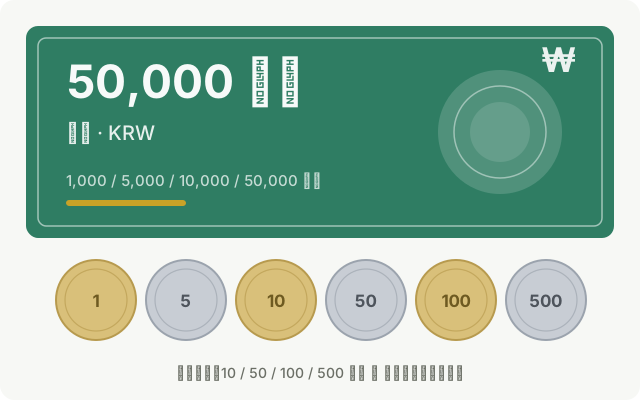
The official currency of South Korea is the South Korean Won (currency code KRW, symbol ₩, or written KRW), issued by the Bank of Korea. The won has no subunit, and smaller denominations like 1-won and 5-won coins or bills under 1,000 won are rarely used in daily transactions. The smallest commonly used bill is 10 won.
Denominations
There are four banknotes: 1,000, 5,000, 10,000, and 50,000 won, featuring portraits of Yi Hwang (Toegye), Yi I (Yulgok), King Sejong, and Shin Saimdang, respectively. The reverse sides depict related cultural heritage sites and artworks. Coins come in four denominations: 10, 50, 100, and 500 won, often featuring designs like the pagoda, ears of rice, Admiral Yi Sun-sin, and cranes.
Cash and Payment Habits
South Korea is one of the most cashless societies globally. Convenience stores, cafes, taxis, street food stalls, and even small vendors generally accept card or mobile payments. International credit cards (Visa, Mastercard, UnionPay, JCB) are widely accepted. The T-money transportation card can be reloaded at convenience stores and used for public transport and small purchases.
It’s advisable to carry a small amount of cash (around 20,000–50,000 won per person per day) for traditional markets, street food, or remote areas. The rest can be paid by card. Exchange rates at authorized currency exchange offices in Seoul, Busan, airports, and districts like Myeongdong are usually better than those at airport counters.
Traveler Tips
- Won denominations are large, and change in the thousands is normal—don’t misjudge the amount.
- Restaurant prices usually exclude service charges, though mid-to-high-end eateries may add a 10% service fee.
- Some small shops may struggle to provide change for 50,000-won bills; carry smaller denominations like 5,000 or 10,000 won.
- Tipping is not customary in South Korea—the bill amount is final.
- T-money cards are widely accepted on public transport and in convenience stores; purchase and reload them at convenience stores beforehand.
Flag Meaning
National Flag Design
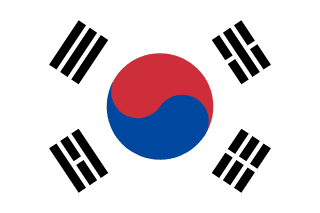
The South Korean flag is officially called the "Taegukgi" (태극기, Taegeukgi). It features a white rectangular field with a 3:2 aspect ratio, centered on a red and blue taegeuk (yin-yang) symbol, surrounded by four black trigrams (kwae) in each corner.
The taegeuk consists of a red upper half and blue lower half, representing the dynamic interaction of yin and yang. The four trigrams symbolize heaven (☰), earth (☷), water (☵), and fire (☲).
Meaning
The white background signifies purity and a desire for peace. The taegeuk circle represents cosmic harmony, with red symbolizing yang (day, creation) and blue symbolizing yin (night, receptiveness), in eternal balance. The four trigrams represent the fundamental elements of the universe and embody the ideals of the nation and virtues of its people.
History and Legal Status
The Taegukgi was designed in 1882 by politician Park Yeong-hyo and first used internationally as the flag of the Korean delegation that year. After the establishment of the Republic of Korea, it was adopted as the national flag. In 1950, the South Korean government enacted the Flag Act, standardizing its proportions, colors, and display guidelines, with further revisions to official color standards in 2004.
Today, the Taegukgi is prominently displayed on South Korea’s National Liberation Day (August 15), Constitution Day (July 17), and National Foundation Day (October 3), as well as at government buildings, schools, and sporting events. It is a powerful symbol of national identity.
South Korea Travel Guide
All Guides »South Korea Travel Quick Guide: Visas, Best Seasons, Budget, and Etiquette
Find out how to choose the right visa, the most comfortable time to visit, and h...
6-Day Classic South Korea Itinerary: Seoul – Busan – Jeju 6 days
Experience three distinct settings—city, port, and island—all in one trip, conne...
3-Day Short Trip to South Korea: Seoul Itinerary 3 days
You can have a great time just in Seoul: the itinerary is divided into three the...
Must-visit attractions in South Korea: Seoul, Busan, Jeju
From Seoul’s palaces and trendy neighborhoods, to Busan’s sea and villages, and ...
Korean Food Guide: BBQ, Korean Set Meals, and Street Snacks
From street food at around $7 per person to high-end Korean set meals, explore K...
Korea Transportation Guide: T-money Cards, KTX, and Airport Express
Use a T-money card to travel on subways and buses across Korea, and take the KTX...
10 Practical Tips for Traveling in South Korea
Install these two apps and bring this one card—half the battle of independent tr...