Singapore
A city-state guarding the eastern end of the Strait of Malacca, renowned worldwide for its garden city landscapes, diverse ethnic cuisines, and efficient governance. It is also a key financial and transshipment hub in Southeast Asia.
Singapore (Republic of Singapore)
| Capital | Singapore |
|---|---|
| Continent | Asia |
| Languages | English, Malay, Mandarin, Tamil |
| Currency | Singapore Dollar (SGD S$) |
| Time Zone | UTC+8 |
| Dialling Code | +65 |
| Area / Population | Approximately 735 square kilometers / Approximately 6 million |
| Visa | Since February 2024, the mutual visa exemption agreement between Singapore and certain countries has taken effect. Most foreign visitors can enter Singapore visa-free for stays of up to 30 days. An electronic arrival card (SG Arrival Card) must be completed online within three days before arrival, and cash declaration regulations must be followed. |
| Best Season | Year-round is suitable, with February to April and July to September being relatively dry and ideal for outdoor and seaside activities. November to January is the rainy season, with frequent short afternoon thunderstorms—just carry an umbrella. |
| Main Cities | Marina Bay, Sentosa, Orchard Road, Chinatown, Little India, Kampong Glam, Clarke Quay, Katong |
Singapore in Detail
Overview of Singapore
Singapore (Republic of Singapore) is a city-state located at the southern tip of the Malay Peninsula in Southeast Asia. It consists of the main island of Singapore and about 60 smaller surrounding islands, covering a land area of approximately 735 square kilometers. It is one of the smallest countries in the world and one of the rare city-states globally. It faces Malaysia across the Johor Strait to the north and Indonesia’s Batam Island across the Singapore Strait to the south. It guards the eastern exit of the Strait of Malacca, making its geographical location extremely strategic. The capital is the City of Singapore. The country does not have provincial-level administrative divisions, relying on community organizations and town councils for grassroots governance. The population is around 6 million, with ethnic Chinese accounting for about 70%, and Malays, Indians, and other ethnic groups forming a diverse society. The country operates under a parliamentary republic system, with the president as the head of state and the prime minister and cabinet holding executive power. It has long been known for its efficient and corruption-free governance.
Singapore is one of the Four Asian Tigers and a globally important financial, shipping, and refining center. Despite its small land area and lack of natural resources, it has become a developed economy with one of the highest per capita GDPs in the world, thanks to its strategic location, open policies, and talent strategy.
Geography and Climate
Singapore has a flat terrain, with its highest point, Bukit Timah Hill, reaching only about 164 meters above sea level. Most of the country consists of low-lying plains, with large areas of reclaimed land along the coast, such as Marina Bay and Jurong Island. About half of the country’s land area is covered by greenery and water bodies, with roadside trees, parks, and sky gardens spread across the island, earning it the reputation of a garden city.
The climate is tropical rainforest, with high temperatures and abundant rainfall year-round. The average annual temperature is about 27–31°C, and humidity remains above 80% throughout the year. The annual rainfall is about 2,300 millimeters. There are no distinct seasons, but the months from November to January experience more rainfall due to the northeast monsoon, while June to August are relatively drier under the southwest monsoon. It is advisable to carry a foldable umbrella when traveling and to note that indoor air conditioning can be very cold, often requiring a light jacket in malls, subways, and cinemas.
Historical Background
Anciently known as Temasek, Singapore was under the influence of the Srivijaya and Majapahit empires from the 14th century. In 1819, British explorer Stamford Raffles landed and signed a treaty with the Sultan of Johor to establish a trading post. In 1826, it became part of the Straits Settlements and quickly grew into a hub for entrepôt trade in Southeast Asia, attracting Chinese, Malay, Indian, and Arab merchants.
During World War II, Singapore was occupied by Japan from 1942 to 1945. In 1963, Singapore merged with Malaya, Sabah, and Sarawak to form Malaysia. On August 9, 1965, it separated from Malaysia and became a republic, a day now celebrated as Singapore’s National Day. Under the leadership of Lee Kuan Yew and his government, Singapore transitioned from an entrepôt port to a developed nation within decades through export-oriented industrialization, public housing policies, anti-corruption measures, and bilingual education.
Economy and Currency
Singapore is a globally significant financial, shipping, and refining center. Key industries include electronics, biomedicine, precision engineering, and chemicals, with services accounting for about 70% of the economy. Changi Airport has consistently been rated the world’s best airport, and tourism and the convention industry are highly developed. The official currency is the Singapore Dollar (SGD, symbol S$), issued by the Monetary Authority of Singapore (MAS). Unlike most countries, Singapore uses exchange rate management rather than interest rates as its primary monetary policy tool, maintaining currency stability by managing a basket of trade partner currencies. As a result, the Singapore Dollar is relatively strong among Asian currencies.
Culture and Society
Singapore is a multi-ethnic, multilingual, and multi-religious society. The official languages are English, Malay, Mandarin, and Tamil, with Malay as the national language and English as the administrative and common language. Ethnic Chinese, Malays, and Indians each retain their own religions and festivals. Lunar New Year, Hari Raya Aidilfitri, Deepavali, and Vesak Day are all public holidays. The society is well-ordered with excellent safety, and the laws are strict. Activities such as importing or selling chewing gum, smoking in public places, and eating or drinking on public transport are regulated with hefty fines, earning it the nickname “a fine city.”
In terms of food, Singapore’s hawker center culture is recognized as an intangible cultural heritage. Affordable local dishes like Hainanese chicken rice, chili crab, bak kut teh, and laksa coexist with Michelin-starred restaurants, offering a wide range from a few Singapore Dollars at street stalls to high-end cuisine.
Tourism Overview
Singapore offers a compact and diverse travel experience: modern landmarks like Marina Bay Sands, Gardens by the Bay, and the Merlion Park; Sentosa Island with Universal Studios, an oceanarium, and beaches; ethnic neighborhoods such as Chinatown, Little India, and Kampong Glam; Orchard Road as a shopping paradise; and tropical nature attractions like the Singapore Botanic Gardens, Zoo, and Night Safari. The efficient and convenient public transport system allows visitors to explore the city in just a few days, and it is also a common transit hub for journeys to other Southeast Asian destinations.
Local Currency: Singapore Dollar (SGD)
Currency Overview
The official currency of Singapore is the Singapore Dollar (currency code SGD, symbol S$, locally abbreviated as $). It is issued by the Monetary Authority of Singapore (Monetary Authority of Singapore, MAS), with 1 Singapore Dollar = 100 cents (cent). The monetary policy of the Singapore Dollar focuses on managing the exchange rate. MAS sets a floating band for a basket of trade partner currencies and intervenes in the foreign exchange market to keep the nominal effective exchange rate of the Singapore Dollar within this band, rather than using interest rate adjustments as the primary tool, as most countries do. This mechanism makes the Singapore Dollar one of the stronger and more commonly used currencies for regional settlements in Asia.
Since its issuance in 1967, the Singapore Dollar has had a one-to-one exchange rate with the Brunei Dollar, and the two currencies can circulate at par in each other’s territories. This is a unique arrangement for the Singapore Dollar.
Denomination System
The current banknotes are issued in denominations of 2, 5, 10, 50, 100, 1,000, and 10,000 Singapore Dollars. The 1,000 and 10,000 Singapore Dollar denominations are no longer printed but remain legal tender and are rarely seen in daily use. The most widely circulated denominations are 2, 5, 10, and 50 Singapore Dollars. The 2 Singapore Dollar banknote is purple and is often made of plastic, making it waterproof, durable, and highly recognizable. There are five types of coins: 5, 10, 20, 50 cents, and 1 Singapore Dollar, while the 1 cent coin has largely been phased out.
Singapore Dollar banknotes have strong anti-counterfeiting features, using plastic substrates, transparent windows, and optically variable patterns. The designs often feature local plants, birds, and historical figures, combining practicality and aesthetic value. You can observe the different designs when exchanging currency.
Cash and Payment Habits
Singapore is a society with highly prevalent electronic payments. NETS, PayNow, GrabPay, Apple Pay, and various credit cards are widely accepted in malls, restaurants, convenience stores, taxis, and ride-hailing services. However, hawker centers, traditional wet markets (pasar), and some old-fashioned food stalls still primarily use cash. It is advisable to carry 50–100 Singapore Dollars in small bills and coins. Subways and buses fully support SimplyGo, allowing direct tap-in with foreign Visa or Mastercard bank cards or mobile phones, or you can purchase an EZ-Link card for top-up use.
Foreign currency exchange can be done at exchange counters in Changi Airport, Chinatown Point, and Mustafa Centre. Exchange rates at Chinatown and Mustafa are usually better than those at the airport. ATM withdrawals generally incur fees, so it is recommended to withdraw enough cash in one go to avoid accumulating multiple fees. Department stores and malls may offer GST refunds for purchases over a certain amount, which can be processed at the airport refund counter upon departure.
Traveler Tips
- Singapore does not have a strict tipping culture. Restaurant bills typically include a 10% service charge and a 9% Goods and Services Tax (GST).
- Hawker center stalls often only accept cash, so prepare small bills and coins.
- Carrying more than 20,000 Singapore Dollars equivalent in cash in or out of the country requires declaration to customs.
- Eating and drinking on subways and buses are prohibited. Littering or smoking in public places can result in heavy fines.
- Refunds require a minimum single purchase of 100 Singapore Dollars at participating tax-free stores, and claims are processed at the airport before departure.
Flag Meaning
Flag Design
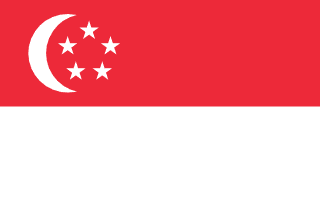
The flag of Singapore consists of two equal horizontal bands of red (top) and white (bottom), in a 2:3 aspect ratio. On the upper left corner of the red band (the hoist side), there is a white crescent moon with its opening facing the hoist, surrounded by five white five-pointed stars arranged in a circle. Both the crescent and the stars are white, positioned tightly in the upper left corner of the flag. The design leaves carefully calculated white space, ensuring the flag remains clearly visible even from a distance.
The red is a bright, pure red, and the white is pure white. The simple and bright contrast makes the flag stand out prominently against the urban skyline. Government agencies, schools, and private individuals all use the same proportions and color standards, with no variant versions.
Meaning
Red represents equality and friendship among humanity, while white symbolizes purity and virtue. The crescent moon symbolizes a young nation on the rise, and the five stars represent Singapore’s five national ideals: democracy, peace, progress, justice, and equality. The arrangement of the stars around the crescent also signifies unity among all ethnic groups under shared ideals.
The combination of the crescent and stars echoes traditional symbols from the Malay world, reflecting the cultural inclusiveness of this multi-ethnic nation. The red and white colors are common in Southeast Asian flags, conveying universal pursuits of equality and purity. They also allow people of diverse ethnic backgrounds, without a shared historical origin, to find common identity under the same flag.
History and Legal Status
This flag was officially adopted in 1959 when Singapore gained self-governance. It was designed under the leadership of then Deputy Prime Minister Toh Chin Chye, who intentionally avoided elements of the colonial Union Jack and direct imitation of other nations’ flags. After Singapore’s independence on August 9, 1965, the flag has been in continuous use.
According to the Singapore Arms and Flag and National Anthem Act, the flag is a solemn national symbol that should be respected by citizens and institutions. No text or images should be added to the flag, and private display must comply with regulations. Damaged flags should be disposed of properly rather than discarded casually. During National Day and significant commemorative events, the flag is widely displayed as the most direct symbol of Singaporean national identity.
Singapore Travel Guide
All Guides »Singapore Solo Travel Quick Guide: Visa, Best Time to Visit, Budget & Local Rules
How visa-free travel between Singapore works, the best time to visit, daily trav...
Classic 7-Day Itinerary in Singapore: Covering Marina Bay, Sentosa, and Tropical Nature 7 Days
From modern landmarks to multicultural neighborhoods, and then to Sentosa Island...
4-Day Short Trip Itinerary in Singapore: Marina Bay, Cultural Districts, and Sentosa Highlights 4 days
Even with limited time, you can fully experience Singapore by grouping attractio...
Complete List of Must-Visit Attractions in Singapore: City Landmarks, Islands, and Tropical Nature All in One Guide
Organized into four categories—Marina Bay, Cultural Districts, Islands & Nature—...
A Guide to Singapore’s Food Scene: Hainanese Chicken Rice, Chili Crab & Hawker Centers
From affordable street food stalls at just a few Singapore dollars to signature ...
Complete Guide to Getting Around Singapore: MRT, Buses, and Transfers from Changi Airport
A comprehensive guide to Singapore’s MRT, buses, SimplyGo, and ride-hailing opti...
10 Essential Travel Tips for Singapore: Fine Red Lines, Air-Con Etiquette & Money-Saving Hacks
From e-visas to hawker center seating, from public fine rules to currency exchan...