Qatar
A wealthy peninsular nation on the shores of the Persian Gulf, known as the Gulf’s jewel for hosting the 2022 FIFA World Cup, the Museum of Islamic Art, and its natural gas wealth.
Qatar (State of Qatar)

| Capital | Doha |
|---|---|
| Continent | Asia |
| Languages | Arabic |
| Currency | Qatari Riyal (QAR ر.ق) |
| Time Zone | UTC+3 |
| Dialling Code | +974 |
| Area / Population | 11,500 square kilometres / Approximately 3 million |
| Visa | Holders of regular passports can enter Qatar visa-free for stays of up to 30 days, provided they hold a passport valid for at least six months and a return or onward ticket; separate visa-free arrangements apply for transit. Please check the latest announcements from Qatar’s Ministry of Interior and its embassy or consulate in your own country. |
| Best Season | The climate is mild from November to March, making it the best season for travel; May to September is extremely hot and humid, with midday temperatures often exceeding 40°C. It’s advisable to schedule outdoor activities in the early morning or evening. |
| Main Cities | Doha, Lusail, Al Khor, Al Wakrah, Al Rayyan, The Pearl, Zubarah, West Bay |
Qatar in Detail
Overview of Qatar
Qatar (officially the State of Qatar) is a peninsular country located on the southwestern coast of the Persian Gulf in Western Asia. It covers an area of approximately 11,500 square kilometres, bordered by the Persian Gulf to the north, east, and west, and sharing a land border with Saudi Arabia to the south, while facing Bahrain across the sea. The capital, Doha, is situated on the eastern coast of the peninsula and serves as the national centre for politics, economy, culture, and transportation. Qatar is a hereditary monarchy ruled by the Al Thani family, with the Emir as the head of state and the Prime Minister as the head of government.
The country is divided into several municipalities, with a population heavily concentrated in the Doha metropolitan area. Qatar is a typical immigrant society, where Qatari nationals make up just over 10% of the total population, while the majority are expatriate workers from South Asia, Southeast Asia, and other Arab countries. This has resulted in a highly international urban landscape and cultural life. The official language is Arabic, but English is widely spoken in business and tourism settings.
Geography and Climate
The terrain mainly consists of low limestone plateaus, deserts, and coastal plains. There are no permanent rivers in the country, and freshwater resources primarily come from desalination. The southern region features inland salt flats and continuous sand dunes, while the northern area around Al Khor includes mangroves and wetland ecosystems. The climate is classified as tropical desert: summers (May to September) are extremely hot and humid, with temperatures often reaching 40–45°C and high humidity adding to the discomfort; winters (November to March) are mild and pleasant, with daytime temperatures of 20–25°C, making it the ideal time for travel and outdoor activities. Rainfall is scarce throughout the year, with occasional short periods of sandstorms.
Historical Background
Qatar has long been a hub for pearl diving and trade along the Persian Gulf, influenced successively by Bahrain and the Ottoman Empire. In the mid-19th century, the Al Thani family, under the leadership of Mohammed bin Thani, established its ruling position and signed an agreement with Britain in 1868. Qatar became a British protectorate in 1916 and gained full independence on 3 September 1971, establishing the State of Qatar. After independence, the country rapidly grew wealthy thanks to its oil and natural gas resources. Following the accession of Hamad bin Khalifa Al Thani in 1995, modernisation and diplomatic diversification were promoted, with his son Tamim bin Hamad Al Thani succeeding him in 2013. In 2022, Qatar hosted the FIFA World Cup, becoming the first Middle Eastern and Arab country to stage the event.
Economy and Currency
Qatar possesses some of the world’s largest natural gas reserves and is one of the top exporters of liquefied natural gas (LNG), with energy exports accounting for the vast majority of government revenue. In recent years, the country has pursued its “National Vision 2030” to develop sectors such as finance, aviation, exhibitions, the Education City, and sports. The official currency is the Qatari Riyal (QAR), issued by the Qatar Central Bank, which has maintained a long-standing fixed exchange rate of approximately 3.64 QAR to 1 USD. The currency is highly stable, and Qatar consistently ranks among the countries with the highest per capita GDP in the world.
Culture and Society
Qatar is an Islamic country, and while its social customs are relatively more open compared to its Gulf neighbours, Islamic law and traditions still deeply influence daily life. Modest attire is recommended in public places, and eating or drinking in public during Ramadan is discouraged. Qatar places great emphasis on preserving its cultural heritage, with institutions such as the Museum of Islamic Art, Katara Cultural Village, and Souq Waqif showcasing Arabic calligraphy, spice trade, and Bedouin traditions. Local cuisine features grilled meats, rice, seafood, and dates, while coffee and black tea are essential for hospitality.
Tourism Overview
Tourism in Qatar is centred around Doha, with highlights including the Museum of Islamic Art, the National Museum, Souq Waqif, The Pearl, Katara Cultural Village, and the Corniche. Outside the city, the UNESCO-listed Zubarah Fort archaeological site and the western desert offer experiences such as dune bashing and inland sea exploration. The stadiums built for the 2022 FIFA World Cup and the new city of Lusail have also become major attractions. With its safety, modern facilities, and visa-free access for many international visitors, Qatar has become a popular destination for short trips in the Middle East and a convenient stopover hub.
Local Currency: Qatari Riyal (QAR)
Currency Overview
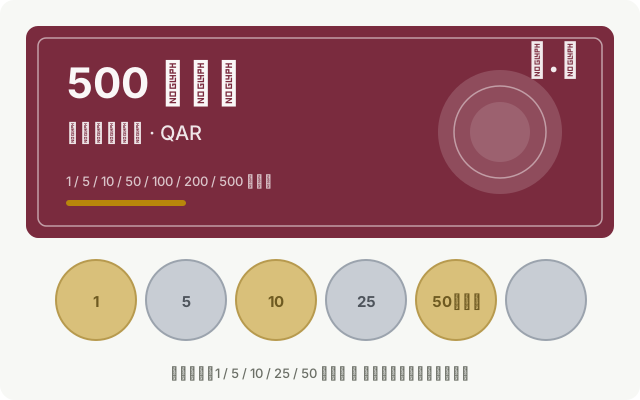
The official currency of Qatar is the Qatari Riyal (currency code: QAR, symbol: ر.ق, often written as QR or QAR internationally), issued by the Qatar Central Bank (Qatar Central Bank). One riyal is divided into 100 dirhams, though smaller denominations are rarely used in daily transactions. The riyal has been pegged to the US dollar for a long time at a fixed exchange rate of approximately 1 USD to 3.64 QAR, making the currency very stable and minimising exchange rate risks for travellers exchanging or spending money in Qatar.
Denominations
The circulating banknotes mainly belong to the fifth series, with denominations of 1, 5, 10, 50, 100, and 500 riyals; the older fourth series has been gradually phased out. Banknotes feature inscriptions in both Arabic and English, with the front often displaying the national emblem, traditional patterns, and landmarks. Coins come in denominations of 25 and 50 dirhams, as well as 1, 5, and 10 riyals. The obverse typically shows the value in Arabic numerals, while the reverse often features the national emblem or traditional designs. Some smaller denomination banknotes are less commonly encountered in daily use.
Cash and Payment Habits
Qatar has a highly modernised payment environment, with widespread acceptance of Visa, Mastercard, UnionPay, as well as Apple Pay and Google Pay in malls, hotels, restaurants, taxis, and on the metro. Card payments and mobile payments are very convenient. Most large stores pose no cash barriers, but traditional markets, small stalls, and some taxis may still prefer cash. It’s advisable to carry a small amount of riyals for use in places like Souq Waqif, for taxi fares, and for tipping.
Traveler Tips
- The riyal is pegged to the US dollar with a stable exchange rate, so there’s no need to worry about significant fluctuations.
- Currency can be exchanged at airports, banks, and authorised exchange offices, with better rates often found at large malls in the city.
- ATMs are widely available in malls, petrol stations, and metro stations, making it easy to withdraw cash with foreign cards, though issuer fees may apply.
- Some hotels and restaurants include service charges in the bill, and tipping is not mandatory—the bill amount is usually final.
Flag Meaning
Flag Design
The flag of Qatar is a rectangular banner with vertical white and maroon (a deep red) stripes. Its aspect ratio is highly distinctive, approximately 11:28, making it one of the narrowest flags in the world. The side adjacent to the flagpole is white, covering about one-third of the flag’s width, while the outer side is maroon. The boundary between the white and maroon is not a straight line but a serrated wave band made up of nine white triangles (or zigzags) with their points facing the maroon side. This colour scheme and proportion have been in use since 1916 and were officially established after Qatar’s independence in 1971.
Meaning
The maroon colour symbolises the blood shed in defence of the nation throughout history, as well as Qatar’s intense sunlight and earthy tones; the white represents peace and purity. The nine zigzags have a specific commemorative meaning: Qatar was the ninth member to join the “reconciled sheikhdoms” following the 1916 treaty, hence the nine-pointed design. The zigzag pattern originally stemmed from early flag-making techniques related to dyeing and cutting, but it later became a fixed national symbol, making the flag instantly recognisable among others.
History and Legal Status
The evolution of the Qatari flag is closely tied to the pearling industry and the British protectorate relationship. Early flags were red, but due to local dyes and strong sunlight, they gradually developed the unique maroon hue. After 1868, a white stripe and serrated edge were added, and the design was further standardised following the signing of the British-Qatari protectorate treaty in 1916. Upon gaining independence in 1971, the maroon and white serrated flag was officially designated as the national flag, with the unique 11:28 aspect ratio also formalised. Today, it appears on government buildings, at sporting events, and on national occasions, and gained global recognition during the 2022 FIFA World Cup.
Qatar Travel Guide
All Guides »Qatar Travel Snapshot: Visa-Free Entry, Best Seasons, Budget & Islamic Etiquette
How long you can stay visa-free, the most comfortable time of year to visit, dai...
Classic 7-day Qatar itinerary: Doha – Lusail – Inland Sea – Zubarah 7 days
This route weaves together Doha city, the World Cup new town, desert wonders, an...
Qatar 4-Day Short Trip: In-Depth Exploration of Doha 4 days
Even staying only in Doha can make for a fulfilling trip: routes are divided int...
Essential Attractions in Qatar: From Islamic Art to Desert Wonders
A curated list of Qatar’s top attractions by city and region, including highligh...
Qatar Food Guide: Grilled Meats, Handheld Rice Dishes & Street Eats
From market stalls to high-end restaurants, explore Qatar’s Arabic and Gulf flav...
Qatar Transportation Guide: Doha Metro, Buses, and Ride-Hailing Services
How to choose between the Doha Metro, Karwa buses, and ride-hailing apps — cover...
10 Practical Tips for Traveling in Qatar
Details like visa exemption, dress etiquette, using the metro, and staying safe ...