Iceland
A high-welfare island nation at the northern end of the Atlantic Ocean, renowned for the Golden Circle, Blue Lagoon hot springs, the Northern Lights, and some of the world’s purest natural landscapes, featuring volcanoes and glaciers.
Iceland
| Capital | Reykjavík |
|---|---|
| Continent | Europe |
| Languages | Icelandic |
| Currency | Icelandic Króna (ISK kr) |
| Time Zone | UTC+0 |
| Dialling Code | +354 |
| Area / Population | 103,000 square kilometres / Approximately 380,000 |
| Visa | Iceland is part of the Schengen Area. Most foreign visitors need to apply for an Icelandic Schengen visa (which can be submitted to the Icelandic Visa Centre), or enter with a valid multiple-entry Schengen visa. The permitted length of stay depends on the visa. |
| Best Season | The summer months of June to August feature mild temperatures and fully open Ring Road conditions, making it ideal for road trips; the period from September to April is the prime time for Northern Lights viewing. |
| Main Cities | Reykjavík, Vík, Höfn, Akureyri, Húsavík, Selfoss, Grindavík, Ísafjörður |
Iceland in Detail
Iceland Overview
Iceland (Republic of Iceland) is an island nation located on the Mid-Atlantic Ridge, facing Norway across the Norwegian Sea to the east and situated about 800 kilometres southeast of the United Kingdom. It covers an area of approximately 103,000 square kilometres, similar in size to Jiangsu Province, yet has a population of only around 380,000, making it one of the countries with the lowest population density in Europe. The capital, Reykjavík, is home to two-thirds of the country’s population and is the world’s northernmost capital of a sovereign state. In winter, due to geothermal heating, almost no chimney smoke can be seen, earning it the nickname “the Smokeless City.” Iceland operates as a parliamentary republic and consistently ranks among the top countries globally in terms of peace index, gender equality, and press freedom. It has no standing army.
Geography and Climate
Iceland is a living example of the divergence between oceanic and continental plates: the Mid-Atlantic Ridge runs through the entire island, where the Eurasian and North American plates separate by about 2 centimetres each year. The country has over 30 active volcanoes and thousands of geysers and hot springs, with geothermal and hydroelectric power supplying nearly all of its energy needs. Vatnajökull Glacier, covering nearly 8,000 square kilometres, is the largest glacier by volume in Europe, and its national park is also one of the largest in Europe. The Jökulsárlón glacial lagoon and Diamond Beach on the southeastern coast showcase the spectacular sight of glaciers meeting the sea. The 2010 eruption of Eyjafjallajökull glacier caused widespread disruption to European air travel, serving as a testament to Iceland’s geological energy.
Although called Iceland, thanks to the influence of the Gulf Stream, the seasonal temperature variation is actually quite moderate: in January, the average temperature in Reykjavík is around 0°C, and about 11–13°C in July. Coastal areas often experience strong winds and rapidly changing weather in winter. The summer months of June and July feature the midnight sun during the polar day; from September to April, nights are long, making it the season for chasing the Aurora Borealis. There are virtually no large native forests in the country. Tundra, black sand beaches, and volcanic lava landscapes create a “moon-like” scenery.
Historical Background
Iceland is one of the youngest lands on Earth, having emerged from the sea due to undersea volcanic eruptions only about ten million years ago. Around the year 874, Norwegian Vikings led by Ingólfur Arnarson settled here; in 930, various clans convened the first Althing (Alþingi) general assembly at Þingvellir Plain, recognized as the oldest surviving parliament in the world. Þingvellir National Park has thus been listed as a UNESCO World Heritage Site. In 1262, Iceland came under the rule of Norway and later became part of the Kingdom of Denmark. For centuries thereafter, it suffered from poverty due to volcanic eruptions, plagues, and trade monopolies.
In the 19th century, a sense of national identity awakened. In 1918, Iceland became a sovereign kingdom in a personal union with Denmark, and on June 17, 1944, it officially became a republic. After World War II, the modernization of the fishing industry and financial expansion in the 1990s brought prosperity. The collapse of three major banks during the 2008 financial crisis dealt a severe blow to the economy, but recovery was achieved with fisheries, aluminium, geothermal energy, and tourism as key pillars. Since the 2010s, Iceland has become a top global travel destination for many, thanks to its role as a film location and its image as the “end of the world.” Starting in 2018, its national football team’s performances have further made the world take notice of this small nation.
Economy and Currency
Iceland is a highly developed economy. Marine fisheries are a traditional pillar, with exports of cod, mackerel, and farmed salmon worldwide. Geothermal resources not only provide energy but have also given rise to industries such as greenhouse tomato and banana cultivation and aluminium smelting. In recent years, software, biotechnology, and creative industries (including musicians like Björk and Sigur Rós, as well as game studios) have flourished. The official currency is the Icelandic Króna (ISK), issued by the Central Bank of Iceland (Sedlabanki). Its exchange rate is quite volatile, which is an important cost variable that travellers should pay close attention to. Cash is rarely used in Iceland—all transactions, including at public toilets and vending machines in remote gas stations, can be completed with cards.
Culture and Society
Icelandic is a North Germanic language that has changed very little over the past thousand years. People can still directly read the 13th-century Icelandic epics, the Eddas and Sagas. Reading Sagas is a tradition among the populace. Despite the small population, Iceland leads the world in per capita book publishing, and giving books as Christmas gifts is known as the “Christmas Book Flood.” Social equality awareness is strong—most people are on a first-name basis and do not use titles. It is a strict rule to shower nude in the public changing rooms before entering geothermal pools. In terms of food, skyr (Icelandic yoghurt), lamb hot dogs, geothermally baked rye bread, and cod are everyday staples. Traditional foods like fermented shark (hákarl) are considered challenges for the brave. Iceland has no trains; cars and domestic flights are the only means of long-distance travel, and almost everyone is skilled at off-road driving.
Tourism Overview
Iceland’s tourism is highly dependent on the Ring Road (Route 1): starting from Reykjavík, a one-day Golden Circle tour (Þingvellir National Park—Geysir geothermal area—Gullfoss waterfall) is a must-do introductory trip. The South Coast route connects Seljalandsfoss, Skógafoss, black-sand Vík, and the glacial lagoon. The Snæfellsnes Peninsula in the west is hailed as “Iceland in miniature.” In summer, you can venture into the inland highlands of Landmannalaugar with its colourful volcanic hills. In winter, the highlights are the Northern Lights, ice caves, and the Blue Lagoon. The cost of living is high and the weather is changeable, but infrastructure is well-developed and the rescue system is advanced, making it a dream destination for road-trippers and photography enthusiasts.
Local Currency: Icelandic Króna (ISK)
Currency Overview
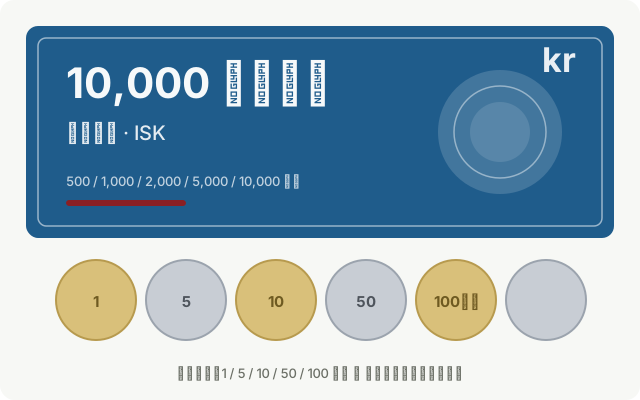
The official currency of Iceland is the Icelandic Króna (currency code: ISK, symbol: kr or ISK), issued by the Central Bank of Iceland (Sedlabanki, full name: Central Bank of Iceland). The Icelandic Króna is not the euro—Iceland is a member of the European Economic Area but has never joined the EU, and its independent currency is an important symbol of its economic sovereignty. During the 2008 financial crisis, the Icelandic Króna depreciated significantly. Since then, exchange controls have gradually been lifted, and today it operates under a free-floating exchange rate. Its value is roughly 1 ISK = 0.05 US dollars (i.e., 100 ISK ≈ 5 US dollars). Be sure to check the real-time exchange rate before your trip. Króna denominations are relatively large, and prices may initially seem “steep,” but dividing by about 20 gives you a rough estimate in US dollars.
Denomination System
There are five banknote denominations: 500, 1,000, 2,000, 5,000, and 10,000 ISK. The figures on the front are all historical Icelandic male political and cultural figures (such as independence movement leader Jón Sigurðsson), while the backs feature corresponding female figures and folk patterns—it is one of the few banknote designs that reflect gender equality. Coins come in five denominations: 1, 5, 10, 50, and 100 ISK. Among these, 1 ISK and 5 ISK coins are almost no longer in circulation, and the most common are 10, 50, and 100 ISK coins. Due to high prices and large denominations, paper money is actually used less frequently in everyday transactions.
Cash and Payment Habits
Iceland is one of the most cashless societies in the world. Even self-service payment machines at gas stations, public toilets by highways, and unmanned stalls on remote farms support contactless credit card payments. Travellers can easily complete their entire trip without using any cash. Visa and Mastercard are accepted almost everywhere. UnionPay cards can be used to withdraw cash at ATMs in central Reykjavík shopping districts, but merchant acceptance is limited. It is recommended to primarily use dual-currency credit cards. If you wish to carry a small amount of cash, you can withdraw ISK directly from ATMs at Keflavík Airport upon arrival. Exchange rates at currency exchange outlets in the city are not much different from those at banks, so there’s no need to shop around. Please note that some gas stations use pre-authorisation deductions, so ensure your card has sufficient available balance.
Traveller Tips
- Iceland does not use euros, and it is not recommended to carry large amounts of euro cash for exchange. Using cards directly is the most cost-effective option.
- Credit card transactions are settled in Icelandic Króna by default. If the POS offers settlement options in other currencies (DCC), always decline.
- For self-service refuelling at gas stations, swipe your credit card first before lifting the nozzle. Pre-authorisation amounts are usually higher than the actual cost and will be automatically settled a few days later.
- The Icelandic Króna exchange rate fluctuates significantly. Travellers on longer itineraries are advised to withdraw cash in smaller amounts and exchange as needed.
Flag Meaning
Flag Design
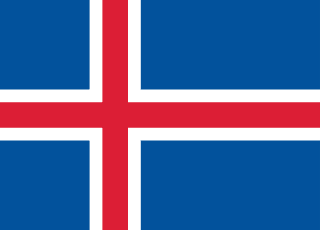
The flag of Iceland is a Scandinavian (Nordic) cross flag with a blue background and red and white borders. The cross is slightly off-centre to the left, symbolising Christian tradition. The red cross is outlined with a thin white border, creating clear colour separation on the flag. The official proportions are 25:18, and precise colour values are defined for blue, red, and white: blue is deep cobalt blue, red is pure red, and white is pure white. The combination of a blue background with a red and white cross makes the Icelandic flag highly distinctive among the flags of the Nordic countries.
Meaning
Icelanders often summarise the three colours of their flag as representing “sea, ice, and fire”: blue stands for the Atlantic Ocean surrounding the country, white represents the glaciers and snow that cover more than one-tenth of the land, and red symbolises the volcanoes and geothermal fires within the island. Another interpretation links the colours to three patriotic spiritual qualities—the blue of mountains, the white of snow, and the red of lava. The red cross with white borders is in the same lineage as the Danish and Norwegian flags and reflects Iceland’s millennia-long connection to the Scandinavian cultural sphere.
History and Legal Status
The design of the Icelandic flag was led by a flag committee established in 1913 and was approved by the King of Denmark in 1915. Initially, it was authorised for use only on land in Iceland. In 1918, when Iceland became a sovereign kingdom, the status of the flag was elevated. On the day the Republic of Iceland was founded in 1944, it was officially raised at Þingvellir. The 1944 Constitution and subsequent Flag Act set forth regulations for its use: government buildings, schools, and ports are required to raise and lower the flag daily, and on June 17, Iceland’s National Day, flags are displayed nationwide. Icelandic law prohibits defacing the flag and mandates that it must not be flown lower than other flags. The blue, white, and red colours also appear on the national coat of arms and government insignia, forming the core of the country’s visual identity system.
Iceland Travel Guide
All Guides »Iceland Travel Quick Guide: Schengen Visa, Northern Lights & Midnight Sun Seasons, Budget, and Local Etiquette
Weather and prices are two key variables for travel in Iceland. This guide expla...
Iceland Ring Road 7-Day Circuit: Golden Circle, South Coast Glacier Lagoon & North Shore Whale Watching 7 days
Drive clockwise along the 1,330-km Ring Road to cover Iceland’s highlights: the ...
4-Day South Coast Short Break in Iceland: Golden Circle, Black Sand Beach, Glacier Lagoon & Northern Lights Itinerary 4 Days
Limited vacation time? Still see Iceland’s highlights: Base in Reykjavik, explor...
Must-visit attractions in Iceland: Hallgrímskirkja Church, the Golden Circle, and Jökulsárlón Glacier Lagoon
From the capital’s iconic Hallgrímskirkja Church to tectonic plate rifts, geyser...
Icelandic Food Guide: Hákarl Fermented Shark, Lamb Hot Dogs, and Skyr Yogurt
Icelandic cuisine reflects Viking survival ingenuity: brave the fermented shark,...
Iceland Travel Guide: Transport Between Keflavík Airport and Reykjavík, Ring Road Self-Drive & Public Transport Passes
Getting Around Without Trains: Keflavík Airport Buses, Reykjavík City Transit, R...
10 Practical Tips for Traveling in Iceland: Costs, Northern Lights, Hot Springs, and Self-Driving Safety
High prices, changeable weather, and unique local rules are three major challeng...