Turkmenistan
A mysterious desert nation in southwestern Central Asia, famed for its white marble capital, the Darvaza Gas Crater ("Gates of Hell"), and its rich carpet culture.
Turkmenistan
| Capital | Ashgabat |
|---|---|
| Continent | Asia |
| Languages | Turkmen |
| Currency | Turkmenistan manat (TMT m) |
| Time Zone | UTC+5 (Moscow Time) |
| Dialling Code | +993 |
| Area / Population | 488,100 square kilometres / Approximately 6.5 million |
| Visa | Most foreign visitors need to apply for a visa to enter Turkmenistan in advance. Typically, an invitation letter (LOI) issued by a registered Turkmen travel agency or inviting organization is required, and the application must be approved by the immigration authorities before the visa can be issued. Obtaining an individual tourist visa is very difficult. Holders of a visa for a third country may apply for a transit visa, usually valid for only 3–5 days. Visa policies are strict and subject to frequent changes, so always refer to the latest requirements from Turkmen official sources or embassies/consulates. |
| Best Season | The most pleasant travel seasons are March to May and September to November when the climate is mild. Summers in the desert are extremely hot, winters in the north are cold, and there are large diurnal temperature variations inland, so bring sun protection and warm clothing. |
| Main Cities | Ashgabat, Mary, Turkmenabat, Daşoguz, Türkmenbaşy, Darvaza, Merv, Nisa |
Turkmenistan in Detail
Turkmenistan Overview
Turkmenistan is a landlocked country in southwestern Central Asia, covering an area of approximately 488,100 square kilometres. It borders Kazakhstan to the north, Uzbekistan to the northeast, Afghanistan to the southeast, Iran to the south, and the Caspian Sea to the west. Its capital, Ashgabat, is located at the foot of the Kopet Dag Mountains in the south and serves as the country’s political, economic, and cultural centre. Turkmenistan is a presidential republic, with Turkmen as the official language, although Russian is still used to some extent. The country is known for its status as a permanently neutral state, which was recognized by the United Nations General Assembly in 1995.
Over 80% of the country consists of desert, with oases and cities located along rivers and canals. The population density is low, and society is relatively closed, meaning travel generally requires organization through a travel agency.
Geography and Climate
About 80% of the country is covered by the Karakum Desert. The Kopet Dag mountain range lies along the border with Iran in the south, and there are port cities such as Türkmenbaşy along the Caspian Sea. Major rivers like the Amu Darya and Murghab River, as well as the Karakum Canal, support oasis agriculture. The climate is a typical temperate continental desert climate, with extremely hot and dry summers where desert surface temperatures can exceed 50°C, and colder winters in the north while the south is relatively milder. The best times to visit are spring and autumn, though be aware of significant day-night temperature differences and occasional dusty winds in spring.
Historical Background
Turkmenistan lies on the historic Silk Road and has been influenced over the centuries by various powers including Persia, Parthia, the Sassanid Empire, the Seljuks, and the Mongols. Merv in the south was an important Silk Road city, and Nisa was the early capital of the Parthian Empire—both are UNESCO World Heritage Sites. In the 19th century, the region was incorporated into the Russian Empire, became the Turkmen Soviet Socialist Republic in 1924, and declared independence in 1991 following the dissolution of the Soviet Union. The first president after independence, Saparmurat Niyazov, implemented strong nationalist policies, and the country has since been ruled by the father-and-son tandem of Gurbanguly and Serdar Berdimuhamedow.
Economy and Currency
The economy is heavily reliant on natural gas exports, with Turkmenistan possessing some of the world’s largest gas reserves. Gas is mainly exported via pipelines to Russia and Iran. The national currency is the Turkmenistan manat (TMT), issued by the Central Bank of Turkmenistan, with 1 manat equal to 100 tenge. There has long been a significant gap between the official and market exchange rates, so travellers should pay close attention to exchange channels and compliance, and always conduct transactions through official banks or authorized institutions.
Culture and Society
The Turkmen people are the predominant ethnic group. Traditionally nomadic or engaged in oasis farming, they take pride in carpet weaving, the Akhal-Teke horse (known as the "heavenly horse"), and the Alabay dog. Turkmen carpets feature rich patterns, and five traditional carpet motifs (gul) are even depicted on the national flag. Society is relatively closed off from international interaction, with strict controls on the internet and media, so visitors must respect local laws and customs. The diet mainly includes pilaf (palow), grilled meat, flatbread, and yogurt. Hospitality is important, and tea and bread are daily staples.
Tourism Overview
Turkmenistan’s tourism focuses on two main themes: “wonders” and “history.” Ashgabat is known for its abundance of white marble buildings, with landmarks like the Independence Monument, Neutrality Arch, and Wedding Palace offering striking visuals. The Darvaza Gas Crater, also known as the “Gates of Hell,” has been burning for decades and is an iconic sight. Merv, Nisa, and Kunya-Urgench are world heritage ancient city ruins. The Caspian coastal city of Türkmenbaşy and the Avaza National Tourist Zone are ideal for leisure. Due to strict visa regulations and the need for travel agencies to arrange itineraries, it is advisable to plan well in advance and allow ample time for visa processing.
Local Currency: Turkmenistan manat (TMT)
Currency Overview
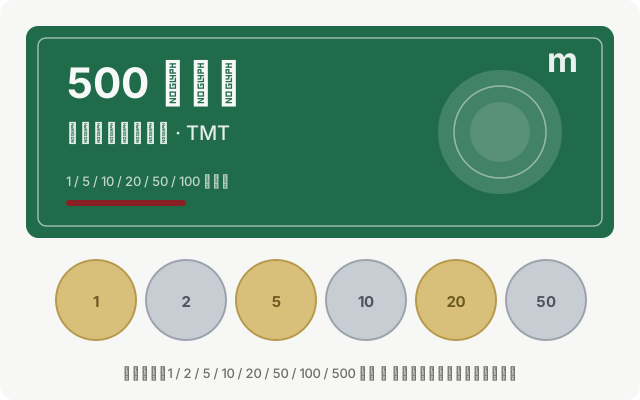
The official currency of Turkmenistan is the Turkmenistan manat (currency code: TMT, symbol: m, internationally written as TMT), issued by the Central Bank of Turkmenistan. One manat is equal to 100 tenge, although coins are rarely used in daily transactions. The manat was introduced in 1993, replacing the Soviet ruble, and has undergone several redenominations and changes in banknotes. Travellers should be mindful of the edition and validity of the banknotes they hold. The manat is not freely convertible on the international foreign exchange market, and it is generally not possible to convert it back upon departure. The official exchange rate is set by the central bank and often differs significantly from the market rate, so always exchange currency through official channels such as banks.
Denomination System
The currently circulating banknotes are primarily from the redenominated series, with denominations of 1, 5, 10, 20, 50, and 100 manat. The notes typically feature portraits of national leaders, landmark buildings, and ethnic patterns, with a formal design. Coins are issued in denominations of 1, 2, 5, 10, 20, 50 tenge, and 1, 2 manat. Due to redenominations and policy adjustments, different editions of banknotes may coexist. When receiving change or making payments, check the denomination and authenticity carefully to avoid accepting outdated or invalid bills.
Cash and Payment Practices
Cash is overwhelmingly the primary method of transaction in Turkmenistan. Hotels, shops, and restaurants generally accept only cash, and the use of international credit cards and UnionPay cards is extremely limited. ATMs are scarce and often do not accept foreign cards. Foreign cash in US dollars and euros is the most practical, and it is recommended to carry small-denomination bills in good condition, as damaged or worn notes may be refused. There is a persistent gap between the official and market exchange rates, so foreign currency should be exchanged only through official channels such as banks, and receipts should be retained. Avoid exchanging money privately with individuals. Cash needs are high during travel, so prepare in advance and keep your money secure, avoiding displaying large amounts of cash in public.
Traveller Tips
- Always arrange your itinerary and invitation letter (LOI) through a registered travel agency, and it is generally necessary to be accompanied by a guide throughout your trip.
- International bank cards are almost unusable, so carry sufficient US dollars or euros in cash and keep receipts for every currency exchange.
- There are strict limits on the amount of foreign currency you can take out of the country, and amounts exceeding the declared limit must be supported by proof of legal origin.
- Avoid private currency exchanges to prevent legal issues or unnecessary disputes.
Flag Meaning
National Flag Design
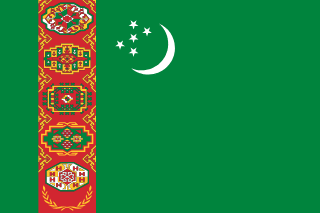
The flag of Turkmenistan is a green rectangular banner with a 2:3 aspect ratio. Along the hoist side, there is a vertical red stripe containing five traditional carpet motifs (gul) arranged from top to bottom, beneath which lie two crossed olive branches forming a wreath. In the upper left corner of the flag is a white crescent moon and five white five-pointed stars. The crescent and stars are clustered together, while the red stripe and carpet motifs are the most distinctive elements of the flag. The five carpet motifs are arranged from top to bottom in their traditional order, with each pattern derived from the central medallion of a carpet belonging to a specific tribe, and their design must conform to the official standard.
Meaning
Green symbolises Islam, life, and nature, as well as the land and prosperity. The five carpet motifs on the red stripe represent the five most prominent historical tribes of the Turkmen people (such as the Tekke, Yomut, Arsary, Chowdur, and Saryk), symbolising national unity and traditional craftsmanship. The olive branches signify peace and neutrality. The crescent is an Islamic symbol, and the five stars represent the five tribes and also the country’s five regions. Both the stars and the crescent are white, representing purity and light.
History and Legal Status
After gaining independence, Turkmenistan adopted the green flag with crescent and stars in 1992, which has since undergone several modifications: the olive branches were added in 1997, and in 2001 the positions of the crescent and stars were adjusted and the layout of the carpet motifs standardised to create the current design. The flag’s proportions and colours are legally defined, and altering or misusing it is prohibited without authorisation. On Flag Day (12 January) and Independence Day (27 September), the flag is widely displayed across the country, including on landmarks like the Neutrality Arch. Today, it appears on government buildings, during national celebrations, and at sporting events, serving as a core symbol of Turkmen national identity and heritage.
Turkmenistan Travel Guide
All Guides »Turkmenistan Travel Snapshot: Visas & Invitations, Seasons, Budget & Local Laws
Why visas are hard to get, how to secure an invitation letter, the best time to ...
7-Day Turkmenistan Itinerary: Ashgabat — Darvaza — Merv — Kunya-Urgench 7 days
White marble cities, burning gas craters, and Silk Road UNESCO sites — experienc...
Turkmenistan 4-Day Short Trip: Ashgabat and the Door to Hell 4 days
Even with limited time, you can see the white marble city and the burning natura...
Essential Attractions in Turkmenistan: Wonders, the White City, and Silk Road Heritage
From a burning natural gas crater to UNESCO-listed ancient cities, here’s a roun...
Turkmenistan Food Guide: Plov, Kebabs, and Desert Melons
The dining table of this Central Asian desert nation revolves around meat, bread...
Turkmenistan Travel Guide: Flights, Trains, and Private Transfers
In-country travel often relies on travel agency arrangements, with flights, trai...
10 Practical Tips for Traveling in Turkmenistan
Visa invitations, cash payments, regulations, and desert gear — these details ca...