Indonesia
The world’s largest archipelagic nation, made up of over 17,000 islands, offers diverse tropical experiences including volcanoes, rice terraces, temples, and beaches.
Indonesia (Republic of Indonesia)

| Capital | Jakarta (the capital is gradually being relocated to Nusantara) |
|---|---|
| Continent | Asia |
| Languages | Indonesian |
| Currency | Indonesian Rupiah (IDR Rp) |
| Time Zone | UTC+7 to UTC+9 (spans three time zones, with Jakarta on UTC+7) |
| Dialling Code | +62 |
| Area / Population | 1.91 million square kilometers / Approximately 278 million |
| Visa | Holders of a regular passport can apply for a visa on arrival (VOA, around 500,000 Indonesian Rupiah) or an e-visa (e-VOA) online in advance. Both are available at major entry points in Bali. |
| Best Season | The dry season from April to October is the best time to visit Bali, Lombok, and Java. The rainy season from November to March brings high humidity and rough seas. |
| Main Cities | Bali, Jakarta, Yogyakarta, Lombok, Komodo, Surabaya, Bandung, Bintan Island |
Indonesia in Detail
Overview of Indonesia
Indonesia (officially the Republic of Indonesia) is the world’s largest archipelagic country, located between Southeast Asia and Australia, straddling the equator. It comprises approximately 17,508 islands, about 6,000 of which are inhabited. Covering an area of roughly 1.91 million square kilometers, it has a coastline of over 54,000 kilometers, bordered by the Pacific Ocean to the north and the Indian Ocean to the south, and neighboring Malaysia, Papua New Guinea, and East Timor.
Indonesia is the world’s fourth most populous country, with around 278 million people, about half of whom live on the island of Java. The official language is Indonesian (Bahasa Indonesia). The capital, Jakarta, is located on the northwest coast of Java, while the government is building a new capital, Nusantara, on the island of Borneo.
Geography and Climate
Located at the intersection of the Pacific Ring of Fire and the Alpine-Himalayan volcanic belt, Indonesia has one of the highest numbers of active volcanoes in the world, with more than 120. Major islands include Java, Sumatra, Borneo, Sulawesi, Papua, and Bali. The fertile volcanic soil has given rise to unique landscapes such as rice terraces and highland areas.
As an equatorial country, Indonesia has a tropical rainforest and tropical monsoon climate, characterized by high temperatures and humidity year-round, with average temperatures of 25–28°C. The dry season typically runs from April to October, while the rainy season lasts from November to March. During the dry season, Bali and the Lesser Sunda Islands offer stable sea conditions, making it ideal for diving and surfing.
Historical Background
The Indonesian archipelago has long been a key hub along the maritime Silk Road. From the 7th century, the Srivijaya Empire rose in Sumatra, and by the 13th century, the Majapahit Empire became a dominant maritime power in Southeast Asia. Starting in the 16th century, Portugal and the Netherlands arrived, with the Dutch colonizing Indonesia for approximately 350 years under the name "Dutch East Indies."
Japanese occupation in 1942 ended Dutch rule, and Indonesia declared independence on August 17, 1945, under the leadership of Sukarno, establishing the Republic of Indonesia. Since then, the country has gone through the Sukarno era, the Suharto era, and a subsequent reform period, gradually moving toward democracy and decentralization starting in 1998. Bali has been a globally renowned holiday destination since the early 20th century.
Economy and Currency
Indonesia is the largest economy in Southeast Asia and a member of the G20. Its economy is driven by manufacturing, mining (nickel, coal), palm oil, textiles, and tourism. In recent years, the digital economy and renewable energy sectors have grown rapidly. The national currency is the Indonesian Rupiah (IDR), issued by Bank Indonesia. Banknotes are issued in relatively large denominations, and cash remains widely used.
Culture and Society
Indonesia has the largest Muslim population in the world, with about 87% of its residents practicing Islam. However, the country also maintains a diverse religious landscape, including Hinduism (notably in Bali), Christianity, Buddhism, and indigenous beliefs. Indonesian serves as the unifying national language alongside over 700 local languages. Traditional music, dance, shadow puppetry (Wayang), batik (a UNESCO-recognized intangible cultural heritage), and wood carving are notable cultural elements.
The cuisine centers around rice, accompanied by dishes such as satay, gado-gado, nasi goreng (fried rice), rendang (spicy beef stew), and various sambal (spicy condiments), featuring rich spices and bold flavors.
Tourism Overview
Indonesia boasts highly diverse tourism resources. Bali is known for its beaches, temples, yoga, and surfing. Yogyakarta is home to two UNESCO World Heritage Sites: Borobudur and Prambanan. Komodo National Park is famous for its Komodo dragons and pink beaches. Lombok offers Mount Rinjani trekking, Lake Toba’s volcanic scenery, and Sulawesi is a diver’s paradise. Overall, the country offers great value as a tropical destination.
Local Currency: Indonesian Rupiah (IDR)
Currency Overview
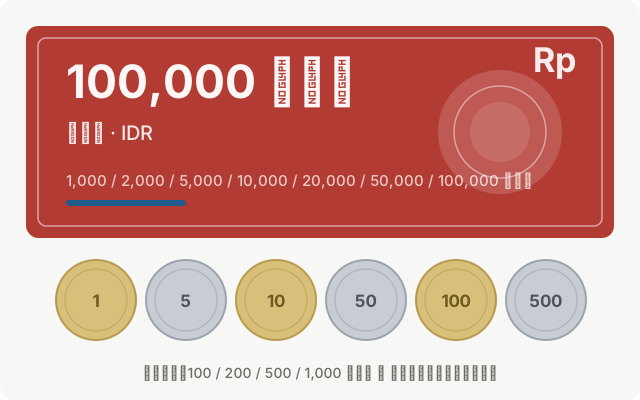
The official currency of Indonesia is the Indonesian Rupiah (currency code: IDR, symbol: Rp, local name: Rupiah), issued by Bank Indonesia. Banknotes are issued in relatively high denominations, with 100,000 IDR being roughly equivalent to $6. In daily transactions, amounts are often counted in units of “ten thousand.” The 1 sen coin (0.01 IDR) is no longer in circulation, and the smallest coin in use is 100 IDR.
Denomination System
There are seven banknote denominations currently in circulation: 1,000, 2,000, 5,000, 10,000, 20,000, 50,000, and 100,000 IDR. All are polymer plastic notes with bright colors and feature portraits of national heroes. There are four coin denominations: 100, 200, 500, and 1,000 IDR, though coins are used less frequently than banknotes. Be careful when paying with 10,000 and 100,000 IDR notes, as their colors are similar (both are predominantly red).
Cash and Payment Habits
Cash is still widely used in Indonesia. Small vendors (warungs), night markets, taxis, becaks (three-wheeled pedal taxis), traditional markets, and some small shops may only accept cash. In tourist areas such as Bali and Jakarta, hotels, restaurants, shopping malls, and convenience stores often accept Visa/Mastercard credit cards, as well as local e-wallets like GoPay, OVO, and DANA.
It’s advisable to carry enough cash: around 500,000–1,000,000 IDR per person per day should cover general meals and transportation. For fine dining or diving activities in Bali, it’s wise to budget more. ATMs are widely available in cities and tourist areas, with withdrawal fees of around 20,000–50,000 IDR per transaction. It’s recommended to withdraw larger amounts per transaction. Currency exchange counters at airports usually offer slightly less favorable rates than authorized exchange services in the city.
Tips for Travelers
- Be careful when paying with 10,000 and 100,000 IDR notes, as their colors are similar—always check the denomination before handing over money.
- When visiting temples in Bali, you’re required to wear a sarong. Most temples provide them free of charge at the entrance.
- During Ramadan, avoid eating or drinking in public during daytime hours in Muslim-majority areas.
- Indonesia has frequent volcanic activity. Check local geological and meteorological alerts before traveling.
- In Bali and Jakarta, ride-hailing apps like Grab and Gojek are the most convenient transportation options.
- Indonesia uses 220V/230V electricity, with mostly Type C (two-pin round) sockets. Bring an adapter if needed.
Flag Meaning
Flag Design
The flag of Indonesia is officially called the "Sacred Red and White" (Sang Merah Putih). It consists of two equal horizontal bands, with red on top and white on the bottom, in a 2:3 ratio. The design is extremely simple, making it one of the most minimalist national flags in the world.
Meaning
Red symbolizes courage and the spirit of struggle for independence, while white represents purity and justice. The colors red and white have long held cultural significance in Indonesian tradition and are synonymous with the term "Merah Putih" (red and white). They are regarded as symbols of the Indonesian national spirit. Due to its similarity to the flags of Monaco and Poland (which have the opposite red-white order), care should be taken to ensure the red is on top and the white is on the bottom when displaying the Indonesian flag.
History and Legal Status
The red-and-white flag first emerged as a symbol of Indonesian nationalism in the early 20th century. On August 17, 1945, Sukarno raised the flag after reading the Proclamation of Independence in Jakarta, and this day was established as Indonesia’s Independence Day. The flag officially became the national symbol. Article 35 of the Constitution explicitly states: “The flag is the Sacred Red and White.”
Today, the red-and-white flag is widely used in government buildings, schools, ports, and during the annual Independence Day celebrations on August 17. Many Indonesians hang the flag in front of their homes to celebrate the occasion, making it one of the most direct visual representations of national identity.
Indonesia Travel Guide
All Guides »Indonesia Travel Snapshot: Visas, Seasons, Budget & Etiquette
Visa options, dry season timing, and halal etiquette in the world’s largest arch...
Classic 7-day Indonesia itinerary: Bali – Yogyakarta – Bali’s Outer Islands 7 days
Volcanoes, temples, rice terraces, and beaches—the combination of Java and Bali ...
4-Day Short Trip to Indonesia: Highlights of Bali 4 days
Bali Alone Offers a Full Experience: Four Routes Covering Beaches, Temples, Rice...
Must-visit attractions in Indonesia: from Borobudur to Komodo
Out of more than 17,000 islands, these are the 15 most worthwhile places to visi...
Indonesian Food Guide: A Nation of Satay, Fried Rice, and Spices
Indonesian cuisine speaks through spices — you can enjoy a satisfying meal at a ...
Indonesia Travel Guide: Domestic Flights, Grab, and Ferries
In this archipelagic nation, travel between islands relies on planes and boats, ...
10 Practical Tips for Traveling in Indonesia
From e-VOA to island safety, these ten tips can help you avoid common pitfalls o...