DR Congo
The largest sub-Saharan African country by area, known for the Congo Rainforest, mountain gorillas in Virunga, and the world's major cobalt belt.
DR Congo (Democratic Republic of the Congo)
| Capital | Kinshasa |
|---|---|
| Continent | Africa |
| Languages | French |
| Currency | Congolese Franc (CDF FC) |
| Time Zone | UTC+1 to UTC+2 (west) |
| Dialling Code | +243 |
| Area / Population | 2.345 million square kilometers (the largest in sub-Saharan Africa) / Approximately 102 million |
| Visa | Most foreign visitors need to apply for a visa in advance to enter the Democratic Republic of the Congo (DRC). Typically, the inviting party obtains an approval letter from the immigration authorities, which is then submitted to the relevant embassy or consulate. A yellow fever vaccination certificate is also required. Travel advisories have been issued for North Kivu, South Kivu, and Ituri provinces in the east, where armed conflict and security incidents are frequent, and travel to these areas is not advised. If travel is essential, stay updated with the latest travel advisories from your government and purchase insurance that includes emergency medical and evacuation coverage. |
| Best Season | The north is hot, humid, and rainy year-round; the south and southeast have a dry season from May to September, which is a relatively suitable travel window. Always assess the security situation before traveling and try to avoid unpaved roads during the rainy season. |
| Main Cities | Kinshasa, Lubumbashi, Goma, Bukavu, Kisangani, Matadi, Virunga National Park, Okapi Wildlife Reserve |
DR Congo in Detail
Overview of the DRC
The Democratic Republic of the Congo (DRC), located in Central Africa, is the largest country in sub-Saharan Africa, covering an area of approximately 2.345 million square kilometers. It is bordered by Uganda, Rwanda, Burundi, and Tanzania to the east; the Central African Republic and South Sudan to the north; the Republic of the Congo to the west; has a short Atlantic coastline to the southwest; and shares borders with Angola and Zambia to the south.
The DRC is a presidential republic. Its capital, Kinshasa, is situated on the left bank of the lower Congo River, directly across from Brazzaville, the capital of the Republic of the Congo, making them two of Africa’s largest cities by population. With a population of around 102 million, the official language is French, along with four widely spoken national languages: Lingala, Swahili, Kikongo, and Tshiluba.
Geography and Climate
The majority of the DRC lies within the vast Congo Basin, covered by the world’s second-largest tropical rainforest. The Congo River, approximately 4,700 km long, is Africa’s second-longest river and the deepest in the world, with depths exceeding 200 meters. It also has the largest water volume and drainage basin in Africa. The eastern border follows the western branch of the East African Rift, an area dense with volcanoes and lakes. Mount Margherita on Mount Stanley in the Rwenzori Mountains is the country’s highest peak at around 5,109 meters; the famous Virunga and Nyiragongo volcanoes are also located in the east.
Most of the country experiences a tropical rainforest or savanna climate, characterized by high temperatures and abundant rainfall. The south and southeast have distinct wet and dry seasons, with the dry season from May to September being relatively cooler. The north and central regions remain hot and humid year-round, with heavy rainfall during the wet season. The higher-altitude eastern mountains are cooler but also prone to road disruptions during the rainy season.
Historical Background
The lower Congo River region was historically the heartland of the Kingdom of Kongo and other Bantu kingdoms. Portuguese explorers arrived at the Congo estuary in the late 15th century. The 1885 Berlin Conference allocated most of the Congo Basin to King Leopold II of Belgium as his personal property, known as the Congo Free State. In 1908, it became the Belgian Congo under direct rule by the Belgian government. On June 30, 1960, the DRC declared independence, with Patrice Lumumba as its first Prime Minister. The country experienced prolonged political instability, with Mobutu seizing power in 1965 and renaming the country Zaire in 1971.
In 1997, Laurent-Désiré Kabila overthrew Mobutu and reinstated the name Democratic Republic of the Congo. Armed conflicts involving multiple neighboring countries broke out in 1998 and lasted for years, particularly devastating the eastern regions. Joseph Kabila succeeded his father in 2001, and multiparty elections were held in 2006. However, armed conflict and humanitarian issues persist in the east, forming a crucial backdrop for understanding the current security situation and travel feasibility in the DRC.
Economy and Currency
The DRC is rich in mineral resources, with significant deposits of copper, cobalt, diamonds, gold, tin, and coltan. The copper-cobalt belt in southeastern Lualaba and Katanga provinces is among the world’s most important sources, supplying a large share of the global cobalt supply—essential for emerging industries such as lithium batteries. Agriculture mainly includes cassava, maize, rice, and coffee. The country has some of Africa’s greatest hydropower potential, with the Inga Falls being a prominent site.
The official currency is the Congolese Franc (currency code CDF, symbol FC), issued by the Central Bank of the Congo (Banque Centrale du Congo). Due to past episodes of hyperinflation, the US dollar is widely used in parallel, especially for large transactions such as airfare, hotels, and fuel, whereas small daily purchases are usually made in Congolese Francs.
Culture and Society
The DRC is a birthplace of influential African music genres. Congolese rumba has been recognized by UNESCO as an Intangible Cultural Heritage, while styles like soukous have had a pan-African impact. Kinshasa remains one of Africa’s key centers for popular music. Like Brazzaville, Kinshasa is also a hub of Sapologie fashion culture, where both cities have turned "dressing with dignity" into a cross-border cultural symbol.
Society is composed of numerous ethnic groups, including Bantu and Nilotic peoples, with strong traditions of etiquette and family values. Staple foods include fufu made from cassava, along with dishes like pondu (cassava leaves), moambe (peanut sauce chicken), grilled fish, and fried bananas. Street food and market snacks are abundant.
Tourism Overview
The DRC offers exceptional potential for nature and eco-tourism: Virunga National Park in the east is one of Africa’s oldest national parks and a UNESCO World Heritage Site, renowned for its mountain gorillas; Nyiragongo Volcano features one of the world’s largest lava lakes; the Okapi Wildlife Reserve protects the unique okapi; and northeastern Garamba National Park is a habitat for species like the white rhinoceros. In the west, Inga Falls and the Congo River offer stunning scenery, while Kinshasa provides a taste of urban life and African music culture.
However, it is important to note that eastern provinces such as North Kivu, South Kivu, and Ituri face ongoing armed conflict, crime, and public health risks such as Ebola and monkeypox. Travel to these areas is not recommended. The aforementioned eastern attractions are not currently suitable for standard travel plans. If visiting other regions, always check the latest travel advisories from your government, purchase insurance with emergency medical and evacuation coverage, take anti-malaria and health precautions, and make safety the top priority when planning your trip.
Local Currency: Congolese Franc (CDF)
Currency Overview
The official currency of the DRC is the Congolese Franc (Franc congolais, currency code CDF, symbol FC), issued by the Central Bank of the Congo (Banque Centrale du Congo). Due to past hyperinflation and currency redenomination, the Congolese Franc has relatively high denominations, and the US dollar has long circulated alongside it—especially in large transactions in cities like Kinshasa, where the dollar is often preferred.
Denominations
Current banknotes come in denominations including 10, 20, 50, 100, 200, 500, 1,000, 5,000, 10,000, and even 20,000 Congolese Francs. Multiple series have been issued over the years, and it’s common to see several generations of notes in circulation. Coins are of very low denomination and rarely used; almost all transactions are conducted with banknotes.
Note that prices may be displayed in both francs and dollars for the same item. Always confirm the currency before payment to avoid misunderstandings.
Cash and Payment Habits
The DRC is a highly cash-based economy. Markets, small shops, taxis, moto-taxis, and street vendors typically accept only cash. Card payments are limited, generally available only at a few high-end hotels, airline offices, and major supermarkets in Kinshasa. ATMs are scarce, often run out of cash, or have low withdrawal limits.
In practice, US dollars serve as the “high-value” currency while Congolese Francs are used for “small change.” It’s advisable to carry newer, undamaged US dollar bills (preferably issued after 2009) and exchange for local currency at authorized exchange counters or banks. Be cautious with street money changers.
Traveler Tips
- Large transactions and entry fees are usually in US dollars, so carry sufficient cash, including smaller denominations.
- US bills that are torn, stained, or outdated may be refused; bring notes in good condition.
- Exchange rates between the Congolese Franc and the US dollar fluctuate significantly; always confirm the current rate and count your money in person.
- Due to safety and hygiene concerns, carry backup cash and any necessary medications, and avoid relying solely on digital payments.
Flag Meaning
Flag Design
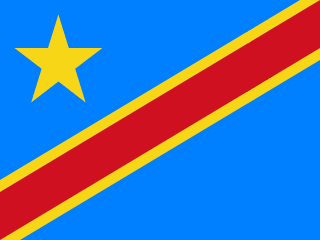
The current flag of the DRC was adopted in 2006: it features a sky blue background with a yellow five-pointed star in the upper left corner (near the hoist), and a red diagonal stripe bordered in yellow extending from the bottom left to the top right. The flag’s aspect ratio is typically 3:4. Dominated by blue, yellow, and red, the design is simple yet distinctive, echoing yet differentiating it from the green, yellow, and red tricolor of the Republic of the Congo. The combination of the diagonal band and star makes it easily recognizable among African flags and is commonly used in national emblems and sports events.
Meaning
Sky blue symbolizes peace and hope; red represents the blood of those who died for independence; yellow stands for the nation’s wealth and prosperity, as well as light; the yellow star in the upper left symbolizes national unity and a bright future, often regarded as a guiding star for the country. Together, these elements reflect the DRC’s aspirations for peace and development amid a turbulent history, and embody the hopes of a resource-rich nation that has faced many challenges.
History and Legal Status
At independence in 1960, the DRC used a blue flag with a yellow star, based on a 1954 design. In 1966, under Mobutu, the flag was changed to a dark green field with a yellow star and torch. When the country was renamed Zaire in 1971, the flag became green with a yellow disc and torch. After Kabila returned to power in 1997, the pre-1971 blue flag with the yellow star was reinstated. The current flag, featuring the red and yellow diagonal band, was officially adopted in the 2006 constitution and has since become a symbol of national reconstruction and unity.
DR Congo Travel Guide
All Guides »Congo (DRC) Travel Snapshot: Safety Situation, Visa Requirements, Health Preparations, and Budget Reference
Congo (DRC) is not a typical vacation destination. Before planning your itinerar...
Classic 8-Day Congo (DRC) Itinerary: Kinshasa, Matadi & the Lower Congo River Corridor 8 days
Focusing on the western region and Kongo Central Province, this itinerary connec...
Congo (Kinshasa) 4-Day Short Trip: In-Depth Explore of Kinshasa City and Stroll Along the Congo River 4 days
Condense the riverbanks, markets, Congolese rumba music, and Sape culture of the...
Must-visit attractions in the Democratic Republic of the Congo: Virunga, Mount Nyiragongo, and the Congo River
Virunga, Nyiragongo, okapi, and Garamba are world-famous, but the eastern part o...
Congo (DRC) Food Guide: Fufu, Cassava Leaves, and Congolese Rumba Nightlife
Cassava and peanuts form the flavor foundation of Congolese (DRC) cuisine, while...
Democratic Republic of the Congo Travel Guide: Flights, Ferries, and Private Transfers
With its vast territory and limited road infrastructure, flying is the best opti...
10 Practical Tips for Traveling in the Democratic Republic of the Congo: Safety, Health, Cash, and Transportation
Safety, health, cash, and transportation are the four key factors that determine...